If we’re perfectly honest, running a trading group is a selfish endeavor for us…
Just not in the way you think.
(understanding what we’re going to lay out is key for you to determine which groups are legit and which ones are trader mills).
90% of people who run a trading group are just trying to fund their own trading by churning through novices with promises of quick, big wins.
We don’t agree with that approach and don’t need the extra income.
Though that doesn’t mean we don’t benefit from our group.
For one, they give us an opportunity to teach all levels of traders, which keeps us sharp.
When you live, eat, and breathe the markets for the better part of 4 decades like us, you accumulate wisdom that we believe is our duty to pass down to those who share our same insatiable appetite for all things trading.
In fact, we like to look at ourselves more as professors of market dynamics than simply traders.
And yet, despite our experience working at some of the most well-known institutions globally, we still benefit from many of our traders.
The market is so infinitely complex that it’s impossible to keep up with it entirely.
But when you have a hive mind of killers like we do in the group, the level of trading for all rises sharply.
There are those who specialize in NQ and ES futures and can tell you with great accuracy when the market is about to turn.
We have others who are expert in technical analysis and reading tape.
Others are constantly pointing out flows in real time on different tickers they are watching.
And pretty much everyone has their specific stocks that they know intimately… how they move and when to take advantage of a specific set-up.
Contrast this to other groups we have been a part of in the past, where it was much more a parasitic, guru-type relationship.
The leader would take on any novice trader, showing off his million-dollar days, while the majority of his subscribers were simply YOLO copy-trading and blowing up their accounts.
No real education, no real value created by any of the others in the group.
This never sat right with us and we decided it was time to elevate the level of trading for more serious traders.
That’s why we created Trade Flow Lab, where we’re dedicated to serving those who…
→ Want to learn from traders who’ve actually managed real (big fund) money, not just posting personal wins online.
(Because when you’re trading, you want to be able to think like the big boys).
→ Are looking to be consistently profitable and don’t need to hit home runs at every at bat.
→ Want to learn trading skills that they can use into old age and pass down to their children.
We’re here to serve the good guys, the ones who have families to take care of, who can’t watch every tick every day, who have aspirations beyond just making money.
And, yes, we’re going to have fun doing it.
We’ve got you.
We love weekends in the group as it gives us time to go through the institutional research and plan for the week ahead.
(This is how you save yourself a lot of time, since the group collects and condenses the most important items to watch each week ahead).
@redbadbear was breaking down how CTA flow models can help predict where larger moves can occur, as CTA's are systematic funds that buy/sell algorithmically at certain ranges.
So if you see $SPX go down into the 7310 level, the chances of a larger sell off increase as CTA's will begin selling automatically.
When you understand the market, you stop second-guessing your trades.
The challenge is, it’s extremely difficult to understand all of the intricacies of the market.
Which is precisely why you see all of these very intelligent macro guys stuck on the sidelines since April while the market has gone straight up.
Will they eventually be right about all of the damage done by the war in Iran? Sure.
But they have also missed an immense rally in many names.
Honestly, the only way to understand how to trade the market effectively is to learn from others who have been in the game for decades and are consistently profitable.
That’s why traders devour all of the content Stan Druckenmiller puts out… to learn how he views and thinks about the market.
But, you only get the smallest of surface area ideas or insights from his publicly available content and it doesn’t teach you how to interpret news or execute trades in real time.
That’s why we created our trading group, Trade Flow Labs, headed by Bear and Missinglinks, who each have many decades of experience in these markets, managing teams and working with some of the best known institutions in the world.
This isn’t some call service where novices copy trades.
It’s where you go to get a PhD in markets and trading.
No, you probably won’t become hyper-profitable overnight.
But you’ll learn how to be consistently profitable AND develop life-long trading and investing skills.
Skills that you have forever and can pass down to your children (along with a fat 529 account).
We also get that there are a lot of scam groups that sound and are too good to be true.
That’s why we have created a 2-week trial period for the first week in June, so you can feel us out.
Just send us a DM and we’ll hook you up.
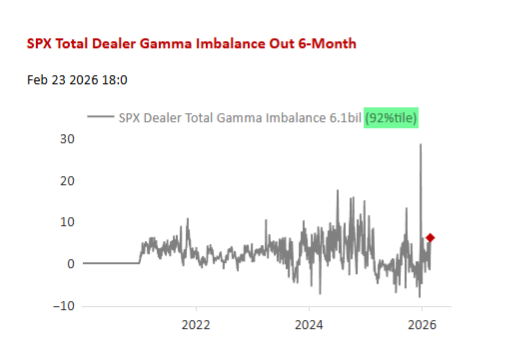
One of the quickest ways to improve your trading is to know where the gamma exposure levels are each week.
(As seen in this gamma chart we share weekly in the group)
Why is having updated gamma levels every week so important to a trader?
It tells you how much the market will swing at specific price points.
The more positive gamma is, the slower the market moves in each direction.
As gamma becomes more negative, you see accelerated moves in each direction (higher volatility).
Knowing this is key for positioning, whether you’re buying or selling options.
You need to know how likely it is that a big move will happen AND where it’s going to happen.
Gamma tells you this so you can position your trades accordingly.
Think about it…
If you know SPX is heading into a high volatility area, you’re going to want to be careful selling options that can swing significantly.
On the other hand, your further out the money options can be more likely to hit in a large negative gamma zone.
So why does no one on X talk about this?
One, because the math behind it is rather technical (you really don’t need to know all of the nuances to use the chart).
And two, because you can’t just buy access to this data.
Which is a shame since it’s such a huge edge to have as a trader every week.
You don’t need a new trading strategy.
You need to stop repeating the same expensive mistakes.
This used to be tedious to determine and required a ton of journaling.
Now, all you need to do is download your trading dataset and use this AI prompt to figure out your strengths and weaknesses.
Use this prompt with AI:
“Analyze my trading dataset and do the following:
• Identify the top 3–5 patterns responsible for the majority of my losses
• Quantify exactly how much each one is costing me
• Ensure the sample size is statistically meaningful
• Identify my highest expectancy trade types based on:
DTE, ticker, position size, day of week, setup, etc.
For each, show:
win rate
average P/L
total P/L
sample size
Then model 2 scenarios:
1. If I completely eliminate my worst-performing patterns
2. If I only trade my best-performing patterns
Show how total P/L, win rate, and drawdowns would change in each scenario.
Then create a clear, rules-based trading system including:
what to trade
what to avoid completely
position sizing rules
behavioral/day-of-week constraints
Format everything clearly using tables and bullet points so it’s easy to make decisions from.”
Most traders are sitting on years of data…but never actually use it to build an edge.
You’d be surprised how useful this is.
Most traders think exiting trades early is a discipline issue.
It isn’t.
It’s a clarity issue.
Here are 3 tools to help you avoid exiting before the real move happens:
1. Predefined exit rules (before you enter the trade)
- Targets to take profits.
- An invalidation level
- And conditions that would justify an early exit
2. Data on your trades
What gets measured gets managed.
Keep a running tally of how often price goes against you before hitting your target.
What’s your average drawdown before a win?
Without knowing these numbers, every pullback is going to have you second-guess yourself.
3. Acceptance of discomfort
Good trades often feel wrong before they work.
If you need certainty before entering or keeping a trade, you’ll keep cutting winners too early.
This is precisely why data is so useful.
It can give you clarity where you are likely to make mistakes so you can course correct.
Trading using flows (following the big money prints) can help you catch big trades ONLY IF you use it along with these 4 other factors.
(The more of these 4 you have, the greater likelihood of a big move in your favor).
1 - Trend (chart)
Are you trading WITH the trend or against it?
Flows that align with a clear uptrend (higher highs, higher lows) tend to follow through.
Flows against the trend? Much lower probability.
2 - Catalyst
Why would this move *now*?
Earnings, news, macro events, sector momentum…
Flows without a catalyst often stall.
Flows with a catalyst can expand fast.
3 - Theme
If you notice a certain theme, such as space stocks pumping, followed by a bunch of flows into a space name, that’s a good sign.
4 - Options premiums (Implied volatility)
Generally you will see IV go up when a move is likely as people are positioning for the big move.
Write these down and make it part of your checklist before you follow any flows you see pop up.
The best traders don’t follow trades blindly…they verify first.
This isn’t to say following someone else’s trade is a losing strategy by itself.
But in order to be long term profitable, you need to understand the trade and context in which it was taken.
If you don’t know why something works,
you won’t know when to get out
If you don’t have a repeatable, reliable strategy, your account will get cooked eventually.
You’ll be staring at an account a fraction of its former value.
If you’re following people and they aren’t teaching you how to think, they are setting you up for failure.
No data = no edge.
No edge = gambling.
In our group, the goal isn’t just profitable trades.
It’s building traders who don’t need to follow anyone, who can thrive without being fed which plays to take.
The biggest mistake killing your PnL isn’t your entries…
It’s what you do after you’re right.
Cutting trades too early is one of the most common issues traders face.
And the reason this happens is more a matter of your psychology, not intellect.
You exit trades early because…
You’re staring at your PnL when you should be watching key levels and market structure.
You are thinking about the last trade you lost instead of looking at each trade independently.
You don’t trust yourself.
So how do you stop yourself from missing out on the big runners?
1 - Have a plan going into each trade and follow it.
Take partial profits at 1-2R and play with profits (this helps you stay calm, knowing your trade is already profitable).
2 - Use trailing stops based on market levels or moving averages.
Avoid using your PnL as a guide as it will cloud your judgement.
3 - Avoid oversizing.
Arguably the biggest issue traders routinely struggle with is oversizing.
A good rule of thumb is if you’re nervous in a trade, you sized too large.
You should be able to sleep at night with any trade you have.
If you can’t, it’s a sign to take some risk off.
That said, everyone needs to develop a system that works for them.
This requires doing some journaling and understanding the trades where you do the best versus the ones that hurt you the most.
Over time, you learn what your edge is so that you can exploit it.
Don’t let impatience get in the way of profitability.
Trades are like trains, there is always another one just around the corner.
(Unless you ride SEPTA in Philly, then you may be waiting awhile).
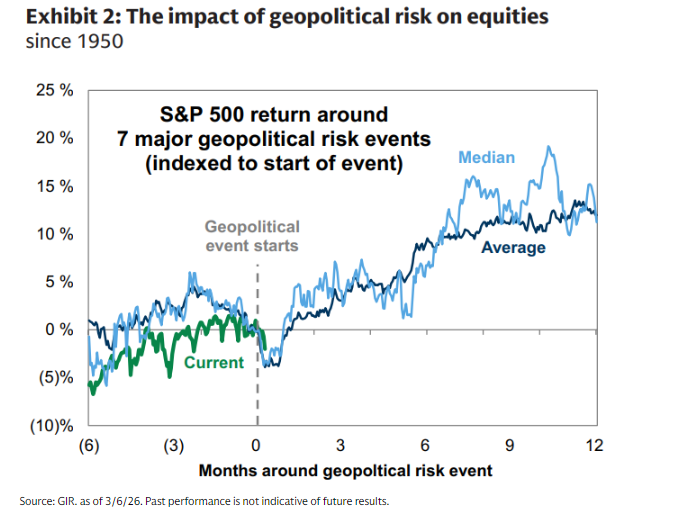
From GS: The big picture . S&P 500 price action this week has resembled the equity market’s behavior during past geopolitical risk shocks – e.g. as pointed out by Ben Snider / GIR strategy, during 7 geopolitical risk episodes since 1950, the S&P 500 declined by an average of 4% in the first week but recovered within the subsequent month. The distribution of outcomes is wide, but the key point is that markets typically price the uncertainty quickly before refocusing on growth and earnings.
Looking ahead, keep an eye on GS economists’ rule of thumb --a sustained $10/barrel increase in oil would reduce 2026 GDP growth by about 10 bp and boost core CPI by less than 5 bp.
There isn't a single account on X that has provided the level of accurate insight into the Middle East conflict more than @redbadbear. If you want real information, not made up shit from randos who don't know jack squat about M.E. Oil, geopolitics, etc, BearFx and TFL are your place.
Oh and add in the flow reading and GEX levels too. This guy does it all.
Nomura’s McElligott says US vol is a “Doomers vs Boomers” market: “Doomers” buy PUTs to hedge left-tail risks (tariffs, private credit, AI), while “Boomers” sell CALLs for yield. Yet VIX ETNs saw heavy long-vega monetization/redemptions last week (~$12.7mm vega supply, plus rebalance supply), helping cap VIX futures despite ongoing “wack-a-mole” macro fears. In VIX space, investors have learned the monetization window can be measured in hours.
Source: Nomura (Charlie McElligott)”