Very cool, entertaining and with high production values: if I were @Nigel_Farage, I’d consider dipping into that £5 million to try to get out a video that can compare to it.
There are 2 career paths in AI right now:
The API Caller: Knows how to use an API. (Low leverage, first to be automated, $150k salary).
The Architect: Knows how to build the API. (High leverage, builds the tools, $500k+ salary).
Bootcamps train you to be an API Caller. This free 17-video Stanford course trains you to be an Architect.
It's CS336: Language Modeling from Scratch.
The syllabus is pure signal, no noise:
➡️ Data Collection & Curation (Lec 13-14)
➡️ Building Transformers & MoE (Lec 3-4)
➡️ Making it fast (Lec 5-8: GPUs, Kernels, Parallelism)
➡️ Making it work (Lec 10: Inference)
➡️ Making it smart (Lec 15-17: Alignment & RL)
Choose your path.
(I will put the playlist in the comments.)
♻️ Repost to save someone $$$ and a lot of confusion.
✔️ You can follow @techNmak, for more insights.
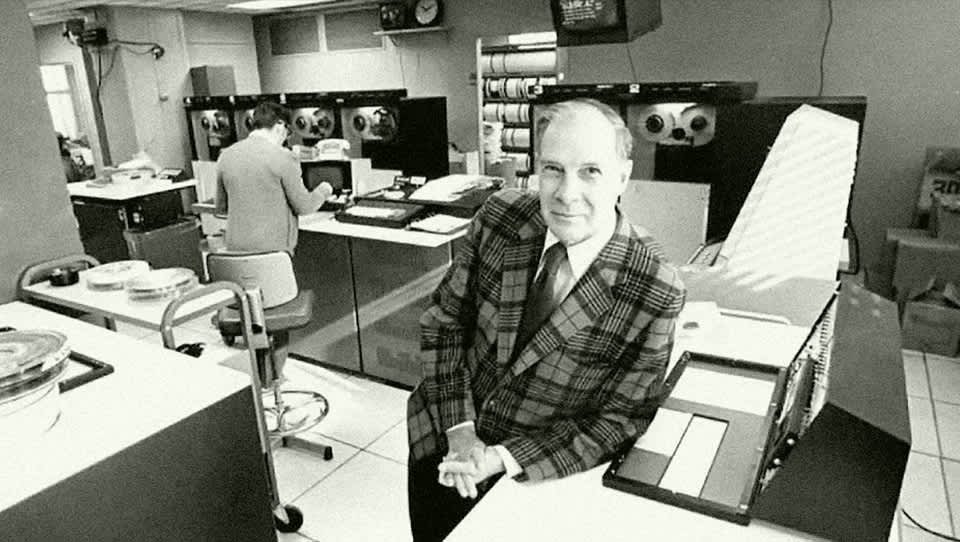
A mathematician who shared an office with Claude Shannon at Bell Labs gave one lecture in 1986 that explains why some people win Nobel Prizes and other equally smart people spend their whole lives doing forgettable work.
His name was Richard Hamming. He won the Turing Award. He invented error-correcting codes that made modern computing possible. And he spent 30 years at Bell Labs sitting in a cafeteria at lunch watching which scientists became legendary and which ones faded into nothing.
In March 1986, he walked into a Bellcore auditorium in front of 200 researchers and told them exactly what he had seen.
Here's the framework that has been quoted by every serious scientist for the last 40 years.
His opening line landed like a punch. He said most scientists he worked with at Bell Labs were just as smart as the Nobel Prize winners. Just as hardworking. Just as credentialed. And yet at the end of a 40-year career, one group had changed entire fields and the other group was forgotten by the time they retired.
He wanted to know what the difference actually was. And he said it wasn't luck. It wasn't IQ. It was a specific set of habits that almost nobody is willing to follow.
The first habit was the one that hurts the most to hear. He said most scientists deliberately avoid the most important problem in their field because the odds of failure are too high. They pick a safe adjacent problem, solve it cleanly, publish it, and move on. And because they never swing at the hard problem, they never hit it. He said if you do not work on an important problem, it is unlikely you will do important work. That is not a motivational line. That is a logical one.
The second habit was about doors. Literal doors. He noticed that the scientists at Bell Labs who kept their office doors closed got more done in the short term because they had no interruptions. But the scientists who kept their doors open got more done over a career. The open-door scientists were interrupted constantly. They also absorbed every new idea passing through the hallway. Ten years in, they were working on problems the closed-door scientists did not even know existed.
The third habit was inversion. When Bell Labs refused to give him the team of programmers he wanted, Hamming sat with the rejection for weeks. Then he flipped the question. Instead of asking for programmers to write the programs, he asked why machines could not write the programs themselves. That single inversion pushed him into the frontier of computer science. He said the pattern repeats everywhere. What looks like a defect, if you flip it correctly, becomes the exact thing that pushes you ahead of everyone else.
The fourth habit was the one that hit me the hardest. He said knowledge and productivity compound like interest. Someone who works 10 percent harder than you does not produce 10 percent more over a career. They produce twice as much. The gap doesn't add. It multiplies. And it compounds silently for years before anyone notices.
He finished the lecture with a line I have never been able to shake.
He said Pasteur's famous quote is right. Luck favors the prepared mind. But he meant it literally. You don't hope for luck. You engineer the conditions where luck can land on you. Open doors. Important problems. Inverted questions. Compounded hours. Those are not traits. Those are choices you make every single day.
The transcript has been sitting on the University of Virginia's computer science website for almost 30 years. The video is free on YouTube. Stripe Press reprinted the full lectures as a book in 2020 and Bret Victor wrote the foreword.
Hamming died in 1998. He gave his final lecture a few weeks before. He was 82.
The lecture that explains why some careers become legendary and others disappear is still free. Most people who could benefit from it will never open it.
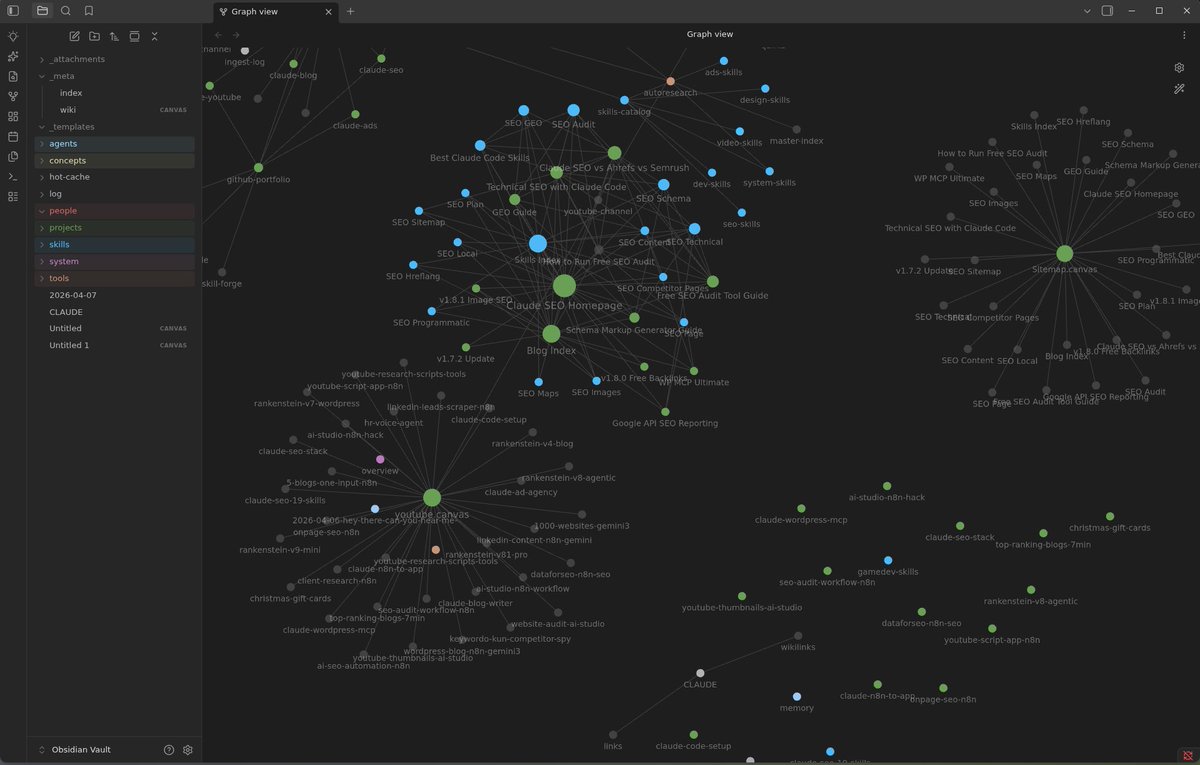
ANDREJ KARPATHY DESCRIBED A KNOWLEDGE SYSTEM THAT GETS SMARTER THE LONGER IT RUNS.
Someone built the whole thing inside Obsidian. 100% FREE.
Your notes become a WIKI THAT WRITES ITSELF and compounds like interest with every source you add.
Here is what is actually going on.
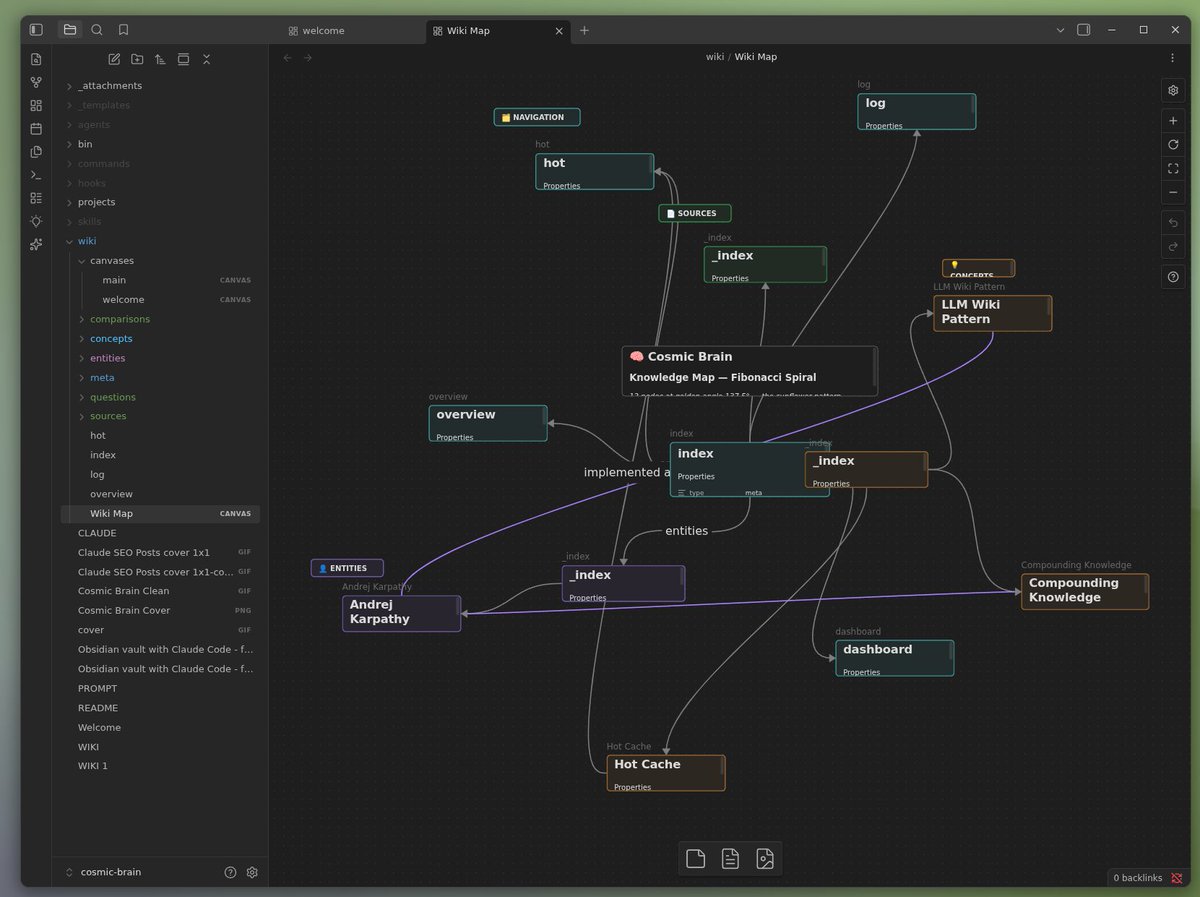
Karpathy dropped a gist a while back describing something he called the LLM Wiki pattern. The idea was simple but the implication was wild. Instead of asking an AI a question and getting an answer that disappears when you close the tab, you use the AI to build and maintain a persistent knowledge base that gets richer every single time you add something to it. The 50th source you add does not create 50 isolated notes. It creates 50 notes woven into a mesh of 500 cross-referenced connections.
Nobody built it properly. Until now.
It is called claude-obsidian. You install it in Claude Code, open your Obsidian vault, type /wiki, and the whole thing sets itself up. From that point forward the AI does the organizing, the cross-referencing, the contradiction flagging, and the filing. You just drop sources in and ask questions.
- /wiki ingest builds structured wiki pages from anything you throw at it, URLs, PDFs, articles, notes
- every new page gets cross-referenced against everything already in the vault automatically
- /autoresearch runs an autonomous research loop, configures depth and sources in one file, produces full wiki sections on its own
- a hot cache file stores the last session context so you never spend 10 minutes re-explaining what you were working on
- /save turns any Claude conversation directly into a permanent wiki page
- /canvas builds a visual knowledge graph connected to your vault
The creator tested /autoresearch on AI marketing automation. Three rounds produced 23 wiki pages. Two of those pages became blog posts that now rank on page one.
Every note app, every second brain system, every Zettelkasten method all have the same problem. They only work if you maintain them. And nobody maintains them. Notes go in, connections never get made, and six months later you have a digital graveyard.
This solves that. The AI maintains it for you. You just add things.
358 stars already. MIT license. Free forever.
Karpathy described the pattern. Someone spent weeks turning it into a tool anyone can install in two minutes and just use.
I still do not understand why this is not the most talked about repo this week.
A guy was paying $200/mo for Claude Max. His subscription burned through in 3 hours of work.
He bought a base Mac Mini for $599. Installed 5 local models on it. One command. One flag.
His office neighbors thought he was mining crypto.
He just taught the machine to sort messages, compress context, and keep the system alive while he sleeps.
At 4am Claude hit its rate limit. The local model picked up. In the morning he read the logs - everything worked. He didn't even wake up.
A team doing the same thing - that's 3 engineers and $15,000/mo on API costs.
He paid $599 once.
35 billion parameters on 16 gigs of memory. Everyone said impossible. One flag in one command proved them all wrong.
And people like him - there's only a handful so far.
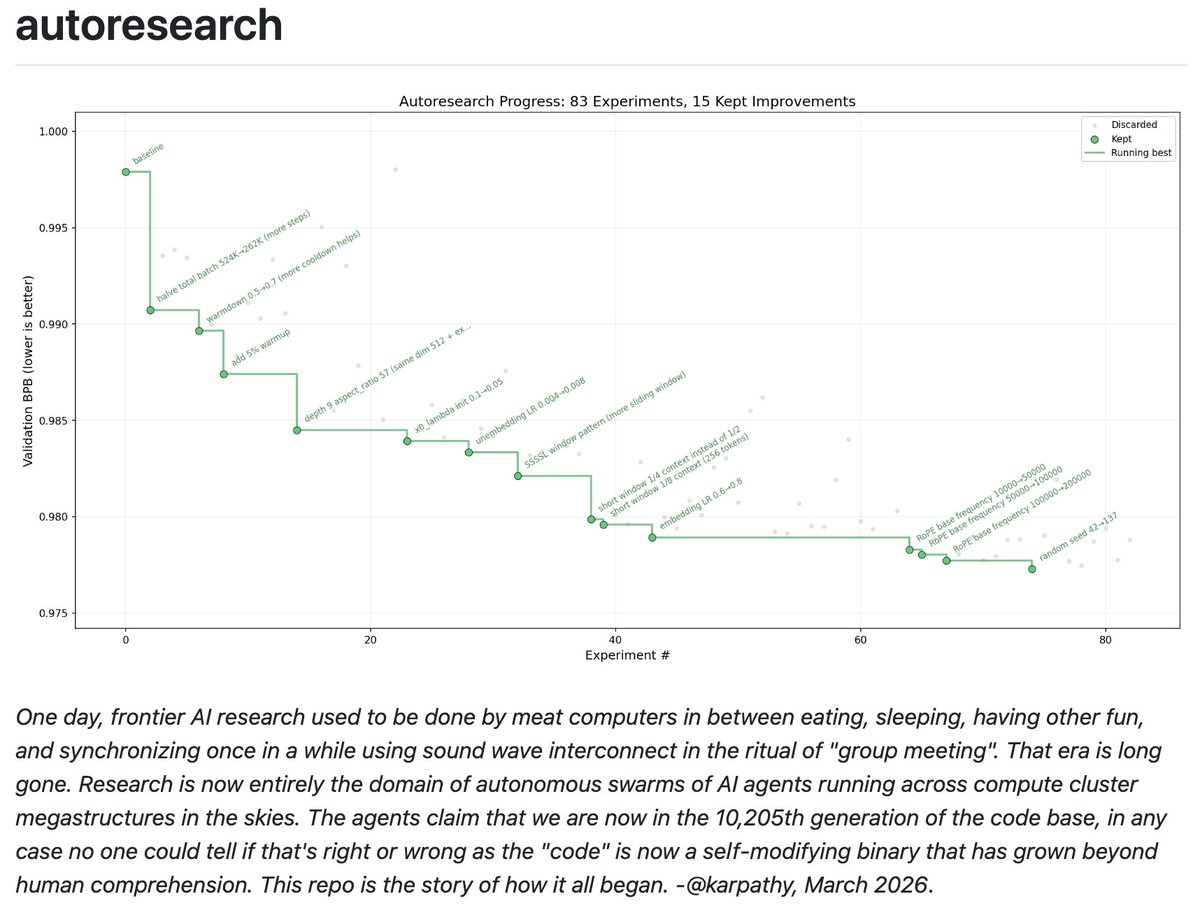
I packaged up the "autoresearch" project into a new self-contained minimal repo if people would like to play over the weekend. It's basically nanochat LLM training core stripped down to a single-GPU, one file version of ~630 lines of code, then:
- the human iterates on the prompt (.md)
- the AI agent iterates on the training code (.py)
The goal is to engineer your agents to make the fastest research progress indefinitely and without any of your own involvement. In the image, every dot is a complete LLM training run that lasts exactly 5 minutes. The agent works in an autonomous loop on a git feature branch and accumulates git commits to the training script as it finds better settings (of lower validation loss by the end) of the neural network architecture, the optimizer, all the hyperparameters, etc. You can imagine comparing the research progress of different prompts, different agents, etc.
https://t.co/YCvOwwjOzF
Part code, part sci-fi, and a pinch of psychosis :)
The Pilot communicated command to the flight engineer through Telegraph. As the maintenance men climbed through the wing tunnels to check the oil on the 12 engines in flight.
The 1930s had a dance floor on this flying ship!
„Ja, der Führer, dieser Lump, hat die ganze Welt ins Unglück gestürzt. Dieser Bluthund! Wenn ich ihn jetzt hier hätte, würde ich ihm die Augen ausstechen.“
Die Schneiderin Elisabeth Mill, deren Sohn an der Ostfront kämpfte, wurde von ihrem Untermieter, dem Reichsbahnschaffner O. Bergmann, denunziert und wegen „unflätiger Hetzreden“ zum Tode verurteilt. Sie wurde am 26. Januar 1945 in Plötzensee hingerichtet.
Elisabeth Mill war 47 Jahre alt. R.I.P.
#NieWiederKrieg #SayHerName
Police Battalion 101 was a unit of the German Order Police, formed in Hamburg and deployed to occupied Poland during the Second World War. Its significance lies in how unremarkable it was. The battalion consisted largely of middle-aged men with families, drawn from civilian life, trained in law enforcement rather than combat, and accustomed to uniforms, paperwork, and hierarchical command. They were not recruited as fanatics or criminals. They understood themselves as professionals carrying out enforcement duties assigned by the state.
Although subordinated to higher security authorities, the battalion retained the structure and self-image of a policing organization. Its official responsibilities were described in neutral administrative terms such as maintaining order, conducting security operations, and carrying out population transfers. These labels concealed what the work actually involved: rounding up civilian populations, guarding detainees, escorting families from their homes, supervising transports, and, when ordered, carrying out mass executions. The language remained bureaucratic even as the outcomes became lethal.
A defining feature of Police Battalion 101 was the way violence became routine rather than exceptional.
Orders were issued calmly, often framed as lawful directives or unpleasant necessities. At the unit’s first major killing operation, men were told they could step aside if they felt unable to participate. Very few did. As operations continued, participation became expected, refusal became socially isolating, and brutality became normalized through repetition. What began as shock gradually became procedure.
The battalion functioned through organization and process. Operations were planned in advance. Civilians were identified, assembled, guarded, transported, processed, and disposed of through standardized methods. Reports were filed. Numbers were recorded. Commanders emphasized discipline, efficiency, and maintaining morale. After operations, personnel returned to normal routines, socialized with colleagues, and prepared for the next assignment. The machinery worked precisely because it felt familiar and structured.
Crucially, those involved did not view themselves as criminals. They saw themselves as enforcing policy, maintaining control, and executing orders handed down through a legitimate chain of command. Responsibility was fragmented. One person guarded a perimeter. Another escorted a group. Another pulled a trigger. Another filled out a form. Each task appeared limited, technical, and detached from the overall outcome. Moral responsibility dissolved into institutional function.
Historical analysis shows that ideology alone does not explain this transformation. Conformity, career pressure, loyalty to colleagues, and faith in authority mattered more. Uniforms conferred legitimacy. Procedures created emotional distance. Targets were defined administratively rather than personally. Violence became acceptable not because it was celebrated, but because it was framed as routine enforcement against a designated population.
Police Battalion 101 illustrates how a system built around control, detention, transport, and compliance can escalate into mass harm without ever abandoning the language of law, order, or professionalism. There was no breakdown of rules. The danger lay in how rules were applied, how categories of people were reduced to files and numbers, and how enforcement replaced judgment. Its history lingers because it shows how ordinary institutions, staffed by ordinary people, can carry out extraordinary cruelty while believing they are simply doing their jobs.
In 1922, a group of scientists went to the Toronto General Hospital where diabetic children were kept in wards, often 50 or more at a time. Most of them were comatose and dying from diabetic ketoacidosis. Others were being treated by being placed on an extremely strict diet, which inevitably led to starvation.
This is known as one of medicine's most incredible moments. Imagine a room full of parents sitting at the bedside waiting for the inevitable death of their child.
The scientists went from bed to bed and injected the children with a new purified extract: it was called insulin.
As they began to inject the last comatose child, the first child injected began to awaken. Then one by one, all the children awoke from their diabetic comas. A room of death and gloom became a place of joy and hope.
In the early 1920s Frederick Banting and Charles Best discovered insulin under the directorship of John Macleod at the University of Toronto. With the help of James Collip insulin was purified, making it available for the successful treatment of diabetes.
In the same year, Banting, Collip, and Best decided to sell the insulin patent to the University of Toronto for $1.
Banting and Macleod earned a Nobel Prize for their work in 1923.
Photo Credits: Library and Archives Canada
🫀 The heart doesn’t start beating the way we thought it did.
There is no single “starter switch” for the first heartbeat.
Recently, scientists captured the exact moment a developing heart goes from complete silence to rhythm, and it happens as a sudden collective event.
Instead of a pre-built pacemaker turning on, many heart cells slowly become electrically active. When enough of them cross a critical threshold, the entire tissue synchronizes at once—producing the first coordinated beat.
The earliest heartbeats are irregular, but they already spread across the heart, driven by calcium-based electrical signals.
The heartbeat begins as a system-level phase transition, one of the clearest examples of emergence in living tissue.
Based on research published in Nature (Jia et al., 2023).
insane
This new paper is basically saying
Cells can now be "prompted" like LLMs.
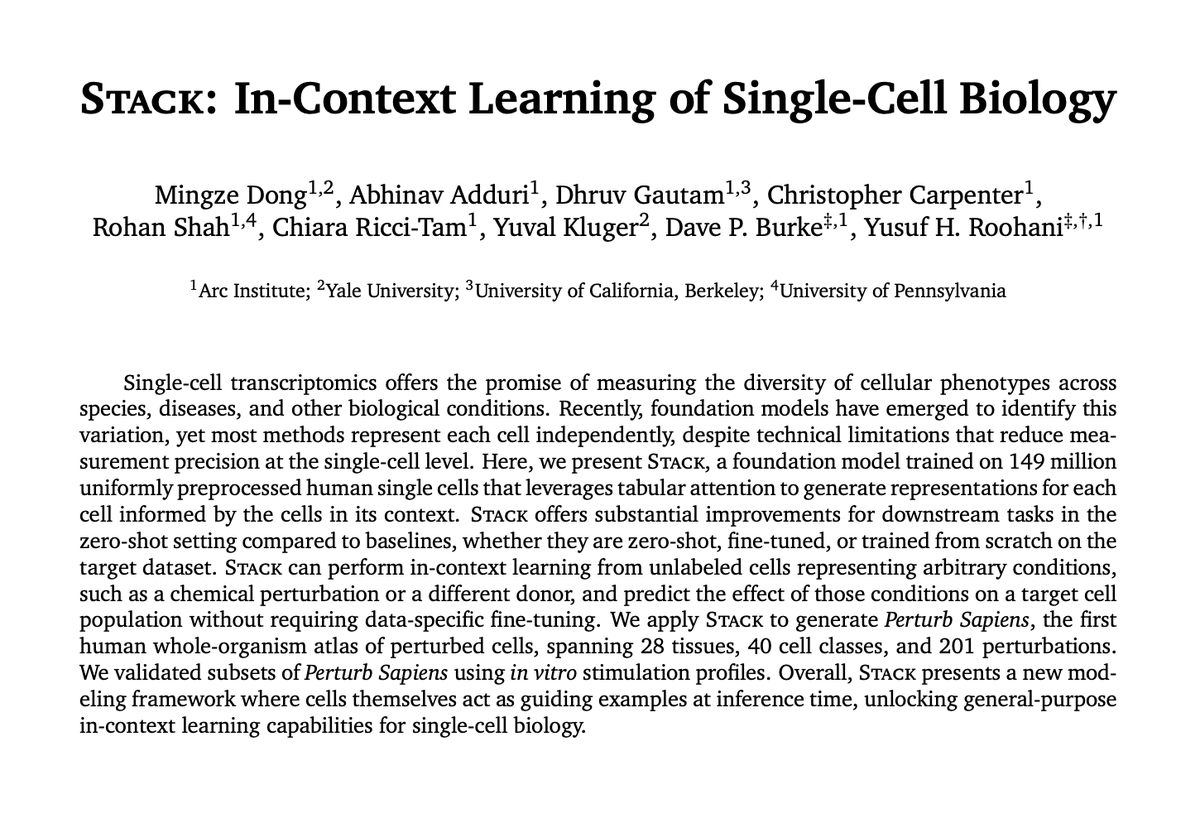
STACK is a foundation model for biology trained on 149 million human single cells.
Instead of treating each cell in isolation, it understands cells in context, like how tokens make sense inside a sentence. At inference time, cells teach the model how to think about new cells.
Why this is a big deal
Most single cell models = "Here’s one cell, guess what it is."
STACK = "Here’s a whole neighborhood of cells, now predict what happens if I perturb them."
It can:
Learn new biological conditions on the fly
Predict effects of chemical perturbations
Generalize across donors, tissues, and diseases
Work zero shot, straight out of the box
This is in context learning, but for human biology.👀
The insane part - They used it to create Perturb Sapiens:
First whole human atlas of perturbed cells
28 tissues
40 cell classes
201 perturbations
That’s a simulation layer for the human body. This is how biological world models begin.
This is huge bio/acc