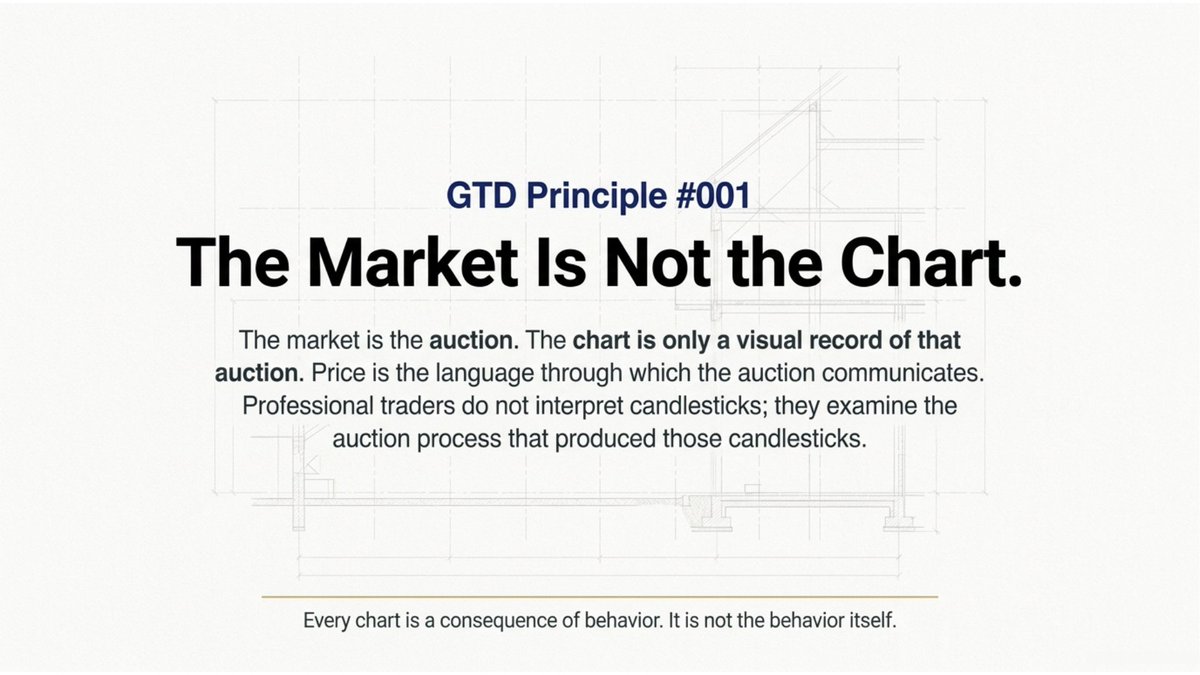
GTD Principle #001 | The Market Is Not the Chart.
A candlestick tells us where price traded. It does not explain the auction process that produced it.
Understanding market behavior requires looking beyond the visual representation of price.
A failed auction is useful because it tells us something about an attempted price exploration. But the failure is understood from the response after the test, not from the level alone.
#AuctionMarketTheory#GoldTrading
Imbalance is not automatically an entry signal. It describes a condition in which the auction is searching more aggressively for prices capable of facilitating trade. Diagnosis first. Execution second.
#Gold#XAUUSD
Balance is information. A market spending time facilitating two-sided trade is doing something very different from a market rapidly searching for another area where trade can develop.
#XAUUSD#MarketProfile
Markets continuously propose prices. Participants decide, through actual exchange, whether those prices can persist. That is why GTD begins with the market as an auction rather than a collection of candle patterns.
#AuctionMarketTheory#XAUUSD
Rejection should not be declared because one candle moved sharply away from a level. Movement away is observable immediately. Rejection becomes a stronger classification when subsequent auction behaviour supports it.
#GoldTrading#XAUUSD
Acceptance is not simply price trading above a level. Ask whether participation can sustain exchange there and whether the market continues to build around the new area.
#XAUUSD#PriceAction
Price is an observation. Value is an inference about where exchange can persist. Treating those two ideas as identical removes an important layer of market context.
#Gold#XAUUSD#AuctionMarketTheory
A breakout establishes a test. The auction that follows helps determine what that test meant. That distinction can prevent traders from confusing movement with confirmation.
#XAUUSD#MarketStructure
Price moving higher tells you where the auction is exploring. It does not, by itself, tell you whether higher prices are being accepted. The behaviour that follows the test matters more than the test itself.
#XAUUSD#GoldTrading#AuctionMarketTheory
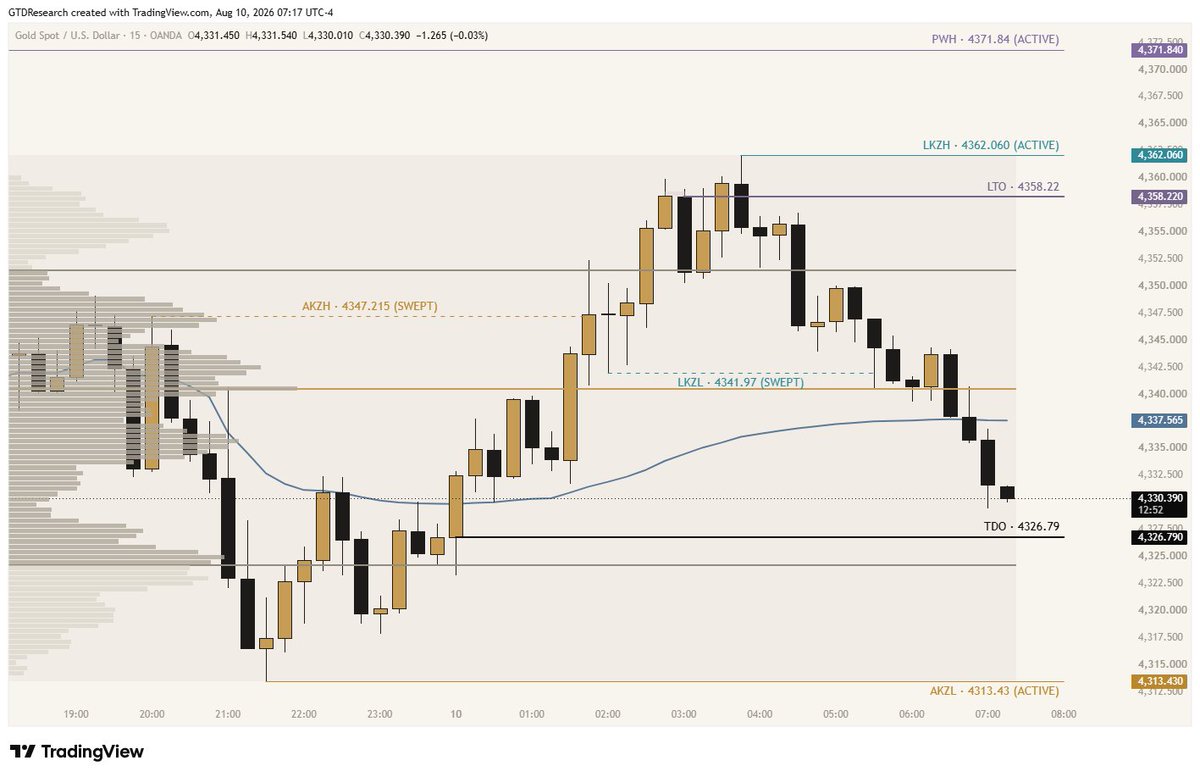
XAUUSD Auction Narrative
10 August 2026 | 07:16 New York
Market: OANDA: XAUUSD | Timeframe: M15
Gold is trading at 4,330.39.
The auction opened at the Gold Session Open (GSO) at 4,343.60. Asia initially traded higher, establishing the Asian Kill Zone High (AKZH) at 4,347.21, before extending lower to establish the Asian Kill Zone Low (AKZL) at 4,313.43.
London opened from the London True Open (LTO) at 4,358.22. The auction expanded through the AKZH, sweeping that liquidity, and established the London Kill Zone High (LKZH) at 4,362.06. The subsequent rotation lower traversed the London range and swept the London Kill Zone Low (LKZL) at 4,341.97.
The Liquidity Map now records the AKZH and LKZL as swept.
Active liquidity remains at:
Above price:
London Kill Zone High (LKZH): 4,362.06
Previous Weekly High (PWH): 4,371.84
Below price:
Asian Kill Zone Low (AKZL): 4,313.43
Previous Day Low (PDL): 4,229.87 (Not Shown)
Static references:
True Day Open (TDO): 4,326.79
London True Open (LTO): 4,358.22
Price is currently 3.6 points above the TDO and 27.83 points below the LTO.
The developing Gold-session Volume Profile is:
Value Area High (VAH): 4,350.00
Point of Control (POC): 4,340.56
Value Area Low (VAL): 4,323.67
Volume-Weighted Average Price (VWAP): 4,337.56
Price is trading inside the developing value area, below the POC and 7.17 points below session VWAP. It remains above the VAL and is therefore positioned in the lower portion of value.
The auction has returned from the London high, moved below VWAP and the POC, and is currently facilitating trade between the VAL and TDO.
This describes the auction at the stated observation time. It does not predict where price must move next.
A chart window is a bounded record. It is not the whole market.
Desk II · Lecture 1.1, The Observable Unit, establishes the evidence boundary for professional market reading. Every unit must declare five elements: instrument, timeframe, visible interval, observation timestamp, and permitted references.
The lecture then separates three levels of statement: an isolated event, an observed sequence, and a classified condition. A professional label must be earned by the sequence visible within the declared boundary. When the available window changes, the reading may require revision. That is evidence discipline, not analytical failure.
The public lecture is available here:
https://t.co/92Bxp5L0Ss
#MarketReading #MarketStructure #XAUUSD
The GTD Auction Thinking Diagnostic examines how a participant currently interprets auction evidence before entering Desk I.
Its 15 questions cover auction foundations, price and value, acceptance, evidence discipline, and risk governance. The result is an educational orientation. It identifies the reasoning framework brought to the material and provides a more deliberate starting point for study.
The diagnostic is not an academic credential. It does not enroll the participant in Desk I, issue a trading signal, or predict market performance.
That boundary matters. A diagnostic should reveal how someone reasons under a defined set of questions. It should not manufacture authority from a score.
Take the Auction Thinking Diagnostic:
https://t.co/M1MbvKNgqd
#AuctionMarketTheory #FinancialEducation #RiskGovernance
Tuition should be disclosed as an academic obligation, with its terms visible before enrollment.
Gold Trading Desk publishes tuition by individual Desk and for the complete five-Desk programme. The schedule records curriculum access, assessment attempts, progression terms, upgrade-credit treatment, and available settlement structures.
Academic standards do not change with the payment route. A tuition payment provides access to the defined programme; it does not purchase a credential or guarantee progression. Each award remains subject to its assessment and registrar requirements.
The same separation applies to outcomes. Tuition funds education. It does not buy market performance, managed capital, or trade instructions.
Review the current tuition schedule and institutional terms:
https://t.co/1gZAl4s6WA
#FinancialEducation #AcademicStandards #ProfessionalDevelopment
The Desk is the Gold Trading Desk member office.
It brings academic study, research, progress, live auction intelligence, observations, journal records, saved references, credentials, and institutional notices into one governed workspace.
The structure reflects a basic operating principle: evidence should remain connected to the record built from it. A current Auction Brief can be preserved as an observation. That observation can be reviewed through the journal. Academic progress and credentials remain separate records rather than being inferred from activity alone.
The workspace is designed to support study and independent judgment. It is not a brokerage terminal or signal dashboard.
Enter The Desk:
https://t.co/I05BDof0Mr
#FinancialEducation #MarketResearch #XAUUSD
What does Desk I actually teach?
Desk I at Gold Trading Desk begins with a simple premise:
Before one can read the market, one must first understand what a market truly is.
DESK I | FOUNDATIONS
School of Market Principles
The programme consists of 25 sequential lectures across five chapters.
Chapter 1 | Understanding the Auction
1.1 The Market Is an Auction
1.2 Market Participants
1.3 The Auction Process
1.4 The Language of Acceptance
1.5 The Discipline of Observation
Chapter 2 | Price & Value
2.1 Price versus Value
2.2 Fair Value
2.3 Imbalance & Repricing
2.4 Acceptance & Rejection of Price
2.5 The Continuous Search for Value
Chapter 3 | Auction Behaviour & Developing Structure
3.1 Price Discovery
3.2 Initiative & Responsive Activity
3.3 Balance, Imbalance & Repricing
3.4 Auction Rotation
3.5 Developing Market Structure
Chapter 4 | Trading Ranges & Auction Resolution
4.1 Trading Ranges
4.2 Boundary Tests: Breakout or Rejection?
4.3 Failed Auctions
4.4 Accepted Departures
4.5 Classifying Auction Resolution
Chapter 5 | Professional Synthesis
5.1 Objective Market Observation
5.2 Separating Evidence, Interpretation & Assumption
5.3 Building an Institutional Narrative
5.4 Professional Market Journaling
5.5 Thinking Like an Institutional Analyst
There are no trade signals in this curriculum.
There are no promises of shortcuts.
Desk I is designed to establish the conceptual foundation required before more advanced market analysis has any real meaning.
The objective is not to teach a trader what to think about the next move.
It is to develop a disciplined framework for how to observe, interpret and reason about an auction.
Explore Desk I:
https://t.co/uEW8YzztSk
25 lectures. Five chapters. One foundation.
Gold Trading Desk
Read the Auction. Respect the Risk. Protect Your Capital.
#GoldTradingDesk #AuctionMarketTheory #XAUUSD #GoldTrading #TradingEducation #MarketStructure #FinancialEducation
A traded price tells us where exchange occurred. It does not tell us where value exists.
Value requires more evidence. It develops through sustained participation, repeated exchange, and the market's willingness to continue doing business around an area.
This distinction matters because a price can be reached, traded, and quickly rejected. Another area may hold the auction for hours as buyers and sellers repeatedly find counterparties.
GTD-RN-002 examines this relationship through acceptance, rejection, value development, and value migration in XAUUSD.
Visit the Research Journal:
https://t.co/WzoQXZ5dnz
#AuctionMarketTheory #PriceDiscovery #XAUUSD
A visible level is not the same as visible liquidity. Our latest GTD Methodology article examines what XAUUSD traders can observe, what must be inferred, and why trading through a high or low does not prove future direction. https://t.co/76igZJiaKx