Breaking: ATA Court Quetta Awards Life Imprisonment to Gulzadi Baloch in Murder Case
BYC face Gulzadi Baloch built a soft public image for BLA under the guise of activism on the claim that her brother Abdul Wadood Satakzai was a forcibly disappeared civilian, she registered him with the missing-persons commission, fought the courts, and sold the family tragedy as proof of state abduction, until BLA itself named him a Majeed Brigade fidayee killed in the Dara-e-Bolan/Mach operation, exposing the “missing person” as a suicide-unit terrorist; that same cover now ends in the murder case, where the ATC Court in Quetta has sentenced her to life imprisonment, collapsing the script that turned a terrorist household into a human-rights campaign.
@5Pillarsuk “Armed gunmen” ? You mean terrorists who killed people gathered for Friday prayer .
Do you feel even a bit of shame in distorting news of terrorist attack on a mosque to downplay it because you support Taliban terrorism ?
Pakistanis dont use the term "POK" and 5 rupee currency note is not valid since 1 jan 2012. It stopped being legal tender from that date.
Hence a total false flag op.
Here is what actually happened, and the timeline matters to those in the fight against terrorism.
Hafiz Gul Bahadur was killed October 17, 2025, in a Pakistani military strike on a TTP shura meeting in Urgun District, Paktika, Afghanistan. He was buried two days later at the Martyrs’ Cemetery of Gagar Baba in Khost Province.
His terrorist faction did not disappear with him. Hafiz Zarar took over as leader, with Azmatullah Mehsud as his deputy, while the group continued operating under the Hafiz Gul Bahadur name. That is the identity swap.
I reported it publicly at the time and warned that his successor, Zarar, would be passed off as Hafiz Gul Bahadur.
So when the press now says Hafiz Gul Bahadur has “re-emerged” and suggests his return could drive the next wave of violence, it’s pure fantasy as he’s still in the ground in Khost.
The Hafiz Gul Bahadur Group can still exist. It can still claim attacks. But that does not mean Hafiz Gul Bahadur is alive or leading it.
I warned about this nearly a year ago. The terrorists created the deception. Now the press is helping sell it. This is another case in how terrorist narratives become accepted as fact.
Don’t chase ghosts around, it’s Zarar you want.
https://t.co/KdE1hcb5Gs
@sid_abu He was such a dumb witt that he continued his rebellion against pakistani state even after 1947 on behest of his afghan sympathisers and handlers and gave a written apology at the end while surrendering to pakistani forces !!!! Please tell that part of his story as well
@NKMalazai Bajaur attack kos ne kiya tha, waziristan mai faqir ippi k peeche kaun tha, liaqat ali khan ko kos ne shaheed kiya tha..... ajeeb he soch ki pasti hai .... koi sahi tareekh parh lo bhai .... jumma khan soofi to pashtun he tha usibki kitab parh lo
@NKMalazai حملے نہیں ہوتے تھے؟ بھائ کوئ کتاب پڑہ لو اور لیاقت علی خان کی شہادت اور 1950 کی دھشت گردی دیکھو۔۔ یہ سب سے بڑی غلطی ہے کہ آپ لوگ سمجھتے ہیں 1980 سے پہلے یہ علاقے بڑے پر امن تھے!!
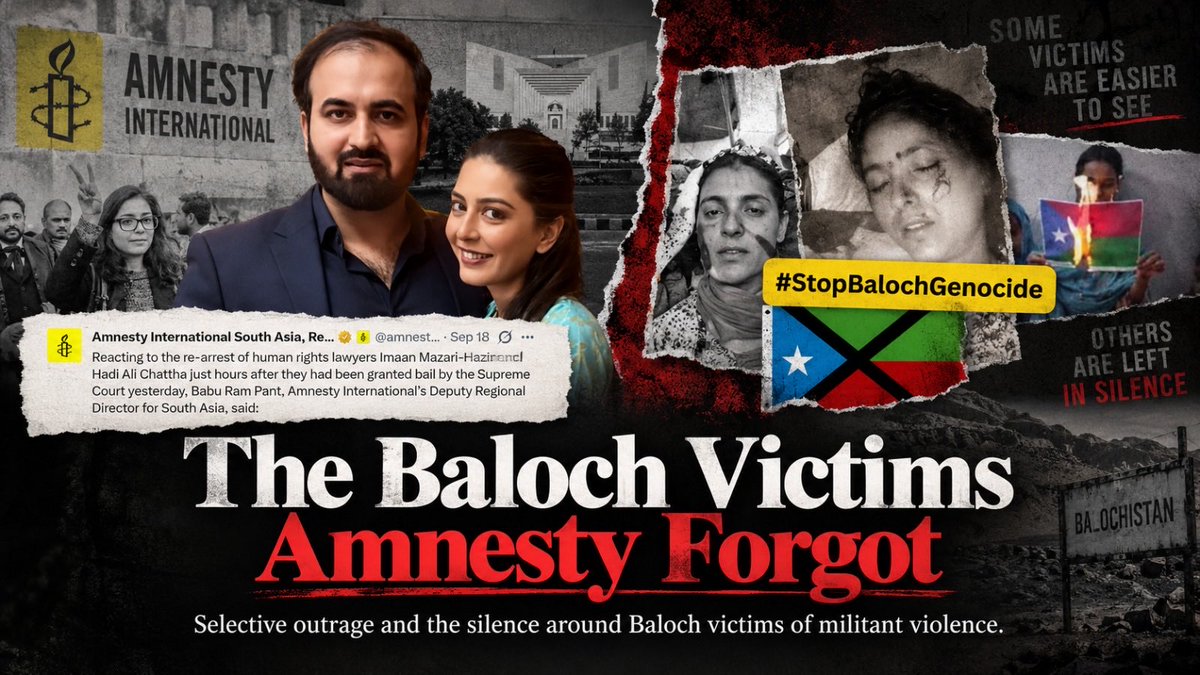
Human rights are supposed to be universal. Yet in Balochistan, one increasingly gets the impression that some victims qualify for international outrage, while others barely qualify for remembrance.
On September 18, Amnesty International issued an emphatic statement on the re-arrest of Imaan Mazari-Hazir and Hadi Ali Chattha, describing their detention as politically motivated and demanding their immediate release. Amnesty has repeatedly issued urgent actions and public statements concerning Imaan Mazari, Mahrang Baloch, Baloch activists, enforced disappearances, and restrictions on protest.
There is nothing wrong with scrutinising the state; that is precisely what a human-rights organisation should do. The question, however, is why the same moral vocabulary becomes so difficult to find when the perpetrator is the terrorist.
Consider Bibi Hanifa and her 17-year-old daughter, Hafsa. They were murdered inside their home in Nushki in August. Contemporary police reporting initially described the killers as unidentified and said the motive remained under investigation. Balochistan's women parliamentarians subsequently condemned the killings as an attack on humanity and explicitly questioned the silence surrounding them.
Where was the comparable international campaign for them? Where were the graphics, urgent actions, statements, hashtags, and carefully worded demands for accountability?
And they are hardly the only civilians disappearing from the international human-rights narrative. During the BLA's coordinated attacks across Balochistan in January 2026, Reuters reported that 18 civilians were killed, including women and children. The BLA claimed responsibility for the wider operation.
Amnesty's own current Pakistan overview acknowledges that militant attacks have killed civilians in Balochistan. Yet its highly visible casework concerning the province overwhelmingly focuses on alleged state abuses, activists, detention, protest restrictions, and disappearances. That distinction deserves scrutiny.
Because a Baloch civilian does not acquire fewer human rights merely because his murderer carries a separatist flag rather than a government uniform. A Baloch mother murdered by militants is still a Baloch woman; a policeman is still a human being; a teacher does not stop possessing rights because militants call him a collaborator; and a labourer's children do not become geopolitically inconvenient footnotes because acknowledging their deaths complicates a fashionable narrative.
This is where the language of "Baloch rights" sometimes becomes strangely selective. The separatist activist confronting the Pakistani state becomes internationally legible, while the Baloch civilian murdered by an armed separatist organisation can become almost invisible.
That is not a defence of unlawful detention, enforced disappearance, or abuse by the state. Those allegations must be investigated precisely because rights are universal. But universality has to work in both directions.
Otherwise, "human rights" slowly ceases to describe a moral principle and starts looking like a filter through which politically useful victims are amplified while inconvenient victims are backgrounded. And that has consequences beyond hypocrisy: it affects how the conflict itself is understood.
If international audiences repeatedly encounter one Baloch identity, the detained activist, the disappeared student, the grieving family confronting the state, but rarely encounter the Baloch teacher, policeman, elder, worker, woman, or child killed by militants, they are not being shown the complete human cost of the conflict. They are being shown a curated one. That is precisely why Balochistan needs a victim-centred human-rights narrative rather than an actor-centred one.
جس سوال کا جواب چاھئے وہ یہ ہے کہ نہ اب امریکہ ہے نہ سوویت یونین پھر پختونوں پر حملے کرنیوالے پختون قبائل کون ہیں؟ اور یہ کیوں کر رہے ہیں؟ باجوڑ سے کوھاٹ ہر جگہ دھماکہ کرنیوالا افغان/پشتون قبائلی کیوں ہے؟ پچھلے پانچ سو دھماکے میں مرنیوالے دھشت گرد قبائلی ہی کیوں ہے؟ پنجابی ، سندھی، پشاور، مردان، صوابی، ہ��ارہ کا کیوں نہیں ہے اور ہر دفعہ قبائلی کیوں ہے؟ بیماری کو پہچانیں ت کہ علاج کر سکیں صرف گالیوں اور بکواس سے کچھ نہیں ہونا۔۔ نہ ہی پنجابیوں پر ملبہ ڈالنے سے کچھ ملنا ہے۔۔
@KomalBukhari4 And keep ur shame to your self ... and feel ashamed of lack of fact awareness that u have ..... you have been readin patta khazana type histories and narratives .... growing into a dumb wit with a keyboard in your hand .... n no sense at all
@KomalBukhari4 So if the establishment can be called punjabi .... then y take exception when Ts are called pashtun or Baloch .... if u want to apply the ethnicity card then apply it accross the board .... dun behave like a bigot
Another gift from our lar o bar fellas who simp for these kharijites. more scholarships should b announced for our neighbouring bradar Islami mulk. As I said before there can be no peace n Pakistan until we flatten a city in Afghanistan for every attack tht takes place n Pakistan
If the Establishment can be termed as "the Punjabi Establishment", by the same token the Taliban can be called "the Pashtun Taliban" and terrorists as "the Pashtun terrorists". Identifying a group with an ethnicity should work both ways.
اس نے کیا غلط کہا۔
31 لوگ 31 خاندان برباد ہو گئے کل۔
پھٹنے والا کون تھا؟
زمین پہ سر دے دینے سے حقیقت بدل جائے گی۔
یا فود چودھری یا کسی اور پنجابی کو ہیرامنڈی کہ اولاد کہہ دینے سے حقیقت بدل جائے گی؟
ویسے ایک بات ھے۔ حافظ گل بہادر بھی پختون انکے ساتھی عسکریت پسند بھی پختون کوہاٹ میں مسجد میں نمیازی ڈاکٹرز، طالب علم، پولیس والوں کو قتل کیا وہ بھی پختون۔۔۔جن افغان طالبان کی سرپرستی حاصل ھے وہ بھی ۔۔۔۔ دلچسپی کی بات- اپنے لوگوں کو مار کر جو
بڑے مقاصد حاصل کئے۔۔۔
�� امریکہ کو پیغام گیا کہ انکا سورج غروب ھورہا ھے
✓ اسلام دشمن قوتوں کو کمزور کیا-اسلام کا بول بھی بالا ھوا۔۔
✓ پاکستانی فورسز (جسے وہ پنجابی سمجھتے ہیں) کو سخت نقصان پہنچایا۔
✓پختون نمازیوں کو مار کر حافظ صاحب نے ثواب، اور جس نے خودکش کیکا انکو جنت نصیب ھوا۔۔
گل بھادر - قرآن کا حافظ بھی، مسلمان بھی، پختون بھی، غیرت مند قبایل بھی۔۔۔ سب سے بڑ کر بہادر بھی۔۔۔کیونکہ اپنے بھائی کو قتل کرکے امریک، پنجاب، پاکستان، یہود و ہنود کو کمزور کرنے کا دعویٰ بھی کرتا ھے۔۔
اب ہم الزام لگائیں گے کہ گل بھادر -غیور،بہادر قبائلی پختون کو ورغلایا گیا۔ بیچارہ روٹی کو چوچو بولتا ھے۔۔
ٹی ٹی پی والے بھی سارے پختون اور انکی بھی ایک اچھی خوبی یہ ھے کہ مارتے بھی پختون کو ھے۔۔کیونکہ اپنے بھائیوں کا مارنا ذرا آسان ھوتا۔۔جنت�� پیسہ طاقت۔
Absolute nonsense! Maulana Hasrat Mohani said no such thing. He was also a member of the Muslim League and resigned from it after the partition, which he opposed, was announced