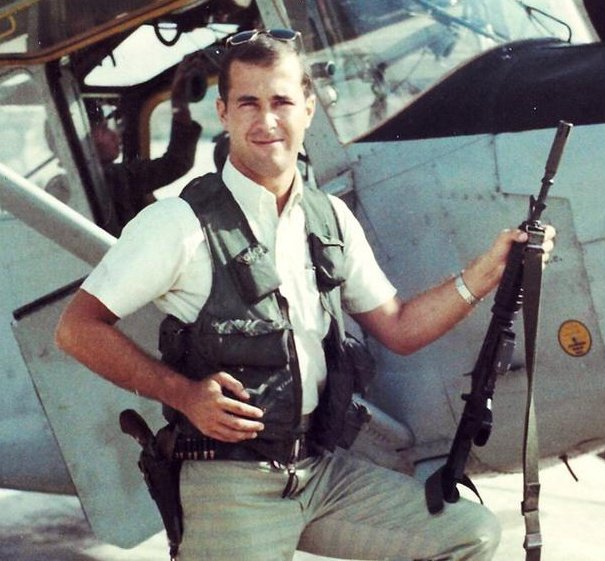
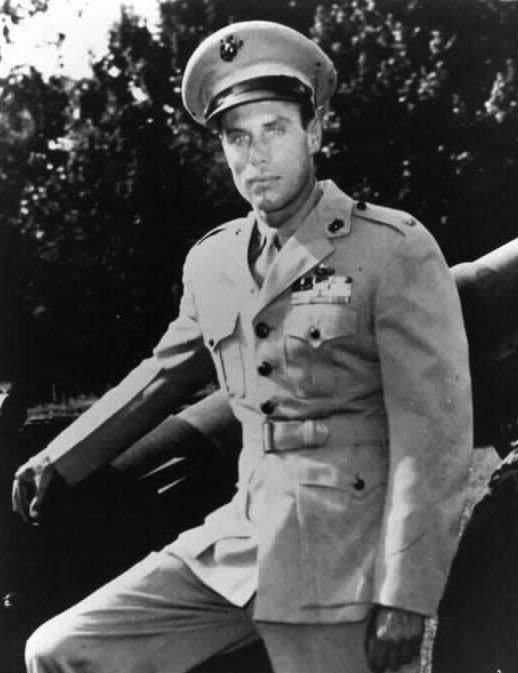
The OSS’s legendary Col. Peter Ortiz, USMC, was born OTD 1913.
Colonel Pierre “Peter” Julian Ortiz was one of approximately 80 Marine Corps officers who served in the OSS during World War II.
Tall, urbane, fluent in ten
languages, he was the son of an American mother and French-Spanish father. Ortiz’s military service began in 1932 at the age of nineteen when he enlisted in the French Foreign Legion and fought Rif Berbers in Morocco.
After his discharge, he served as a military movie technical advisor in Hollywood. Upon World War II’s
outbreak, Ortiz re-enlisted in the Foreign Legion, fought in the Battle of France, was wounded and captured. After a year-
and-a-half as a POW, he escaped and eventually reached the United States.
Ortiz enlisted in the Marine Corps in 1942 and was commissioned a second lieutenant. In January 1943, Ortiz, now a captain and a member of the OSS, was
sent to Morocco, tasked with organizing local tribesmen to conduct reconnaissance
missions against the German army. Ortiz fought in the Battle of Kasserine Pass and conducted a series of covert deep penetra-
tion reconnaissance missions.
After being severely wounded in one such mission, Ortiz was evacuated to the United States. Upon recovery, he began OSS training. In 1944, he participated in two missions, UNION I and II, to the Savoie, Isère, and Drôme departements of France.
Wearing his Marine Corps uniform
complete with decorations, his daring exploits made him the bane of the Germans.
Two of his more spectacular adventures included the theft of ten Gestapo vehicles from a military garage that were used to rescue downed RAF airmen; and forcing a group of German officers at gunpoint to drink toasts to the president of the United States and the Marine Corps.
A group of officers from the German 157th Division, which had previously suffered at the hands of Ortiz and the Maquis (French Resistance), were in the bar of a club Ortiz occasionally visited and were loudly cursing the “tall American Marine” (Or-
tiz), the Allies, President Franklin Roosevelt, and the U.S. Marine Corps.
Ortiz, who was sitting nearby and dressed in civilian clothes, had heard enough. He returned
to his safe house and donned his Marine Corps uniform and brace of Colt Model 1911 pistols over which he pulled on his raincoat.
He then returned to the club and
approached the German officers. Ortiz ordered drinks for them, then doffed his raincoat to reveal his dress Marine Corps uniform complete with badges and decorations,and aimed his pistols at the stunned officers: “A toast to the president of the United
States,” he said.
After the Germans had downed their drinks, Ortiz ordered another
round and said: “A toast to the Marine Corps.”
Some accounts have him then shooting the officers, killing them. Ortiz said that he escaped without killing the officers because by letting them live, the story of his action would boost his legend even more and further erode German morale. Later captured, despite attempts to escape, he remained a POW until the war’s end.
Colonel Ortiz is one of the most highly decorated Marine Corps officers in World War II and the most highly decorated member of the OSS.
His decorations included
two Navy Crosses, the Legion of Merit with Combat V, two Purple Hearts, Member of the Order of the British Empire (Military Division), Chevalier of the Legion
d’honneur, the Ouissam Alaouite, and five Croix de Guerre.
The OSS Society him by inscribing the name of his mission - UNION - on the OSS Congressional Gold Medal.
The story of his remarkable service is told in our short documentary, “Call Sign CHAOS: Gen. Jim Mattis and the US Marine Corps”: https://t.co/9RTqVFUHqc
One of very few Heckler & Koch HK33 assault rifles assembled in the US as the Harrington & Richardson T223 and tested in Vietnam in the hands of a US Navy Seal on the Mekong Delta in August 1968
YOV-10D Night Observation Gunship System trials with an XM197 20mm cannon in a ventral turret slaved to a FLIR sensor in the chin and 2.75-inch rocket pods under the wing
XM18 7.62mm Minigun pod trials mounted on a UH-1 Huey helicopter at Quantico on March 8th 1965
The ammunition belts are delinked while being fed into the drum that held 1,500 rounds, enough for 15 seconds on the trigger
British FV102 Striker ATGM carrier launches a Swingfire missile while on maneuvers in the Arctic
The 5-round launch bin was fixed in traverse but as seen in the clip true to its name the missile could swing round up to 90 degrees to engage its target