Bitcoin -50% from peak. Gold -23% from highs. $BTC ETFs: $3.4B in outflows.
RAAC burned 6.2M $pmUSD to protect collateral coverage.
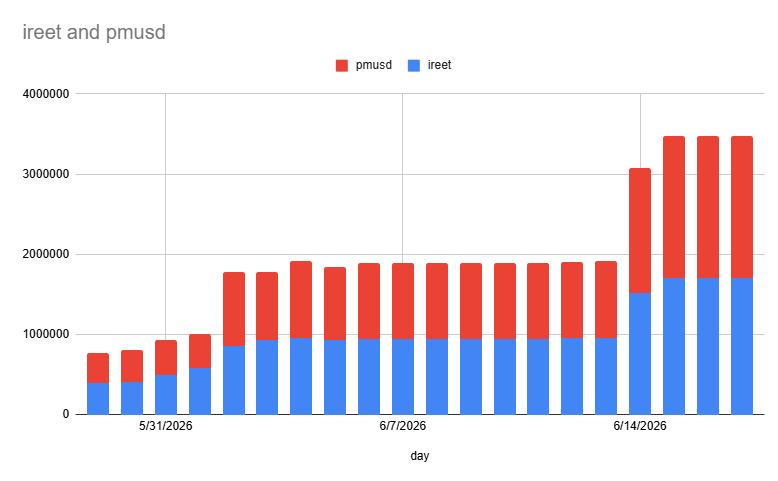
$iREET pool TVL: 3.9x in 30 days.
June market report🔽
https://t.co/4IVzYjoDh7
Since the start of the Bond maturity, the $iREET token on @curvefinance grew from 345.6k to 1.70m units.
This growth will be supported by CRV emissions from RAAC's voting power.
You can get iREET from the pmUSD pool.
iREET: 17 Properties. Real Rent. On Ethereum.🧵
Buying real estate IRL is not simple. You need capital, credit history, legal documentation, a broker, often a local presence, and it takes months of process before you can own anything.
Then, once you do, the average annual yield on a single-family rental property (in the US) sits between 5% and 8%. On top of that, you have no liquidity, no composability, and most importantly no way to put that asset to work beyond collecting rent.
$iREET is an asset that offers a whole other level of possibilities if you are interested in real estate investment.
@raacfi now indirectly controls 4.1% of Curve’s voting power, making it the 4th largest governance participant. This structural advantage allows them to consistently direct emissions to their pools, ensuring $pmUSD yields stay predictable and long-term. 🚀
You know what day it is for $veCRV holders🗳️
Less than 14h left to vote for the $pmUSD pools.
Fresh $pmUSD & $WFRAX voting incentives are deposited!
There you go: https://t.co/H6WDgBkCKj
cc:@fraxfinance
Even if math was never your strongest suit, there is an elephant in the room...👇
It's all about choosing where you move your stablecoin liquidity folks.
Just sayin @StakeDAOHQ looks good...🐘
https://t.co/ApHqDnMD8B
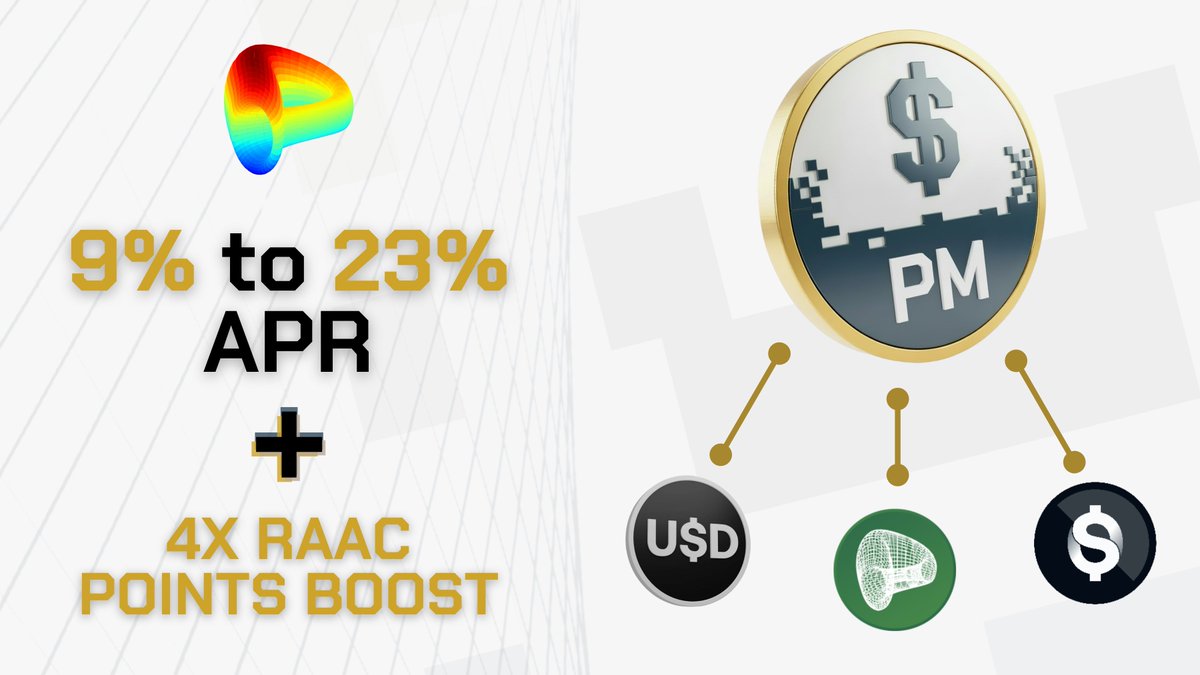
POINTS BOOST ARE LIVE ON @CurveFinance🚨
Until March 31st, LPs will not only get one of the top stablecoin APRs in the space, but also receive a 4× multiplier for RAAC's Points Program🤖
Deposit $pmUSD / $crvUSD / $frxUSD or $OUSD now 👇
https://t.co/zO47zctWfk
Gud yield🦙
What if your stablecoin was backed by gold, and you could still plug it into Curve, Convex, and Gearbox?
That’s what RAAC built with pmUSD.
They’re using tokenized gold as collateral to mint pmUSD: a dollar stablecoin that’s backed by real-world gold under the hood.
That pmUSD liquidity is flowing into Curve, and it’s already grown to around $30M in under two months.
Now you've got a gold-backed dollar sitting inside one of DeFi’s deepest liquidity venues, earning a yield of ~11% – 33%.
You can route the LP position through places like Convex, StakeDAO, Yearn, or even try leveraged strategies, Gearbox.
And if you’re holding pmUSD in those pools, you’re automatically stacking RAAC points heading into their H1 2026 TGE.
A stablecoin yield, backed by real-world collateral, is plugged into the Curve flywheel that’s actually pulling capital.
Glad to partner with @RaacFi and highlight pmUSD while this side of DeFi starts getting interesting again.
HOW TO GET A TOP STABLECOIN YIELD IN DeFi NOW WITH $pmUSD?
Tired of crypto volatility? Time for you to look into a more reliable side of DeFi👀
Move your liquidity to a gold-backed stablecoin & explore every option to farm the best stable yields.
EVERYTHING IS HERE👇
You can now earn new RAAC Points using @beefyfinance and @yearnfi👀
Staking LP tokens from @CurveFinance pools on both platforms is now tracked✅
Climb the leaderboard and participate in the RAAC Points Program here: https://t.co/RHEXkPqGOr
$27M in pmUSD LPs on Curve, grateful for the momentum🙌
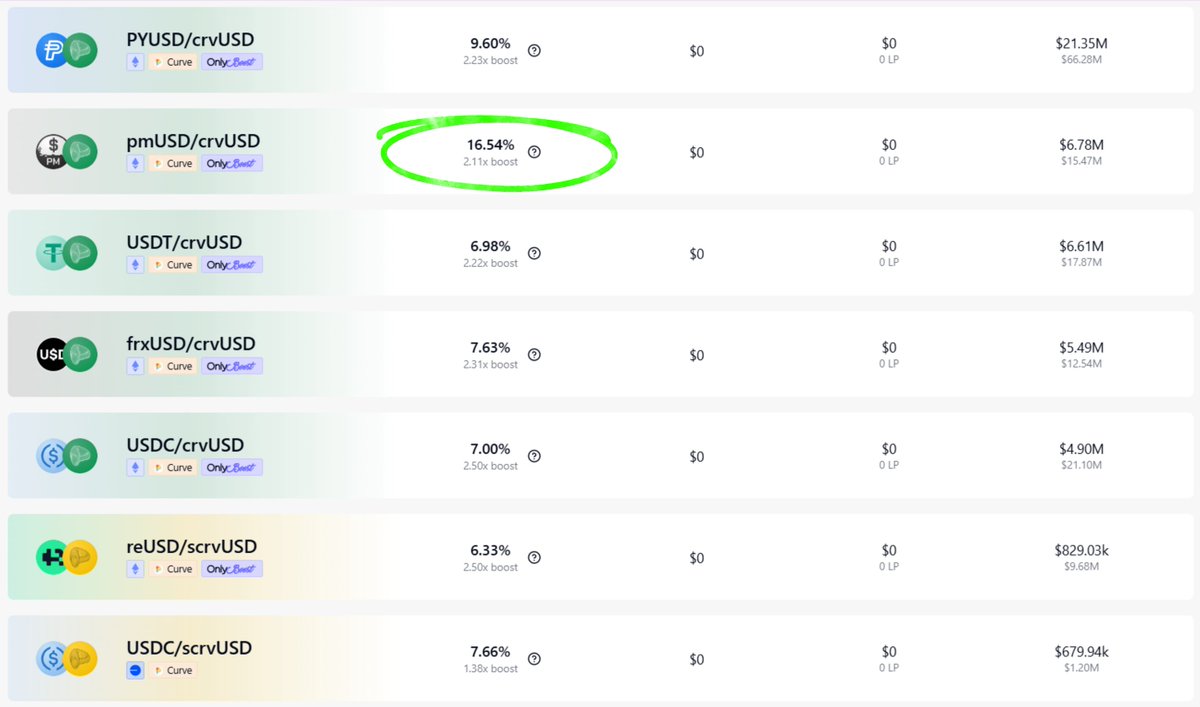
In less than 2 months, RAAC's first product has grown into a meaningful stablecoin yield opportunity in DeFi, currently still offering up to 27% APR on Curve Finance: https://t.co/ZynDtT5XWV
This growth has been supported by recent integrations across the ecosystem. LPs can now optimize yield through @ConvexFinance, @StakeDAOHQ, @yearnfi, and @beefyfinance.
Yield farmers can explore leveraged strategies via @GearboxProtocol as well.
Borrowing strategies with @roycoprotocol are also live, adding more flexibility around pmUSD liquidity. And of course, the team is working hard on more integrations.
But we’re still early 👀
Ahead of our TGE in H1 2026, we’re building the next layers of the RAAC ecosystem, and new products will be launched in the next few weeks.
RAACLend & iREET will mark RAAC’s first concrete step into tokenized real estate and unlock new RWA-backed yield strategies.
Finally, remember that all pmUSD liquidity providers are automatically eligible for our ongoing Points Program leading up to the TGE.
To clearify, why am I this bullish on:
$FRAX, $CRV, $CVX, $AAVE
@Fraxfinance builds the next Gen money stack, with their high performance L1 blockchain Fraxtal, their financial SuperApp FraxNet and frxUSD, their Genius aligned stablecoin backed by tokenized T-Bill, which is already deep connected into DeFi’s fundamentals, engineered to serve as money for institutions and retail in this forming on chain economy.
This stable is on top already widely connected via multiple PegKeeper pools with other serious protocols on @CurveFinance, anchoring deep stablecoin liquidity on @Ethereum, for example paired with stables like $fxUSD from @protocol_fx, $pmUSD from @Raacfi or the stable from Curve itself $crvUSD.
$FRAX is Frax’s ecosystem token at the heart of the Frax stack.
By locking your FRAX into $veFRAX you get access to the revenue generated through their AMOs, their LST’s, their RWA stablecoin backing, tying the token directly to real economic output.
Now, why $CRV?
Over the past cycles, Curve established itself as the primary DEX for stablecoins on Ethereum, because its AMM design is optimized specifically for low-slippage trading.
When frxUSD or other stablecoins build liquidity through PegKeeper pools on Curve, it further reinforces the deepest stablecoin infrastructure available.
$CRV represents ownership of that liquidity layer.
The token captures value through governance and emissions control and when locked as $veCRV it earns a share of protocol fees, means, $CRV is a direct entry for exposure of the core stablecoin liquidity layer of DeFi.
If you name $FRAX & $CRV, it’s very logicial, to name $CVX.
Since @ConvexFinance owns a very high amount of FRAX and near halve of $veCRV, it means, it can actively influence where Curve emissions flow.
Convex uses that voting power to direct incentives toward selected pools and boosts rewards for its users.
All in all, $CVX captures value by sitting at the control point of Curve incentives.
Through Convex’s veCRV position, $CVX holders gain indirect exposure to boosted rewards, protocol fees and governance influence over @Curvefinance.
As long as Convex coordinates emissions for Curve, $CVX represents ownership of that incentive layer, effectively a high impact position on Curve’s stablecoin liquidity engine.
Let’s finally talk about $AAVE, as one of the most battle-tested lending protocols in DeFi, if not the most, with years of production usage, deep liquidity and a massive user base.
This is where things get even more recent, because Aave recently published their new proposal “Aave will win”, focusing on moving the token further from pure governance toward real economic ownership and revenue distribution for token holders.
The proposal outlines a clear path for @aave by strengthening the connection between protocol performance and token holders.
In simple terms, $AAVE captures value through governance and now soon revenue, representing ownership of DeFi’s most important integrated credit layer.
Viewed together, this is definitely not a collection of isolated bets.
Liquidity, incentives, governance and credit are all wired together.
These protocols hold positions in each other’s systems and actively design solutions around shared directions.
To give or repeat some examples for this coordinated infrastructure:
frxUSD anchors liquidity through Curve’s PegKeeper pools, while Convex steers emissions via their holdings in veCRV and concentrates incentives around those frxUSD pools.
That reinforced liquidity then goes straight into Aave, where frxUSD is now very likely to become productive collateral.
So capital literally circulates between them.
Not only has every project in this lineup already found product-market fit and is generating very solid revenue, the structural shift of TradFi discovering and entering the on-chain economy, combined with how these projects reinforce each other, is what makes this thesis sustainable in my view.