Associate Professor in EECS at @MIT | Co-Founder at @unconvai | Founding Advisor at @mosaicml | Programming Systems | Neural Networks | Unconventiona Computing
At Unconventional, we’re building the computational substrate for the AI era.
Scientists and SWEs interested in dynamical systems (Diffusion, Neural ODEs, Deep Equilbrium Models, and Energy-based models) DM or email [email protected] (subject: dynamics). Things are getting really interesting really fast…
Most real-world systems are dynamic.
So why do we still treat computation as static?
Our latest blog explores computation through motion using gyroscopes, rods, springs, and ordinary differential equations to perform handwritten digit classification.
A deep dive into:
• dynamical systems as compute
• differentiable ODE solvers
• physics-inspired machine learning
• emergent computation through interaction
Read here: https://t.co/pIwwvT72Bw
Fixed point iterations for parallelizing nonlinear dynamics is all the rage:
- Newton for RNNs
- Picard for diffusion models
- Jacobi for parallel decode of LLMs
But how do these techniques relate, and when should you use them?
We show you how in our new paper 🧵
Tomorrow, May 15, is the final day to submit pre-proposals for the Unconventional Grant.
Over the past several weeks, we’ve seen proposals spanning:
• computation as dynamics
• in-memory and in-physics compute
• architectures that minimize data movement
• new abstractions beyond linear algebra
Many converge on the same intuition: meaningful efficiency gains in AI will not come from scaling existing approaches alone, but from fundamentally different ways of representing and computing.
We are looking for technically grounded ideas that challenge assumptions across hardware, systems, and learning.
We’re not looking for taller ladders to the moon. We’re looking for rockets.
https://t.co/7ups8vMcdZ
Tomorrow, May 15, is the final day to submit pre-proposals for the Unconventional Grant.
Over the past several weeks, we’ve seen proposals spanning:
• computation as dynamics
• in-memory and in-physics compute
• architectures that minimize data movement
• new abstractions beyond linear algebra
Many converge on the same intuition: meaningful efficiency gains in AI will not come from scaling existing approaches alone, but from fundamentally different ways of representing and computing.
We are looking for technically grounded ideas that challenge assumptions across hardware, systems, and learning.
We’re not looking for taller ladders to the moon. We’re looking for rockets.
https://t.co/7ups8vMcdZ
Just some personal thoughts now that the AI co-mathematician tech report is public...
First, I'm so excited to see the co-mathematician team's hard work out for the world to preview. 💪+🦾=🔥 The team has built a system for mathematicians, with mathematicians. The fact it's now top of the FrontierMath leaderboard is a cherry on top, not the goal. Vibes and utility >> benchmarks.
The system is currently being tested with a small number of professional mathematicians. It is not widely available, but I personally hope that, one day, we can get even more capable systems into the hands of all mathematicians.
It's been a privilege working with this team at Google DeepMind since January.
Props to @dhhzheng, @ADaviesAI, and @pushmeet for their leadership. Give them all a follow to not miss exciting upcoming work.
A company you’ve probably never heard of raised $475M six months ago to create a radically new way of building AI. No Von Neumann bottleneck, no memory bandwidth issues, hugely less power required.
This is their first test chip expected this summer.
They are testing whether they can use fundamental electronic circuits to generate intelligent behavior.
NVIDIA, TPUs and similar chips will rule for the next five years at least, but at some point, a new way of building AI will emerge.
I don’t know if it’ll be found by @unconvAI or not, but I’m glad well funded companies like this are tackling this problem.
Short video by the CEO describing their work below.
The unconventional way we’ve set ourselves up is to give us the time, horizon, and perspective to rethink the whole stack. Here is one of the reasons why,
Getting to 1000x energy efficiency in AI isn’t about one breakthrough.
It’s about solving two hard constraints:
1. Data movement dominates energy
2. Amdahl’s Law caps system-level gains
Which means you have to rethink everything: models, hardware, and how they’re designed together.
If this kind of problem excites you, you’ll enjoy our latest blog: https://t.co/3FFKWIm1nc
At [un] @unconvAI we're not only rethinking computers, but also how intelligence emerges from the physical world. We're working at the frontier and our computing primitives are physics.
If you're interested in the intersection of nonlinear dynamics and language and reasoning, apply here:
https://t.co/iGpuKvuJxe
Super interesting paper from @therealgabeguo.
Most diffusion models are Markovian---they only know about their current state.
These non-Markovian bridges actually keep in mind the entire path, which is great for creating videos and other objects that need to remember history!
Super excited to join @NaveenGRao and his team of rockstars at Unconventional AI.
Our goal is to make AI 1000x more energy efficient by radically rethinking its foundations from all the way down the stack---beginning with hardware and going all the way to algorithms.
We’re introducing the Unconventional Grant.
A new research grant program supporting bold, unconventional ideas in AI.
We’re allocating $500,000 in total funding, awarding up to five $100,000 grants to researchers exploring new paradigms in efficient, scalable, and biologically inspired AI systems.
We’re especially interested in ideas that challenge how AI systems are built today, from unconventional circuits and architectures to new approaches in neural networks and theory.
Not incremental work.
Not safe bets.
Ideas that push the field forward.
https://t.co/nkSvjhZE12
We’re introducing the Unconventional Grant.
A new research grant program supporting bold, unconventional ideas in AI.
We’re allocating $500,000 in total funding, awarding up to five $100,000 grants to researchers exploring new paradigms in efficient, scalable, and biologically inspired AI systems.
We’re especially interested in ideas that challenge how AI systems are built today, from unconventional circuits and architectures to new approaches in neural networks and theory.
Not incremental work.
Not safe bets.
Ideas that push the field forward.
https://t.co/nkSvjhZE12
I’m super excited to share this news with the world! Solving the problem of efficient intelligence hardware is what we care about; this requires creativity and exploring a lot of unexplored or under-explored lines of thought.
These grants are for academic researchers and they have no strings attached. Use the funds to generate unconventional ideas on how to solve the problem.
I’m personally excited to see the proposals! Click the link and apply.
Stop copying the past. Is modern AI just a "cargo cult" worshipping the GPU?
For 60 years, hardware and software have lived in completely separate worlds. But AI is forcing us to tear down those walls. The industry is stuck optimizing old abstractions and linear algebra not because it’s the best way to build intelligence, but because it’s what we inherited.
We’re flipping the script at Unconventional AI and introducing neural co-evolution.
We are building hardware and neural networks together from day zero to bypass the limits of traditional computing and unlock mind-blowing 1000x efficiency gains. The era of siloed design is over.
Ready to see the future of compute? Read the full breakdown in our latest blog post.
https://t.co/DA8uxkecFZ
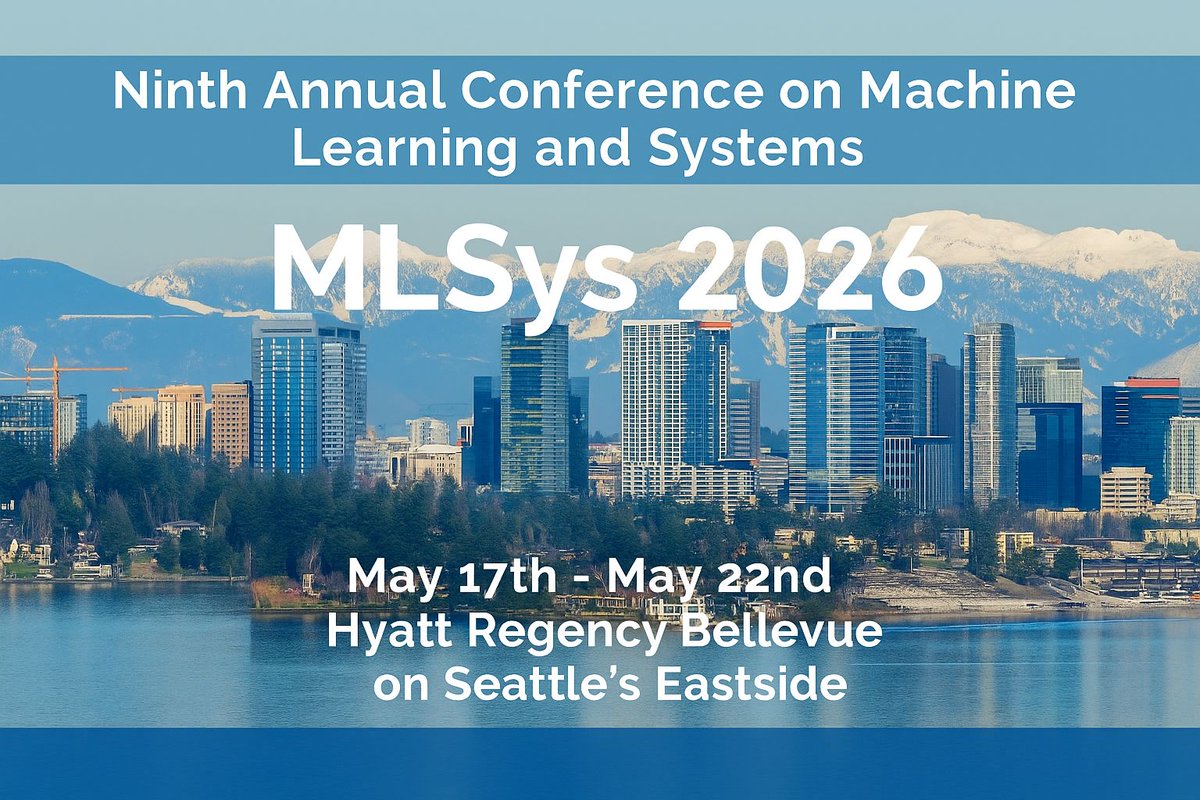
The MLSys’26 program is live!
Check out the accepted papers: https://t.co/PKTMF2pOt2
This year marks several exciting firsts:
• 28 industry track papers bridging MLSys research & real-world deployment
• Our inaugural competition track featuring AWS Trainium, Google Graph Scheduling, and NVIDIA FlashInfer AI Kernel contests
Early registration deadline: April 1 — don’t miss it! See you in Seattle this May🌲
My image of top PL researchers: Wow, they really know their shit.
My experience as a PL researcher: Drifting in an opium haze of confusion about topics on which I am an "expert" -- a haze which only partly and momentarily clears when we write the key ideas section of a paper.
Parallelizing nonlinear RNNs is gaining traction!
More efficient than transformers; more expressive than linear RNNs.
My PhD thesis provides an intro guide to the math (Newton's method) behind the parallelization.
Great as a quick-start if you want to explore this new field!