🚨 As an Auto Executive Here is My Perspective on Ferrari's New EV
Bottom line....
They built an extraordinary EV. The market’s reaction suggests that may not be enough.
Ferrari unveiled the Luce yesterday:
• 1,050 horsepower
• Jony Ive co-designed interior
• nearly $650,000 starting price
• Ferrari’s first fully electric vehicle
Today, Ferrari stock fell roughly 7%.
As someone who has spent 25+ years inside automotive leadership, I think this reaction says something important:
This is not about whether Ferrari built a technically impressive car.
They did.
This is about whether Ferrari fully understands what its customer is actually buying.
Ferrari customers are not primarily purchasing transportation.
They are purchasing:
identity,
emotion,
heritage,
scarcity,
mechanical theater,
and cultural symbolism.
That is what makes luxury automotive branding so fragile during technological disruption.
The challenge with EVs; especially at the ultra-luxury level is not performance.
Electric drivetrains already deliver extraordinary performance.
The challenge is preserving mythology.
And that is much harder.
Ferrari appears to understand this intellectually:
the engineered sound,
the tactile controls,
the dramatic specs,
the emotional design language.
But the market reaction suggests investors are still questioning whether the EV transition aligns with the emotional expectations of Ferrari’s core customer base.
That distinction matters.
Because in luxury markets, brand identity often carries more pricing power than engineering itself.
What do you think?
🚨 What Auto Executives Are Quietly Realizing About EV Demand Is Starting To Show Up Everywhere
One thing I am watching very closely as a longtime auto operator:
The peer set is increasingly voting with its capital and the signal is becoming difficult to ignore.
@Lamborghini retired the Lanzador EV program after leadership acknowledged demand inside its luxury performance customer base was “close to zero.”
Bentley pushed its all-electric transition goal from 2030 to 2035.
Porsche scaled back parts of its electrification strategy and abandoned its in-house EV battery effort.
Stellantis absorbed a massive EV-related write-down.
@Ford took a nearly $20 billion charge tied to the F-150 Lightning pivot and broader EV recalibration.
What is fascinating is how emotional the @Ferrari reaction has become internally and externally.
For instance, in a direct conversation I had with another senior auto executive yesterday after the Luce reveal, the reaction was:
“I’m still processing it. Can't believe the decision. It’s ultra brave. But the internet is on fire. Get your popcorn and sit and watch.”
Ferrari conversation matters beyond Ferrari.
The issue is no longer:
“Can the industry build compelling EVs?”
The issue is increasingly:
“Does customer demand especially in emotional/luxury/performance segments actually align with the speed of the eelctric transition?”
Sometimes the "gee whiz" technology/innovation folks get ahead of consumer demand.
That is a very different strategic question than the industry was asking even 24 months ago. 👀
What do you think? Did the industry get ahead of itself?
🚨 What Auto Executives Are Quietly Realizing About EV Demand Is Starting To Show Up Everywhere
One thing I am watching very closely as a longtime auto operator:
The peer set is increasingly voting with its capital and the signal is becoming difficult to ignore.
@Lamborghini retired the Lanzador EV program after leadership acknowledged demand inside its luxury performance customer base was “close to zero.”
Bentley pushed its all-electric transition goal from 2030 to 2035.
Porsche scaled back parts of its electrification strategy and abandoned its in-house EV battery effort.
Stellantis absorbed a massive EV-related write-down.
@Ford took a nearly $20 billion charge tied to the F-150 Lightning pivot and broader EV recalibration.
What is fascinating is how emotional the @Ferrari reaction has become internally and externally.
For instance, in a direct conversation I had with another senior auto executive yesterday after the Luce reveal, the reaction was:
“I’m still processing it. Can't believe the decision. It’s ultra brave. But the internet is on fire. Get your popcorn and sit and watch.”
Ferrari conversation matters beyond Ferrari.
The issue is no longer:
“Can the industry build compelling EVs?”
The issue is increasingly:
“Does customer demand especially in emotional/luxury/performance segments actually align with the speed of the eelctric transition?”
Sometimes the "gee whiz" technology/innovation folks get ahead of consumer demand.
That is a very different strategic question than the industry was asking even 24 months ago. 👀
What do you think? Did the industry get ahead of itself?
🚨 Ferrari Brought In The Pope. X Still Thinks It Looks Like A Kia. 😂
At this point the Ferrari Luce rollout may genuinely be seeking divine intervention.
The reaction says something much bigger about branding than cars.
People are not FOR THE MOST PART debating the specs.
They are debating whether it FEELS like a Ferrari.
That distinction is exactly why so many luxury and auto executives are quietly watching this launch so closely right now.
@mchamarthi describes a convo with one senior auto executive told me after the reveal:
“It’s ultra brave. The internet is on fire. Get your popcorn and sit and watch.”
That perfectly captures what is happening here.
The Ferrari conversation has become a real-time case study in what happens when innovation collides with emotional brand identity.
This explains this dynamic extremely well below 👇
Will Ferrarri bounce back or take this one off the production schedule? Or use the latter as their bounce back strategy?
Photo courtesy @Polymarket
🚨 What Auto Executives Are Quietly Realizing About EV Demand Is Starting To Show Up Everywhere
One thing I am watching very closely as a longtime auto operator:
The peer set is increasingly voting with its capital and the signal is becoming difficult to ignore.
@Lamborghini retired the Lanzador EV program after leadership acknowledged demand inside its luxury performance customer base was “close to zero.”
Bentley pushed its all-electric transition goal from 2030 to 2035.
Porsche scaled back parts of its electrification strategy and abandoned its in-house EV battery effort.
Stellantis absorbed a massive EV-related write-down.
@Ford took a nearly $20 billion charge tied to the F-150 Lightning pivot and broader EV recalibration.
What is fascinating is how emotional the @Ferrari reaction has become internally and externally.
For instance, in a direct conversation I had with another senior auto executive yesterday after the Luce reveal, the reaction was:
“I’m still processing it. Can't believe the decision. It’s ultra brave. But the internet is on fire. Get your popcorn and sit and watch.”
Ferrari conversation matters beyond Ferrari.
The issue is no longer:
“Can the industry build compelling EVs?”
The issue is increasingly:
“Does customer demand especially in emotional/luxury/performance segments actually align with the speed of the eelctric transition?”
Sometimes the "gee whiz" technology/innovation folks get ahead of consumer demand.
That is a very different strategic question than the industry was asking even 24 months ago. 👀
What do you think? Did the industry get ahead of itself?
🚨@Ferrari Execs Be Aware. Critics are attacking the IDENTITY of the car, not the engineering.
As a former C-level exec for Stellantis I can confirm The Luce’s specs are extraordinary.
Yet most of the backlash is not about horsepower, charging speed, or engineering.
It is about identity recognition.
People are asking:
“Does this still FEEL like a Ferrari?”
That is an incredibly difficult branding problem during technological disruption; especially when mythology is part of the product itself.
Do you believe Ferrari is about to see how far can an iconic luxury brand evolve (or devolve) before customers emotionally stop recognizing it?
🚨 As an Auto Executive Here is My Perspective on Ferrari's New EV
Bottom line....
They built an extraordinary EV. The market’s reaction suggests that may not be enough.
Ferrari unveiled the Luce yesterday:
• 1,050 horsepower
• Jony Ive co-designed interior
• nearly $650,000 starting price
• Ferrari’s first fully electric vehicle
Today, Ferrari stock fell roughly 7%.
As someone who has spent 25+ years inside automotive leadership, I think this reaction says something important:
This is not about whether Ferrari built a technically impressive car.
They did.
This is about whether Ferrari fully understands what its customer is actually buying.
Ferrari customers are not primarily purchasing transportation.
They are purchasing:
identity,
emotion,
heritage,
scarcity,
mechanical theater,
and cultural symbolism.
That is what makes luxury automotive branding so fragile during technological disruption.
The challenge with EVs; especially at the ultra-luxury level is not performance.
Electric drivetrains already deliver extraordinary performance.
The challenge is preserving mythology.
And that is much harder.
Ferrari appears to understand this intellectually:
the engineered sound,
the tactile controls,
the dramatic specs,
the emotional design language.
But the market reaction suggests investors are still questioning whether the EV transition aligns with the emotional expectations of Ferrari’s core customer base.
That distinction matters.
Because in luxury markets, brand identity often carries more pricing power than engineering itself.
What do you think?
@Ropespinner2@Ferrari CEO of Software Business to achieve 20B Euro in revenue by 2030 - augmenting our brands with software experiences. Sustainable, Affordable, Safe mobility for all. Official title Chief Software Business Growth Officer.
🚨@Ferrari Execs Be Aware. Critics are attacking the IDENTITY of the car, not the engineering.
As a former C-level exec for Stellantis I can confirm The Luce’s specs are extraordinary.
Yet most of the backlash is not about horsepower, charging speed, or engineering.
It is about identity recognition.
People are asking:
“Does this still FEEL like a Ferrari?”
That is an incredibly difficult branding problem during technological disruption; especially when mythology is part of the product itself.
Do you believe Ferrari is about to see how far can an iconic luxury brand evolve (or devolve) before customers emotionally stop recognizing it?
🚨 As an Auto Executive Here is My Perspective on Ferrari's New EV
Bottom line....
They built an extraordinary EV. The market’s reaction suggests that may not be enough.
Ferrari unveiled the Luce yesterday:
• 1,050 horsepower
• Jony Ive co-designed interior
• nearly $650,000 starting price
• Ferrari’s first fully electric vehicle
Today, Ferrari stock fell roughly 7%.
As someone who has spent 25+ years inside automotive leadership, I think this reaction says something important:
This is not about whether Ferrari built a technically impressive car.
They did.
This is about whether Ferrari fully understands what its customer is actually buying.
Ferrari customers are not primarily purchasing transportation.
They are purchasing:
identity,
emotion,
heritage,
scarcity,
mechanical theater,
and cultural symbolism.
That is what makes luxury automotive branding so fragile during technological disruption.
The challenge with EVs; especially at the ultra-luxury level is not performance.
Electric drivetrains already deliver extraordinary performance.
The challenge is preserving mythology.
And that is much harder.
Ferrari appears to understand this intellectually:
the engineered sound,
the tactile controls,
the dramatic specs,
the emotional design language.
But the market reaction suggests investors are still questioning whether the EV transition aligns with the emotional expectations of Ferrari’s core customer base.
That distinction matters.
Because in luxury markets, brand identity often carries more pricing power than engineering itself.
What do you think?
🚨 As an Auto Executive Here is My Perspective on Ferrari's New EV
Bottom line....
They built an extraordinary EV. The market’s reaction suggests that may not be enough.
Ferrari unveiled the Luce yesterday:
• 1,050 horsepower
• Jony Ive co-designed interior
• nearly $650,000 starting price
• Ferrari’s first fully electric vehicle
Today, Ferrari stock fell roughly 7%.
As someone who has spent 25+ years inside automotive leadership, I think this reaction says something important:
This is not about whether Ferrari built a technically impressive car.
They did.
This is about whether Ferrari fully understands what its customer is actually buying.
Ferrari customers are not primarily purchasing transportation.
They are purchasing:
identity,
emotion,
heritage,
scarcity,
mechanical theater,
and cultural symbolism.
That is what makes luxury automotive branding so fragile during technological disruption.
The challenge with EVs; especially at the ultra-luxury level is not performance.
Electric drivetrains already deliver extraordinary performance.
The challenge is preserving mythology.
And that is much harder.
Ferrari appears to understand this intellectually:
the engineered sound,
the tactile controls,
the dramatic specs,
the emotional design language.
But the market reaction suggests investors are still questioning whether the EV transition aligns with the emotional expectations of Ferrari’s core customer base.
That distinction matters.
Because in luxury markets, brand identity often carries more pricing power than engineering itself.
What do you think?
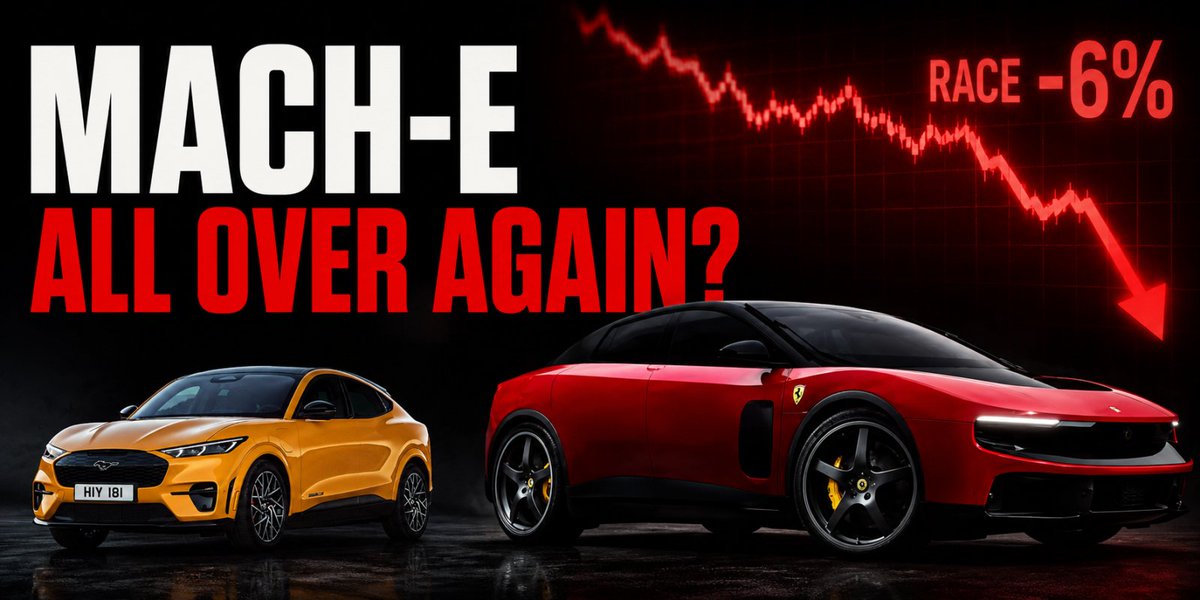
🚨Ferrari May Be Repeating Ford’s Biggest Branding Mistake With The Mach-E
The Mach-E backlash was never really about whether the car was good.
It was about identity.
People looked at it and said:
“That’s not a real Mustang.”
Now Ferrari is facing a very similar branding challenge.
Most people are not criticizing the Luce’s engineering.
The specs are incredible.
What they are questioning is whether it still FEELS like a Ferrari.
That distinction matters enormously in luxury branding.
Because iconic brands are not just selling products.
They are selling mythology, emotional recognition, identity, and cultural symbolism.
And once customers emotionally disconnect from those identity cues…
the technology almost stops mattering.
That is why comments like:
“It looks like a Kia” are so dangerous for Ferrari.
The risk is not building an EV.
The risk is accidentally creating a:
“That’s not a real Ferrari”
moment. 👀
Is that where we are?