The process is automated and highly tunable allowing for multiple structures to be generated, edited, read and erased at a fast pace.
Contact me if you want to try it out in your samples at [email protected]
I am excited to share with you our recent work published today in @NatureNano, where we developed a novel nanolithography method that enables the generation and in-situ readout of a myriad of nanometric topological ferroelectric structures.
https://t.co/ISbUdiC6oK
@ORNL
Evolution of Ferroelectric Properties in SmxBi1–xFeO3 via Automated Piezoresponse Force Microscopy across combinatorial spread libraries | ACS Nano https://t.co/fSRSLDlWIN
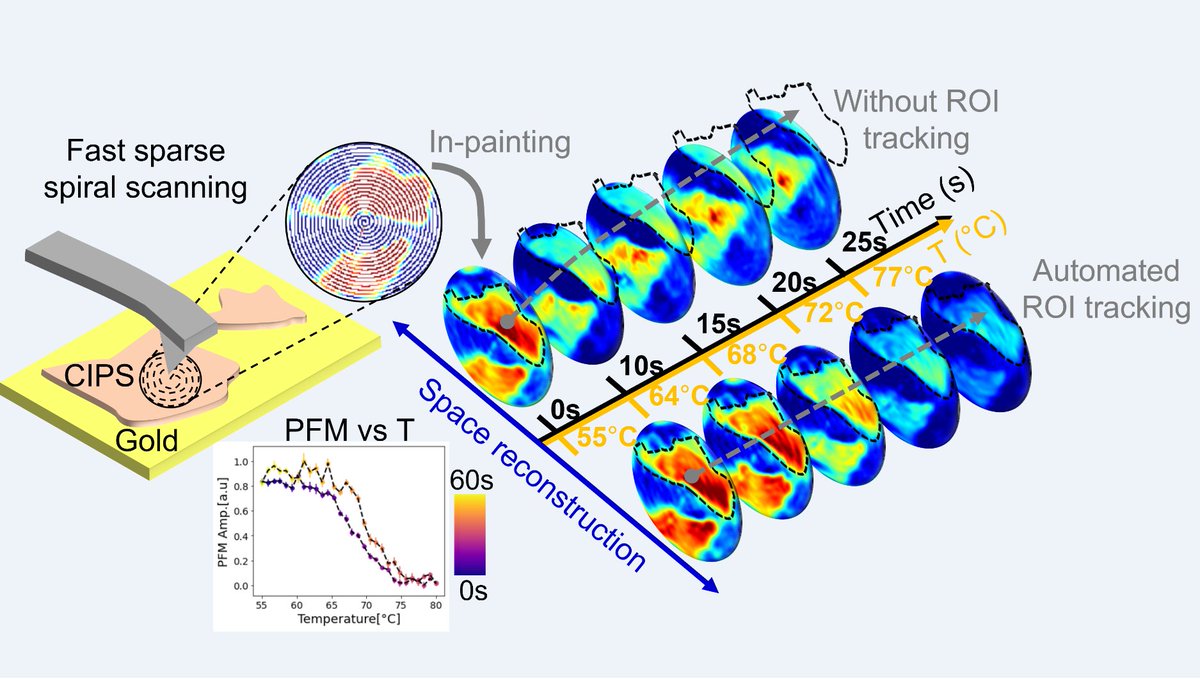
!! Check out the recently published article 'Automated piezoresponse force microscopy domain tracking during fast thermally stimulated phase transition in CuInP2S6' M Checa et al. https://t.co/cLTF7fAaCQ… published in #Nanotechnology@IOPPublishing@mcheca7@ORNL
Do you want to know how to track drifting ferroelectric domains at the nanoscale in an automated and fast manner?
At @ORNL, we have used fast sparse scanning in combination with compressed sensing image reconstruction to achieve it. Check it out!
https://t.co/4kPeHzb4Ka
Here you have our 2 last papers at @ORNL in collaboration with @PennStateMRI studying:
1. The influence of doping and thickness on domain wall avalanches in lead zirconate titanate:
https://t.co/hRtYwQH6yH
and...