@lilyraynyc Maybe they should just stop putting their thumb on the scale because every time they do recently the outcome is basically worse than the original problem.
Technically, just being on the census is enough to impact the direction of the government.
In many states, the census counts people, not citizens. This affects the apportionment of congressional seats, which has an impact on the electoral college.
This is a fact, and stating this is non-political. Please do not judge me or assume my beliefs. I’m just a guy with a poly sci degree.
This is a test to see how fast Google crawls this page.
https://t.co/TxEKKBCOFg
For substance below is some content from my Linkedin post today.
Next week I'll be starting my 4th "disappeared from Google" audit of the year on a Webflow site.
I was skeptical before but now I'm confident in saying this is a trend.
Webflow is not like WordPress where for a minimally viable setup you could install an SEO plugin and deselect the "discourage search engines from this site" option.
Neglecting technical SEO can result in extreme consequences and it's not forgiving.
Things like URL structure, site architecture, canonicalization, hreflangs, and sitemap customizations must be taken into account before launching a site.
And if you also need custom attributes added to the <head>, then that can be a problem.
You must remember that with Webflow you're working with client-side rendering and it provides limited support for adding client-side JS to your pages.
There is no ability to add server-side files or programming of any kind.
The only things you get without any configuration are a basic robots.txt, and a sitemap.xml (of which URLs are added automatically).
Everything else has to be intentionally configured...and properly.
You can set a global canonical tag but it's protocol-sensitive. If you set this without [ https:// ] it's totally moot
Without the canonicals end up looking like //contact, //about, //blog
You also have to be mindful that the staging domain is a reachable URL.
Remove the brackets and go do this search 👇
site:*.webflow[.]io
You see what I mean.
@allthewaywego22 This doesn't make sense, you're just saying things.
Nothing I mentioned has to do with catering content to an audience.
At most, I'm encouraging monitoring user behavior and providing a good UX. Surely it's prudent to ensure that your existing content is working?
From what we know so far, the August Update seems like an HCU refinement.
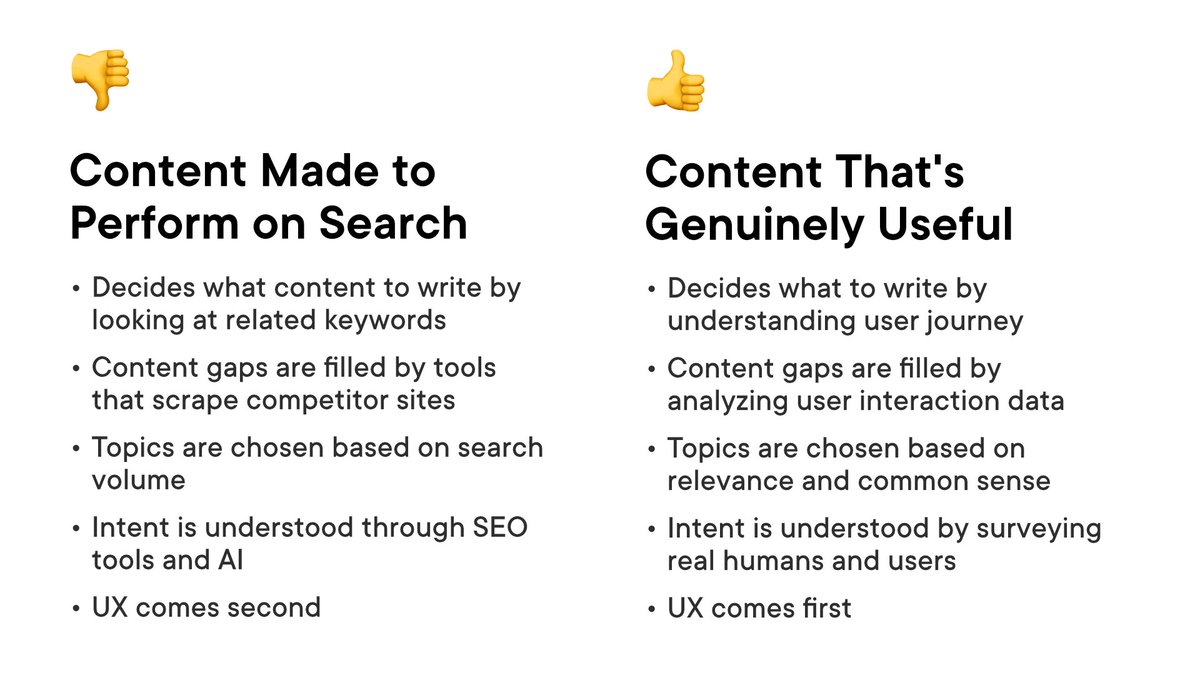
My key advice 👉 TALK TO PEOPLE
Insights from SEO tools < Insights from real users
Assessing usefulness and originality is an inherently human thing.
As you likely know Google updated their core update advice page.
There's one particular line I encourage SEOs to pay attention to:
"Consider how you can improve your content in meaningful ways. For example, it could be that rewriting or restructuring your content makes it easier for your audience to read and navigate the page."
👉 Rewriting OR *restructuring* - it's not just about the helpfulness of the content itself.
If your layout and structure are 🗑 people will be less likely to engage with your super helpful content.
Since the HCU I have significantly divested in SEO software and re-invested that budget into UX tools.
As far as SEO-specific tools go I'm running very lean.
@Contentsquare + @hotjar and @mixpanel are now a key part of my stack and the results have been great.
I'm getting far more ROI and use out of those two than I ever did with $400+/mo SEO software.
I'm also using @SurveyMonkey to conduct user surveys and @usertesting for testing designs and UX.
So that's my advice, you can take it or leave it.
And if you disagree feel free to leave a comment below about how I must not know how search works.
✌
#SEO