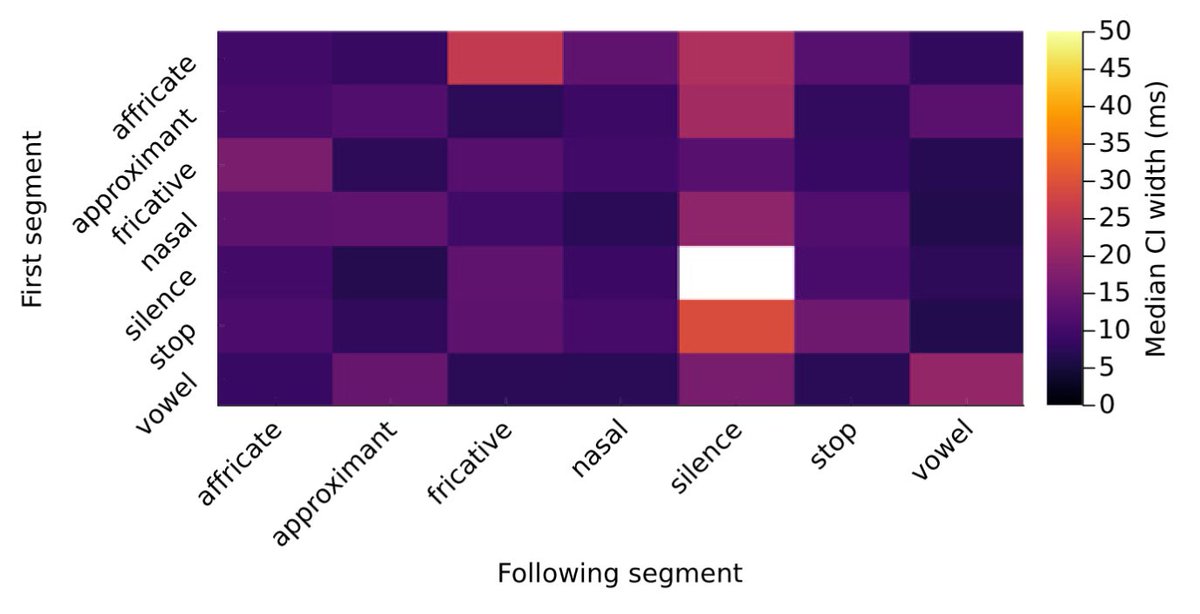
New paper on a gradient approach to speech segmentation! A new feature in the Mason-Alberta Phonetic Segmenter generates gradient intervals for boundary placement in forced alignment.
https://t.co/mNWmkqdxcp
New paper on a gradient approach to speech segmentation! A new feature in the Mason-Alberta Phonetic Segmenter generates gradient intervals for boundary placement in forced alignment.
https://t.co/mNWmkqdxcp
The widths of the boundary regions tend to match phonetic intuitions, where more ambiguous segmentations (e.g., vowel-vowel, approximant-vowel) are wider than less ambiguous segmentations (e.g., fricative-vowel, stop-vowel).
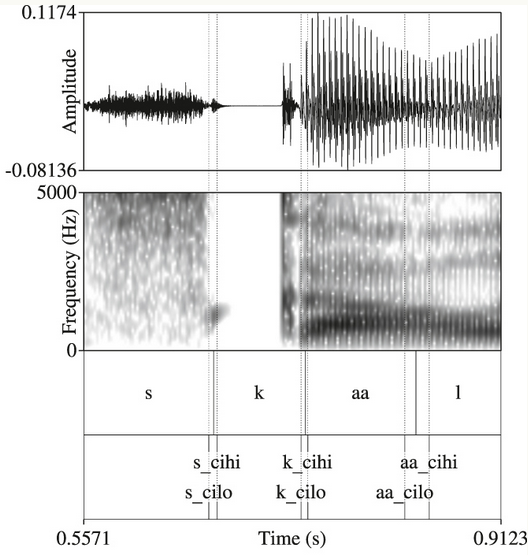
ALT: A TextGrid in Praat showing the segmentation overlaid on a spectrogram and a waveform for the first four sounds in "scholar". The boundary region between the low-back vowel and the lateral is wider than the one between the voiceless velar stop and the low-back vowel.
New annotation formats are JSONs that list each boundary for a file and its associated widths, and a large CSV with boundaries in each row. Praat TextGrids are also output with PointTiers for the boundaries to aid in visualization.
Lines 241-242 of VA's HB 1263 and SB 378 conference report create 2 tiers of grad students. Those paid to teach will not be allowed to bargain, while those paid to research will. This is unjust and needs to be corrected by allowing ALL higher ed workers to bargain!
Lines 241-242 of VA's HB 1263 and SB 378 conference report create 2 tiers of grad students. Those paid to teach will not be allowed to bargain, while those paid to research will. This is unjust and needs to be corrected by allowing ALL higher ed workers to bargain!
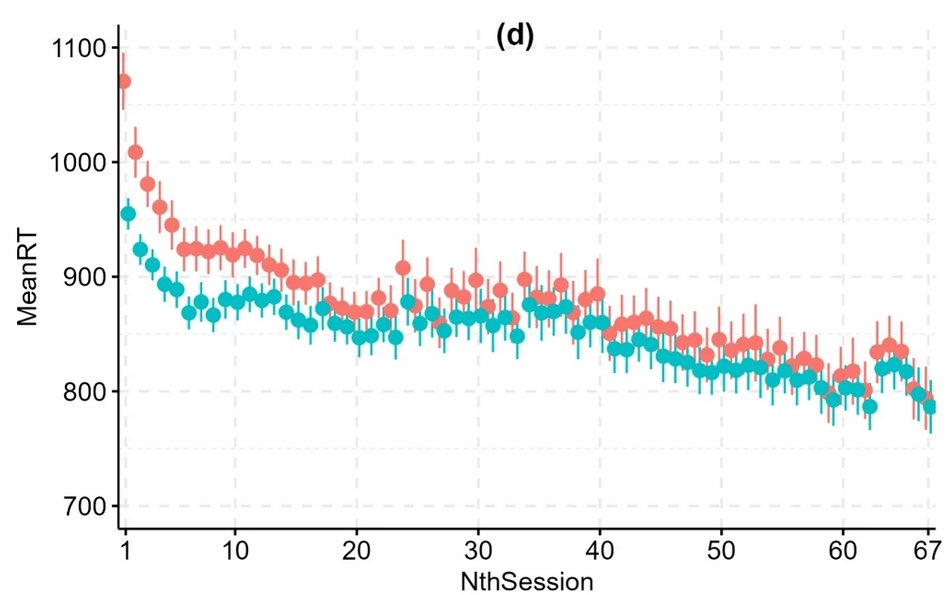
New OA paper, new data set: SingleMALD! We had 40 native speakers of Canadian English do lexical decision for over 26,000 English words and 9,000 pseudowords. Evidence for participants getting faster throughout extensive testing periods. https://t.co/UQAeMhaisO
This paper looked at closure duration and f0 perturbation as voicing distinction cues for intervocalic flaps in American English and found that listeners were more likely to make their choice based on the change in f0. https://t.co/Owf58i0G5u
@JanalynAMiklas@GMU_English
Is @SpringerNature not embarrassed to keep publishing collections with articles like this? This one will unquestionably need to be retracted for being nonsense and full of inappropriate citations... https://t.co/uJrZYjmEkz
A basic end-user system for aligning American English with MAPS is available on GitHub. We will be adding to this system as we continue to develop refinements, new language options, performance improvements, and new tools. https://t.co/USATtVUxbH
Finally, we explore how certain practices used in training these systems is in tension with how phoneticians view the speech signal. Overcoming this tension may require rethinking either what we segment or how we design the targets for our acoustic models.
Have you ever been interested in using the "earbuds method" to measure acoustic nasalance, but were perhaps unsure of how the accuracy compares to a traditional nasometer? Then check out my new #OpenAccess article out now in @ASA_JASA!
https://t.co/0llzUAyc5n