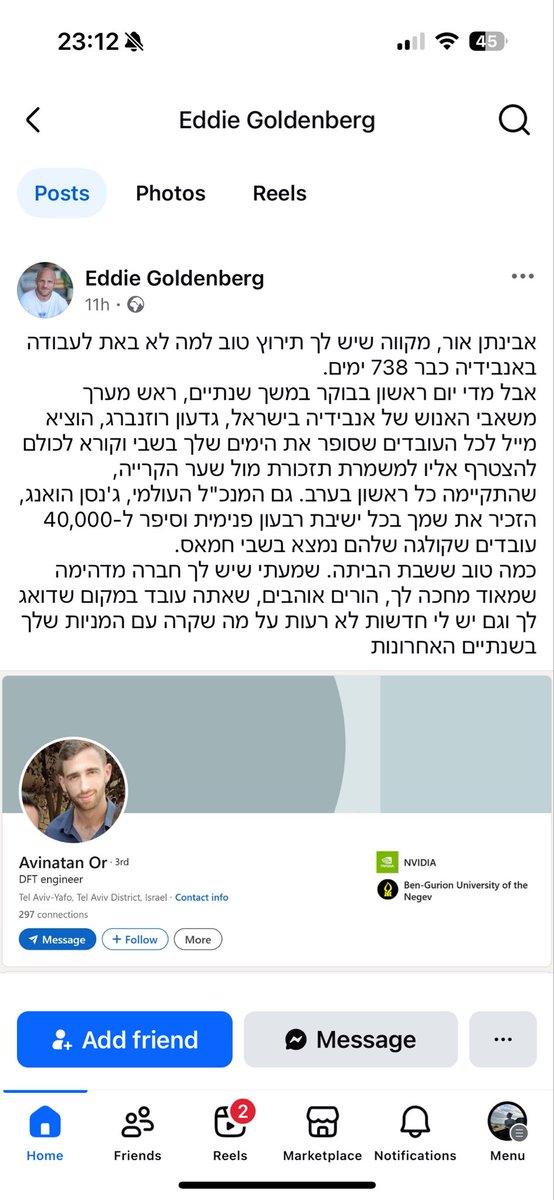
Absolute perfection. Avinatan Or’s boss at @nvidia writes to him, read till the end:
“Avinatan Or, I hope you have a good excuse for not showing up to work at NVIDIA for 738 days.
But every Sunday morning for two years, the head of NVIDIA Israel’s HR, Gideon Rosenberg, sent an email to all employees counting the days you were in captivity and calling everyone to join him for a reminder vigil in front of the Kirya gate, held every Sunday evening. Even the global CEO, Jensen Huang, mentioned your name in every quarterly internal meeting, telling 40,000 employees that their colleague was being held captive by Hamas. How wonderful that you’ve returned home. I heard you have an amazing girlfriend who’s eagerly waiting for you, loving parents, that you work at a place that cares for you, and I also have some pretty good news about what’s happened with your stocks over the past two years.”
"We will never forget."
Those words adorn the walls inside and outside the New York Stock Exchange today on September 11, twenty-four years after the World Trade Center attacks.
My friend @JayWoods3 — in 2001 a market maker on the trading floor — reminded me that September 17 marks another date worth remembering.
That was the morning the @NYSE reopened after the attacks.
US markets had been closed for four days, the longest halt since 1933.
The world was still in shock. Professional sports hadn’t resumed. Airports remained empty.
Late-night TV hosts like Letterman and Leno had gone dark, unsure of how to make people laugh again.
And yet, in the financial center of the world, lights flickered back on.
“We got the building open and went back to work that day,” Woods told me. “It was a sign of resilience — you can knock America down but we’ll still get back to work.”
He said the motto at the time, “let freedom ring,” took on a greater meaning when the opening bell rang on September 17th, 2001.
Woods remembers commuting by boat into lower Manhattan that day with his colleagues.
Armed guards greeted them at the dock, pressing American flags into their hands as they got off the boat.
Traders that morning walked through checkpoints into the exchange perimeter, past photographers, police and the smell of burning plastic and ash still rising from Ground Zero.
Once inside, Woods said he learned that two members of the exchange community had been killed in the attacks. In the absence of texts and social media, traders had scattered on 9/11 not knowing which colleagues had survived.
And yet, trading resumed.
Stocks fell more than 6% that day but no one seemed to mind the losses. The fact markets had opened at all told the world America was still standing.
In the days that followed, first-responders were invited to the exchange, meeting applause as they walked through the crowded trading floor.
As share prices declined, Woods said his clients called him not to ask why their stock was dropping but to check in to see if he was okay:
“Just going to work that day had a small part in bringing the country back after 9/11. To be on the floor that day was one of the most patriotic things I’ve been involved with in 33 years.”
@mikealfred@ericjackson You do not ignore a person who boosted your companies value tenfold, whether you like him or not.
Shows lack of consideration at the very least.