There should be no S3 for Hype imo
Jeff already gave an airdrop which today is worth 14 billion plus
The team continues to give to the long term believers via the AF, which uses 99% of the revenues to buy and burn hype. The gift is, that if you believe long enough, you get rewarded over time
Giving people another big airdrop worth billions, defeats the work the AF has done to date
The reward should be that you believe hyperliquid will continue to grow and scale, and that that is rewarded over time bc the revenue is distributed to its holders over time
1/ Today, @multicoin publishes our HYPE analysis and valuation
HYPE is now one of our largest liquid fund positions and we've been accumulating aggressively since February
Full report and disclosures in link. Link here -
https://t.co/tA2kwWbG9Q
Hyperliquid, a decentralized crypto platform, is open 24 hours a day, seven days a week. The exchange has emerged this year as a go-to spot for Wall Street’s weekend warriors. https://t.co/3dUhMXjVao
Hyperliquid, a decentralized crypto platform, is open 24 hours a day, seven days a week. The exchange has emerged this year as a go-to spot for Wall Street’s weekend warriors. https://t.co/3RFisC8oso
okay so the hyperliquid announcement is omega giga bullish and there are enough tldr's around for you to read the basics but here are my favourite parts:
- the core team clearly has high leverage even with the biggest players in the game as they secure a deal with extremely favourable terms
- one of the biggest friction points (bridging to HL) will soon be direct through circle's cross-chain protocol
- hard to describe how big of a win this is from a regulatory standpoint just before the clarity act is likely to pass. two of the most scrutinised and regulation-friendly teams just threw a massive amount of reputation and money at HL right before it goes through the senate. that timing isn't an accident
- this deal reaffirms the HL team remains extremely aligned with the growth of the token and redistributing the wealth created on chain back to users
- there are no 'leaks' in the HL team, in crypto it's very common to see tokens outperforming into unknown announcements, $HYPE has been bleeding coming into this announcement
- there is no other chain where increasing TVL feeds directly into token increase, $HYPE now does
this announcement really helps smooth over the bear cases and creates an even higher ceiling for the bull cases
hyperliquid will be the house of all finance and all others will be competing through builder codes
hyperliquid
Everyone is arguing about $USDH dying. They're missing the point entirely. What happened today is the single most important business move in Hyperliquid's history.
Let me explain. Revenue, liquidity, politics, lobby, and what it means for the USDH vote debate.
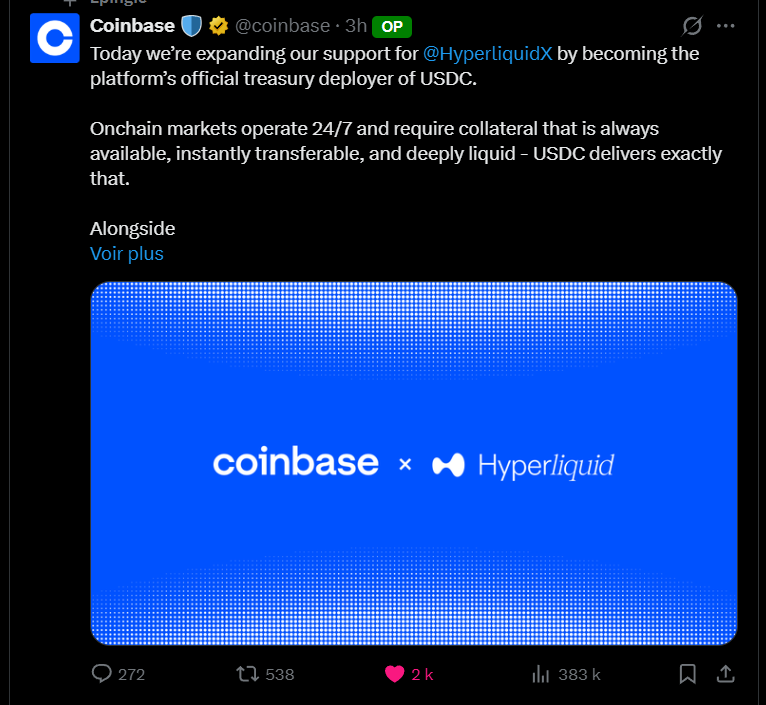
Coinbase is now the official treasury deployer of $USDC on Hyperliquid under AQAv2. Circle handles the technical side (CCTP, cross-chain infra). Both are staking hyperliquid:native. Native Markets agreed to sell the USDH brand assets to Coinbase.
$USDH is sunsetting. But the mechanics it pioneered are not. They just got applied to a $4.7B asset instead of a $100M one.
Let's break down why this is a win on every single front.
LIQUIDITY
The biggest complaint from traders and builders for months: fragmentation. $USDH had the alignment but not the liquidity. $USDC had the liquidity but not the alignment. You had to choose.
That choice is gone. One stablecoin. One orderbook per pair. No split liquidity. No confusion for HIP-3 deployers picking a quote asset. No friction for new users bridging in.
$4.7B in USDC on Hyperliquid, 2x year over year. That is the base generating yield now, not $100M.
REVENUE
Under AQAv2, the treasury deployer shares 90% of the reserve yield revenue with the protocol. Run the numbers on the current $USDC supply:
$4.7B at 3.8% interest rate, 90% shared with the Assistance Fund = $160M+ per year flowing directly into HYPE buybacks. That is $440K per day. Every day.
For context, USDH at peak supply was generating a fraction of this on $100M. The AQA model worked. It just needed to be applied at the right scale.
POLITICS AND LOBBYING
This is the angle most people are sleeping on. Coinbase is the largest publicly traded crypto company in the US. They spent over $100M on crypto lobbying and political action in the last cycle. They are the single most powerful voice for crypto regulation in Washington.
The CLARITY Act markup is happening today. Coinbase has been one of its strongest advocates. Having them financially aligned with Hyperliquid, staking HYPE, operating as treasury deployer, is not just a liquidity play. It is a regulatory shield.
Every conversation about "is Hyperliquid a US regulatory risk" just got a lot harder to make when Coinbase is literally staked into the network.
Circle staking 500K HYPE and moving toward becoming a validator. Jeremy Allaire posting "Hyperliquid." That is institutional endorsement at the highest level.
THE USDH QUESTION
"Was USDH a failure?" "Was the vote theater?" "Did Native Markets just flip an asset?"
No. USDH was a weapon. It was a credible threat that proved a protocol can demand yield sharing from stablecoin issuers. Before USDH, Hyperliquid had $5B+ in USDC generating $150-200M/year for Circle and Coinbase. The protocol saw none of it.
USDH launched. The AQA model proved that yield can be redirected onchain, transparently, back to the protocol. It only reached $100M in supply but that was never the point. The point was forcing incumbents to the table.
Basit said it best: the entire lifecycle of USDH from launch to sunset should be studied. Coinbase didn't come to Hyperliquid out of goodwill. They came because USDH proved they would lose the venue if they didn't align.
"But Paxos offered better economics during the vote." Maybe on paper. But 95-100% of a stablecoin that might have also struggled to reach $100M in supply is still less revenue than 90% of $4.7B. The vote was never about picking the best yield split on a small asset. It was about creating the leverage to capture yield on the dominant one.
WHAT THIS MEANS FOR BUILDERS
USDC becomes the canonical quote asset for HIP-4 outcome markets. No more guessing which stablecoin to build around. Hyper Foundation is issuing grants to HIP-3 and HIP-1 deployers who integrated USDH to cover migration costs. Feeless conversions from USDH to USDC during the transition.
For HIP-3 deployers running equity perps, commodity perps, outcome markets: one liquidity pool, one collateral asset, deeper books.
SECOND ORDER EFFECTS
Coinbase operating perps through Hyperliquid via builder codes? Not confirmed, but now structurally possible. Their existing perp product is weak. Hyperliquid's infrastructure is the best in crypto. The incentive alignment is there.
Tether now has a clear path to compete. AQAv2 is an open spec. Any stablecoin issuer can stake 500K HYPE and share yield to become an aligned quote asset. Competition is good.
AQAv2 becomes a blueprint for every other chain. Hyperliquid just proved that a protocol can force the largest stablecoin issuers in crypto to share revenue at the protocol level. No one has done this before.
Hyperliquid.
This is the story of Hyperliquid, the most profitable startup per employee on earth, told from a guarded office in Singapore.
Last year, its team of 11 generated $900 million in profit. It's 3 years old, has never taken a dollar of venture capital, and is beginning to change how century-old markets work.
Its founder, Jeffrey Yan (@chameleon_jeff), had never taken a physics class when he picked up a textbook at 16. Two years later, he won gold at the International Physics Olympiad. In 2019, he started trading with $10,000 from a living room in Puerto Rico—working off a television because he didn't own a monitor.
Within 3 years, he was running one of the largest anonymous crypto trading firms.
Then he shut it down. Yan was rich and free, but he had spent years inside crypto, watching it betray itself. Bitcoin's central premise was decentralization. Yet the biggest exchanges were centralized. Crypto kept reintroducing the dependence on trust it was built to eliminate. He set out to create what should have existed.
Hyperliquid is a blockchain with a trading exchange on top, and anyone can build on it. Yan's vision is to house all of finance. In 3 years, it has done over $4 trillion in volume. And in the past few months, it has begun to outgrow crypto.
Markets for oil, silver, and the S&P 500 now trade on Hyperliquid around the clock, weekends included, and are growing roughly 40% week on week. When the US and Israel bombed Iran on a Saturday in February, Hyperliquid was the venue traders turned to.
Hyperliquid's success has cost Yan his freedom. He works out of a secret office in Singapore and cannot travel without two bodyguards. Even the team's housekeeper doesn't know what they do.
In January, @domcooke spent a week at their office. Read his profile on Yan and @HyperliquidX below.