Head of Data and Digital Preservation at the BFI National Archive. Working on digital preservation, audiovisual archiving, using AI with care. Opinions my own.
Recent text-to-speech models small enough to run on a CPU:
phonon-31m-en - 31M
Paradee-8M - 7.9M
Leokani-tts - 7M (4.5M version too)
PiVo - 1.4M (vocoder included)
Paradee runs ~62x real time on a single CPU thread.
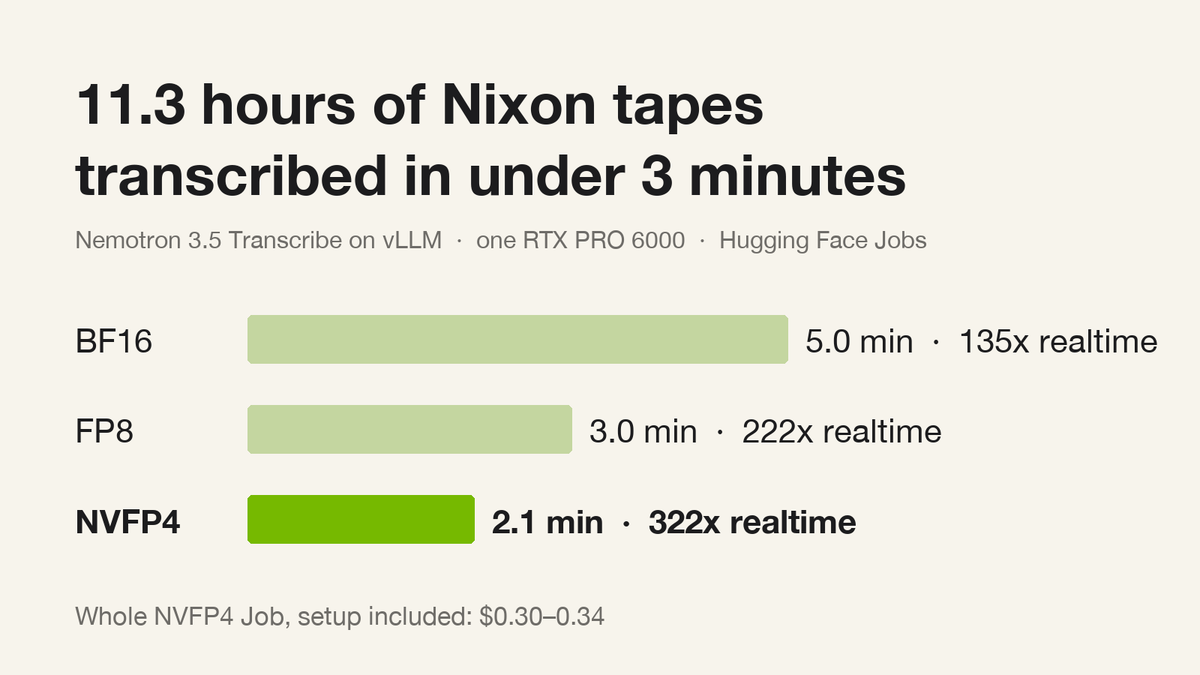
Nemotron 3.5 Transcribe from @NVIDIAAI is very fast with @vllm_project!
11.3 hours of 1971 Nixon tapes on one RTX PRO 6000 (NVFP4): under 3 minutes of transcription. Whole Job, setup included: about $0.30.
For batch jobs, I run vLLM inside the @huggingface Job and send many requests at once using my tool saturate, which tunes the concurrency as it goes. A 79.7-hour run took just under 10 minutes.
Recipe: https://t.co/Sbn8NJspei
OCR models often get stuck in loops, so I asked Claude Opus if it could stop one from looping by editing its weights.
It changed 0.0085% of them and with no training, it now reads this 1881 page instead of writing 16,399 characters of dots!
Prompt was basically: "read this, find a smallish OCR model and fix its repetition doom loops. You can spend up to 5 hours and $100 on @huggingface Jobs."
It only took under 3 hours in the end and about $10 of Jobs compute.
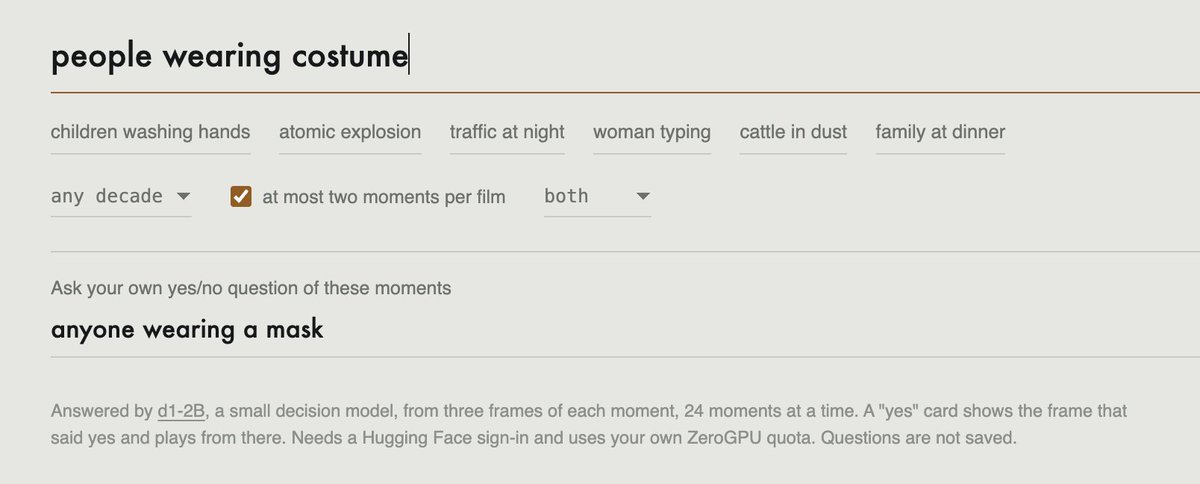
Can a decision model help discover moments in old films?
Search 1,864 public-domain Prelinger films by caption, then ask a yes/no question. @liquidai's d1-2B checks 3 frames per result clip and jumps to one it labels yes.
"anyone wearing a mask?"
https://t.co/k7CsFMMEjR
Tried this on a bunch of old newspapers.
- 1760s Fraktur, polytonic Greek, pre-reform Russian: all read well to my untrained eye; layout included
- Big broadsheets need full-res input: error rate 25% → under 10% (these are examples where many OCR models struggle.
From recognizing text to understanding documents. 📄
Meet Xiaomi-OCR-0, an open-source document understanding model with just 0.8B parameters.
It brings document parsing, key information extraction, and OCR-oriented visual question answering into one lightweight model.
It scores 95.24 on Real5-OmniDocBench and 83.2 on average across five OCR-oriented VQA benchmarks.
On OmniDocBench v1.6, Xiaomi-OCR-0 ranks first in document parsing performance among models with fewer than 1B parameters.
Model weights, inference code, an interactive demo, MCP service, and Agent Skill are now open source. 👇
🤗 Huggingface: https://t.co/Ef8QOGcOkG
🔗 GitHub: https://t.co/x35kkNldK7
📄 Demo: https://t.co/V6cVuZCRF1 #XiaomiAI #OCR #OpenSource
running NVIDIA Nemotron 3.5 Transcribe (30B-A4B) on a single RTX 3060. 12GB VRAM, 16GB RAM. (config below)
90 seconds of three people talking over each other, done in 27s. speaker labels and word timestamps in one pass. 1 hour context.
His Girl Friday (1940) is famous for the fastest overlapping dialogue ever filmed, so i threw it at it.
stock NeMo-Speech.cpp can’t offload experts to cpu yet, so i added a small patch: n_cpu_moe (like llama.cpp --n-cpu-moe) plus a higher output budget, because the default cuts dense crosstalk off halfway.
config:
nemo-speech serve
--asr-model NVIDIA-Nemotron-3.5-Transcribe-30B-A4B-AD-IQ4_NL.gguf
--asr.salm.n_cpu_moe 40
--asr.salm.max_sequences 1
--asr.salm.n_ctx_per_sequence 73728 --asr.salm.max_context 73728
--asr.salm.n_batch 1024 --asr.salm.encoder_max_batch 4
env: NEMO_SALM_LOAD_MODE=mmap NEMO_SALM_OUT_TPS=12
Added a script to run this on @huggingface Jobs with one command (@vllm_project + NVIDIA's NeMo plugin, inside the job).
It's very fast: 4.9 hours of 1940s radio transcribed in 2.5 min once the model is up. Whole job, setup included: $0.48.
Speaker tags + word timestamps, here on Hitchcock's 1940 Suspense audition:
[5:21] spk2: No, I'll go.
[5:39] spk1: Is it not true that you let lodgings?
https://t.co/Sbn8NJspei
NEW from me: Britain’s AI testing agency outguns US
Britain wants to pour another £120 million — roughly $160 million — into a government lab that tests the world’s most powerful AI models, an infusion of cash that alone is more than 10 times the annual budget of its US counterpart.
It contrasts sharply with the approach in the US, where federal efforts to evaluate AI are receiving far less cash and are shared by different parts of government.
https://t.co/DZbEgjnrza
Meet NVIDIA Nemotron 3.5 Transcribe 🎙️
An open-weight, promptable 30B MoE model with ~4B active parameters that brings transcription in 40 languages, speaker attribution, translation, contextual prompting and audio understanding into one checkpoint.
Watch it keep track of who said what when everyone’s talking at once.
1/ 🧵
Your OCR says it’s done—but did it get everything right? 🤔 In high-stakes workflows, even a small error can be costly.
🚀 Meet the MiniCPM-OCR suite: an open-source solution to parse fast and guard the results.
Two new models:
🔹 MiniCPM-OCR 1.0 — SOTA OCR performance and speed at 1B scale. Compact, accurate, and fast.
🔹 MiniCPM-OCR Jev — A 2B decision model that helps assess parsing accuracy, with performance approaching that of Qwen3.5-397B-A17B on JevOCRBench.
⚡ What’s new?
Small model, SOTA results: MiniCPM-OCR 1.0 scores 93.68 on Real5-OmniDocBench and 54.7 on OCRBench v2.
A sharp goalkeeper 🛡️: MiniCPM-OCR Jev is model-agnostic, checking text, formulas, and tables from different OCR parsers. It achieves 93.6 on JevOCRBench, outperforming JEV-35B-A3B (90.1) and approaching Qwen3.5-397B-A17B (93.8).
Up to 128 pages per minute 🤯: With DSpark, MiniCPM-OCR runs at 1.49× the speed of PaddleOCR-VL-1.6 and 3.62× that of MinerU2.5 Pro. The SDK’s concurrency optimizations further boost throughput to as much as 128 pages per minute.
Deploy where you work: Day-0 support for Arm, Houmo AI, Intel, and NVIDIA, plus 10 more chip vendors through FlagOS.
Ready for your stack: vLLM, SGLang, llama.cpp, and Ollama, with quantized models, fine-tuning support, and Agent Skills.
🔗 GitHub: https://t.co/2SlATAJk08
🤗 Hugging Face:
MiniCPM-OCR 1.0:https://t.co/i347di4Fju
MiniCPM-OCR Jev:https://t.co/ayVzhCJenh
👉 Try the Demo:https://t.co/QsFAJT3AFy
Use the API:https://t.co/dP01jBS2j2
OCR is not solved!
I asked an OCR model claiming SOTA on popular benchmarks to read one line from an 1881 contents page.
It wrote 16,421 characters. Mostly dots.
🚀Excited to announce Nanbeige4.3-33B!
To push the performance ceiling of small agents, our strategy in Nanbeige4.3 starts with building a powerful teacher first.
Nanbeige4.3-33B delivers SOTA agentic performance among open models at ~30B parameters:
* Strong results on agentic coding and cowork benchmarks.
* When integrated into mainstream agent harnesses, it tackles real-world tasks with cost-efficient inference.
* It will serve as a teacher for upcoming smaller Nanbeige models, starting with Nanbeige4.3-3B.
https://t.co/tSToQgZf2O
https://t.co/D228euvybz
#LLM #Agent
Seeing some bad takes on British Government AI funding: some notes.
1. The Government has announced a tranche of funding for a number of different AI-related organisations and initiatives. It comes to roughly £600m (excluding private sector input.) This has led to a series of partisan bad takes by people who don’t really follow this conversation. That is annoying because only I can have partisan bad takes.
2. Two common takes: “this is nothing, AI labs spend hundreds of millions every day/month etc! We can’t compete! Common British L” Or “Government is terrible at picking winners and investing, should be left to the private sector.” These takes reflect usually partisan pre-existing notions, neither actually understands what this money does or doesn’t do, and neither actually examines what the money is going towards either. Apples to oranges type stuff.
3. Let’s break down two of the more significant sets. The first is more funding for AISI (+£120m), and the second is for a new AI Biosecurity Lab (£100m, + around £200m from frontier companies).
4. AISI is the world’s best resourced institute doing this work and leading in its class. Don’t take my word for it - feel free to read MI5 Chief’s recent speech, or any number of expert statements from frontier companies. IT IS NOT a frontier AI company competitor. IT IS NOT designed to produce cutting edge LLMs or agents or consumer applications. It is, effectively, a research organisation staffed by clever people whose job is to analyse what frontier AI companies are working on and test their stuff. So if you’re measuring this announcement of investment and saying “it’s nothing compared to what AI firms spend”, you’re comparing totally different things. Instead, look how much spending Britain’s AISI gets relative to its international counterparts on getting access and insight into this frontier.
5. The UK’s AI Biosecurity Lab (AIBL) is even newer than AISI, and a world first. IT IS NOT a competitor to private sector biolabs. IT IS NOT an example of Government intervening and ‘picking a winner.’ Its job - modelled after AISI - is to “develop technical capabilities that help the UK better understand, prevent, detect and respond to biological threats.” It will do this by attracting best in class talent + working with frontier companies + working with the UK’s wider biosecurity landscape + other agencies.
6. Both of these organisations represent continuity in British Government thinking: ‘AI brings with it a whole bunch of positive things, but also risks. We should create organisations that attract top talent to help us analyse and understand this technology.’ You see this in MI5’s recently launched AI Threat Assessment Centre (AITAC) and the AI Economics Institute (AIEI) launched earlier this year. You can absolutely think this is the right or wrong approach btw but that’s the broad strategy.
7. So the comparisons to frontier companies’ spending is just misplaced. You’re working yourself into a tizzy over a misunderstanding of why the state is allocating resources. You shouldn’t compare these to frontier companies, but instead to other AISIs or other foreign govt AI investments I guess. Finally, if I asked many of those commenting what they would do differently, I would guess they wouldn’t really know.