“The Socceroos aren’t just a team. We’re a reflection of modern Australia.”
A desperately needed message for Australia, and Australians of all hues and backgrounds.
Bravo @Socceroos!!! 👏🏾 👏🏾👏🏾👏🏾
The Socceroos have a message for us all ❤️
We are all united for Australia at the FIFA World Cup 2026™ and we are CERTAIN, they are going to do us proud! Come on boys! 🇦🇺
🏆 #FIFAWorldCup | June 12 - July 20 | Every Match on SBS 📺
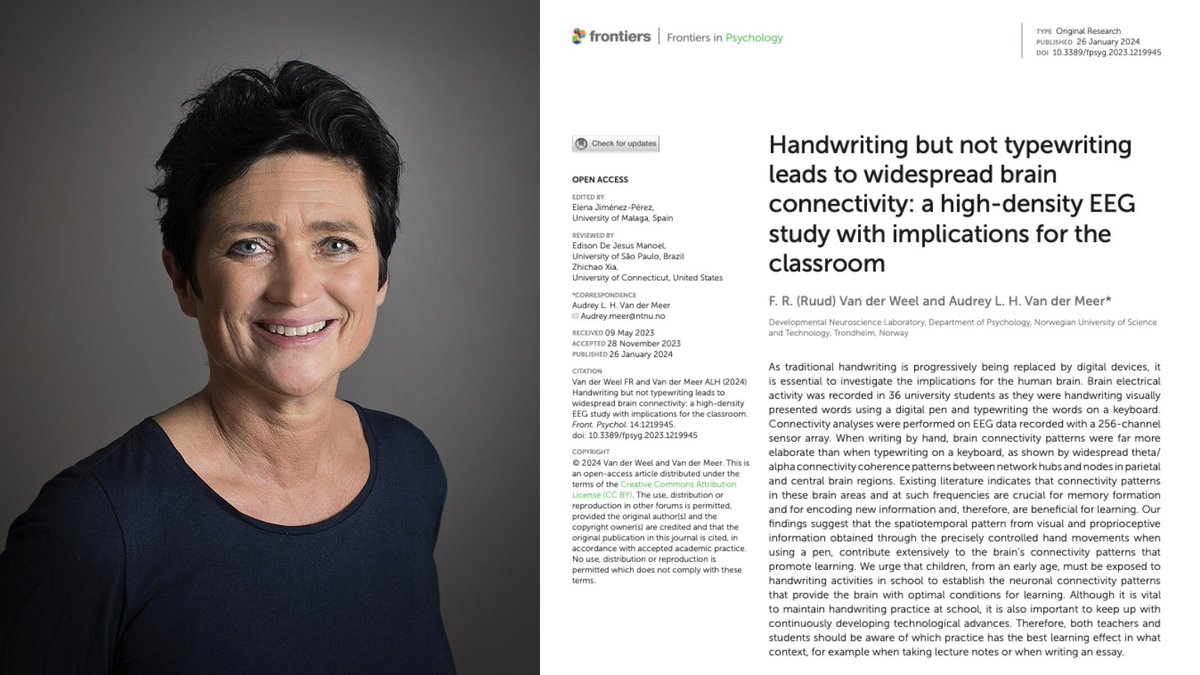
A Norwegian neuroscientist spent 20 years proving that the act of writing by hand changes the human brain in ways typing physically cannot, and almost nobody outside her field has read the paper.
Her name is Audrey van der Meer.
She runs a brain research lab in Trondheim, and the paper that closed the argument was published in 2024 in a journal called Frontiers in Psychology. The finding is brutal enough that it should have changed every classroom on Earth.
The experiment was simple. She recruited 36 university students and put each one in a cap with 256 sensors pressed against their scalp to record brain activity. Words flashed on a screen one at a time.
Sometimes the students wrote the word by hand on a touchscreen using a digital pen, and sometimes they typed the same word on a keyboard. Every neural response was recorded for the full five seconds the word stayed on screen.
Then her team looked at the part of the data most researchers had ignored for years, which is how different parts of the brain were communicating with each other during the task.
When the students wrote by hand, the brain lit up everywhere at once.
The regions responsible for memory, sensory integration, and the encoding of new information were all firing together in a coordinated pattern that spread across the entire cortex. The whole network was awake and connected.
When the same students typed the same word, that pattern collapsed almost completely.
Most of the brain went quiet, and the connections between regions that had been alive seconds earlier were nowhere to be found on the EEG.
Same word, same brain, same person, and two completely different neurological events.
The reason turned out to be something nobody had really paid attention to before her work. Writing by hand is not one motion but a sequence of thousands of tiny micro-movements coordinated with your eyes in real time, where each letter is a different shape that requires the brain to solve a slightly different spatial problem.
Your fingers, wrist, vision, and the parts of your brain that track position in space are all working together to produce one letter, then the next, then the next.
Typing throws all of that away. Every key on a keyboard requires the exact same finger motion regardless of which letter you are pressing, which means the brain has almost nothing to integrate and almost no problem to solve.
Van der Meer said it plainly in her interviews.
Pressing the same key with the same finger over and over does not stimulate the brain in any meaningful way, and she pointed out something that should scare every parent who handed their kid an iPad.
Children who learn to read and write on tablets often cannot tell letters like b and d apart, because they have never physically felt with their bodies what it takes to actually produce those letters on a page.
A decade before her, two researchers at Princeton ran the same fight using a completely different method and ended up at the same answer. Pam Mueller and Daniel Oppenheimer tested 327 students across three experiments, where half took notes on laptops with the internet disabled and half took notes by hand, before testing everyone on what they actually understood from the lectures they had watched.
The handwriting group won by a wide margin on every question that required real understanding rather than surface recall.
The reason was hiding in the transcripts of what the two groups had actually written down.
The laptop students typed almost word for word, capturing more total content but processing almost none of it as they went, while the handwriting students physically could not write fast enough to transcribe a lecture in real time, which forced them to listen carefully, decide what actually mattered, and put it in their own words on the page.
That single act of choosing what to keep was the learning itself, and the keyboard had quietly skipped the choosing and skipped the learning along with it.
Two studies. Two countries. Same answer.
Handwriting makes the brain work. Typing lets it coast.
Every note you have ever typed instead of written went into your brain through a thinner pipe. Every meeting, every book highlight, every idea you captured on your phone instead of on paper was processed at half depth.
You did not forget those things because your memory is bad. You forgot them because typing never woke the part of the brain that would have made them stick.
The fix is the thing your grandmother already knew.
Pick up a pen. Write the thing down. The slower road is the faster one.
@tanya_plibersek responds to @AngusTaylorMP comments on migrants coming to Australia. Pretty disappointed in Angus stoking division. This is does not make our country stronger, nor safer. In fact, it could be argued that the opposite occurs.
https://t.co/vHt461D91Z
@ColeKellen1@GupBGaming@AOC US citizens have killed US citizens by car. Again, so what? Cars are inanimate objects, like phones, they were just an example.
Gambling is linked with family violence and suicide. It has ruined people’s lives, destroyed families. That’s why people are calling for change.
@GupBGaming@AOC But don’t you want to reduce the crime rate? If you remove the people that are less likely to commit a crime, you’ll increase the crime rate.
It makes sense to focus on those more likely to commit crime, remembering that just because some people do it, it doesn’t mean all do it
@GupBGaming@AOC It’s not an either/or thing. Harm from #gambling is real, & what have illegal immigrants got to do with gambling anyway? Interacting with anyone is more risky than interacting with a phone, and no one has been raped by a car either - so what?
The Canberra Day Fun Run is on Monday March 9 and @HandsCanberra is running its Canberra Appeal.
Why not join me in supporting @HepatitisACT (supporting good liver health in the community) or one of the myriad of other charities involved?
https://t.co/3S3vlrvpPP
I’m sure there couldn’t possibly be any conflict of interest for a politician to be the Chair, or even just a member, of the Parliamentary Friends of Thoroughbred Racing group, when developing gov policy on gambling advertising, could there? 😉 https://t.co/oUZdLkBLi3
Join in the support for independent advocacy and action by signing the petition to save #SaveVicHealth
By being an independent body, @VicHealth can prioritise community health and wellbeing over other more self interested interests
https://t.co/zv9p8CB0XE via @ChangeAUS
I support independent, non-profit news written by experts. You can too by donating to The Conversation. Give today: https://t.co/vyrRDdMHac via @ConversationEDU
Multiple sources confirm the Albanese government has pushed lobbyists and industry groups to use encrypted messages and verbal briefings when proposing policy ideas, to avoid FOI and disclosure requirements. Read more: https://t.co/vbPcpcwcKy
Great article talking about how sensationalist media coverage and false balance of ideas contribute to normalisation of extreme views, contributing to social disharmony, which news outlets then condemn
@Deakin https://t.co/xG5NAEzYW7
Well done @TGAgovau in recognising and rejecting industry tactics to prevent action being taken to reduce #VitaminB6 toxicity
These tactics are also used by #alcohol#tobacco & #gambling industries to prevent delay & minimise good health policy https://t.co/zvU2y73HBe
Great to see @VicGovAu adopting a preventive approach to youth crime.
Yes, we need to hold people accountable for their behaviour, but prevention & early intervention can reduce crime from occurring in the first place, a much better outcome https://t.co/TLhXTQagcT