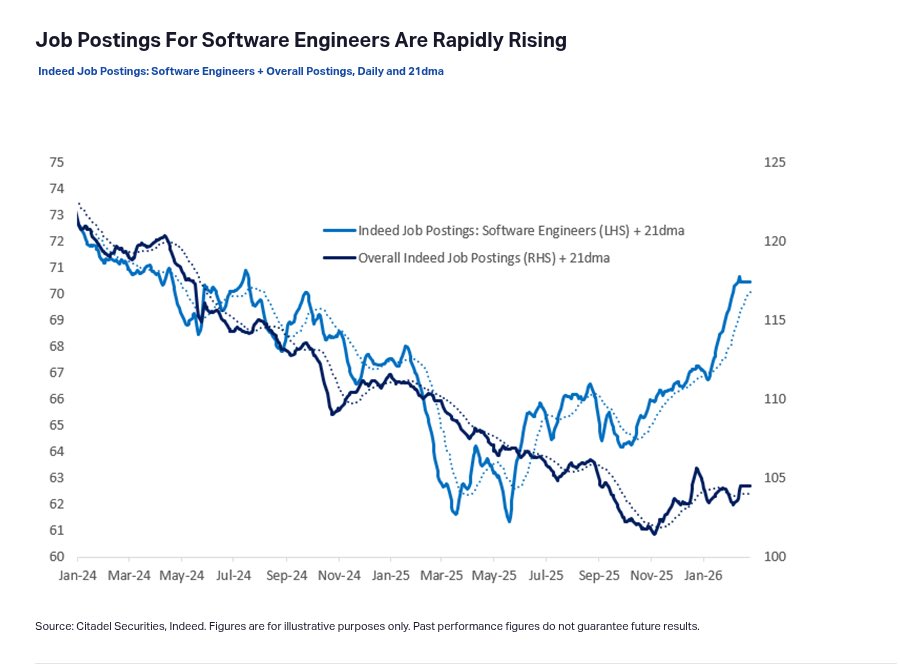
Q: How are job postings for software engineers rising rapidly despite AI agents automating coding?
A: Because there’s far more code to manage than ever before. We’re already seeing a 14x YoY increase in GitHub commits, and it’s accelerating.
AI has dramatically lowered the cost of writing code, so it’s now being used across far more businesses, applications, and use cases.
We’re at the beginning of a massive productivity boom driven by the proliferation of bespoke software throughout the entire economy.
Coding has been AI’s breakout use case this year. The fact that it’s increased demand for software engineers — rather than decreased it — should call into question the entire “AI will cause mass job loss” narrative.
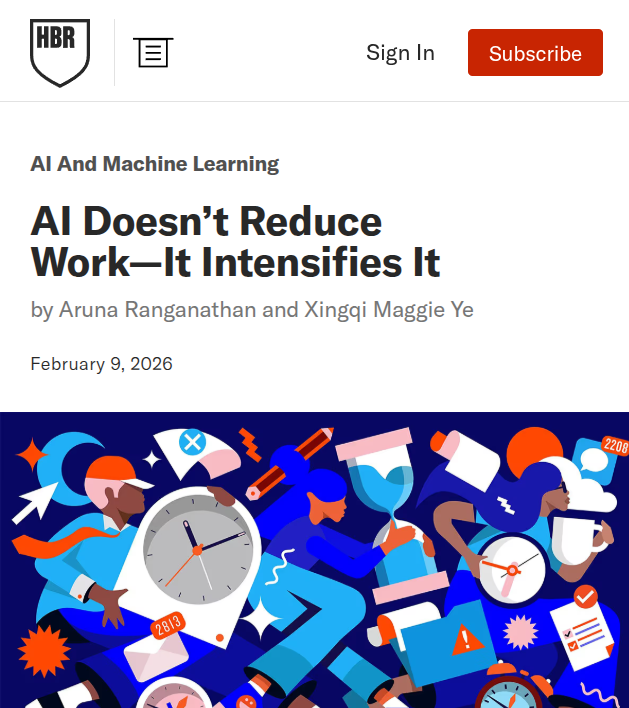
Powerful new Harvard Business Review study.
"AI does not reduce work. It intensifies it. "
A 8-month field study at a US tech company with about 200 employees found that AI use did not shrink work, it intensified it, and made employees busier.
Task expansion happened because AI filled in gaps in knowledge, so people started doing work that used to belong to other roles or would have been outsourced or deferred.
That shift created extra coordination and review work for specialists, including fixing AI-assisted drafts and coaching colleagues whose work was only partly correct or complete.
Boundaries blurred because starting became as easy as writing a prompt, so work slipped into lunch, meetings, and the minutes right before stepping away.
Multitasking rose because people ran multiple AI threads at once and kept checking outputs, which increased attention switching and mental load.
Over time, this faster rhythm raised expectations for speed through what became visible and normal, even without explicit pressure from managers.
Introducing Prism, a free workspace for scientists to write and collaborate on research, powered by GPT-5.2.
Available today to anyone with a ChatGPT personal account: https://t.co/9mTLAbxPdH
कोचिंग इंडस्ट्री में बड़ा इंटरवेंशन!!
Google अब परीक्षा की तैयारी करने वाले छात्रों के क्षेत्र में Gemini AI के माध्यम से प्रवेश कर रहा है।
इसकी शुरुआत Google अमेरिका के कॉलेजों में दाखिले के लिए होने वाली SAT परीक्षा से कर रहा है। Google ने इस परीक्षा के लिए फुल-लेंथ प्रैक्टिस टेस्ट लॉन्च किए हैं, जहाँ AI न सिर्फ स्कोर बताता है, बल्कि गलतियों की वजह समझाता है और पर्सनलाइज़्ड स्टडी प्लान भी देता है।
AI आसानी स��� छात्रों की learning ability और स्तर के हिसाब से खुद को एडॉप्ट कर सकता है, इसलिए कम से कम टेस्ट सीरीज और तैयारी के असेसमेंट के लिए तो यह एक गेम चेंजर साबित हो सकता है।
Google ने संकेत दिए हैं कि आने वाले समय में यह सुविधा दूसरी प्रतियोगी परीक्षाओं तक भी बढ़ाई जा सकती है।
Google owns every layer of the AI stack.
Most other top players are strong in 1 or 2 layers and then “rent” the rest.
When a company owns chips, the data center layer, the foundation model team, and the big consumer apps, it can tune all of it together.
That gives lower cost per unit of AI work, fewer external dependencies, and faster shipping because you are not waiting on a partner’s hardware roadmap, cloud pricing, or product priorities.
And that's why increasingly the AI advantage is starting to look less like “who has the best model” and more like “who controls the most of the supply chain that makes the model cheap, fast, and widely used.”
- OpenAI and Anthropic is strong at models and apps, but they still rely on someone else for cloud capacity and mostly someone else for chips, which can squeeze margins and limit freedom when capacity gets tight.
- Microsoft is strong in cloud and distribution, but its headline model layer is tightly tied to OpenAI and its custom silicon story is still “new.”
- Amazon Web Services are closest to catching up on infrastructure and silicon, and it is trying to build up the model and app layers, but it does not have Google-level default distribution like Search or Android.
The missing layer in your stack becomes the place other companies can “tax” you, slow you down, or gain leverage over you.
If Musk really pulls this off, it’s game over for every old idea of computing. One terawatt of AI power in orbit? That’s not scaling up that’s rewriting physics and economics in the same line. Starship becomes more than a rocket, it becomes a power plant for intelligence. Wild to think the next big data center might be floating above us.
@AskPerplexity Truly inspirational. We need better ways to achieve the compute required for growth in an eco-friendly manner.
Hope this starts a new industry, creates more jobs, and, on the side, makes humans interplanetary.
Just imagine the interest this would have driven in retail, with people trying the AI saree trend. Not to mention the wealth of data generated in content and shared prompts.
The interest generated with retailers on product marketing; the opportunities seem endless.
Google's Gemini app is the #1 app in the US App Store, driven by its Nano Banana model, which has been used to edit 500M+ images since its August 26 launch (@technacity / 9to5Google)
https://t.co/OY5P6ToZLx
https://t.co/HfAfbGFz35
📫 Subscribe: https://t.co/OyWeKSRpIM