BREAKING: CNN's fact-checker exposes an AVALANCHE OF LIES from Trump about Canada — and there's a new one almost every day.
Donald Trump doesn't just have policy disagreements with Canada. According to CNN's chief fact-checker Daniel Dale, who happens to be Canadian himself, Trump has built his entire trade war narrative on a foundation of demonstrably false claims — and the lies keep coming.
Just today, Dale documented, Trump falsely claimed Canada's unemployment rate is "10% and rapidly rising." The actual number: 6.4%, and it's been DECLINING for three straight months. Trump also falsely claimed Canada does "95% of its business with the US." The real figure is 72%.
He blamed the entire US-Canada trade deficit on high Canadian agricultural tariffs, despite the fact that roughly 97% of US agricultural exports to Canada are already tariff-free, and the actual deficit stems overwhelmingly from cheap Canadian crude oil imports that benefit American consumers.
And that's just today's batch. Dale's running tally over the past 18 months reads like a highlight reel of fabrication.
Trump has falsely claimed Canada doesn't buy American agricultural products, when it's actually the world's SECOND-LARGEST buyer of them. He's falsely claimed Canadians support becoming America's 51st state, when polling shows overwhelming opposition.
He's falsely claimed Canada is among the world's highest-tariff nations, when World Trade Organization rankings place it near the bottom. He's falsely claimed Canada "essentially doesn't have a military," ignoring that Canadian forces have fought alongside American troops in multiple wars and rank in the upper half of NATO by force size.
He's also falsely inflated the US trade deficit with Canada to "$200 billion" (nowhere close), falsely claimed Canada bans American banks (more than a dozen currently operate there), falsely claimed Canada is "constantly surrounded" by Chinese and Russian ships (fiction), and falsely accused former PM Trudeau of using trade tensions to run for reelection — despite Trudeau, quite obviously, not running.
This isn't policy disagreement. This is a dispute over the nature of reality!
This is a sitting president manufacturing an entire economic conflict with one of America's closest allies using numbers he simply invented, over and over, across nearly two years, with virtually no correction or accountability.
When the facts don't support your trade war, apparently the solution is just to make up new facts. Someone needs to tell Trump that the world doesn’t work like that, and it may as well be CNN’s Daniel Dale.
Please like and share if you’re sick of Trump’s lies!
Alberta's pro-independence groups claim reclaiming $15-27 billion annually means a golden era. However, a mere 5% increase in cross-border trade costs could shrink Alberta's economy by 4%, costing $20 billion yearly or $3,900 per person.
https://t.co/WC95CzxYK8
3:40 AM.
I turn to my phone on the nightstand and confirm the time. I already know I’m not going back to sleep.
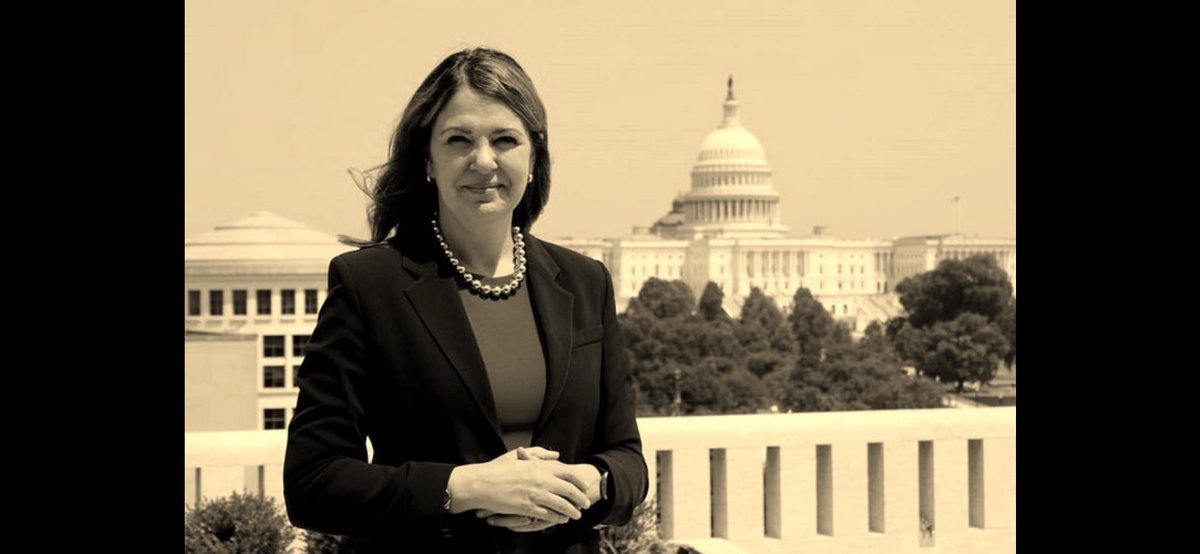
Not after another reckless act from a Premier who, by every measurable standard, appears completely off the rails.
So Danielle Smith can take comfort in one thing: she got through to us. Loud and clear.
Albertans understand now that something is deeply wrong.
Whether she is compromised by foreign interests, political extremists inside her own party, or simply by the pursuit of power itself almost no longer matters. The result is the same: a government willing to risk Alberta, risk Canada, and risk social stability to preserve political control.
And the hardest part is this: it feels abusive.
The endless pushing.
The endless escalation.
The endless chaos.
Albertans are exhausted.
We don’t need months of anxiety hanging over our heads because of some reckless October 19 referendum fantasy.
We do not need our province turned into a political powder keg while healthcare deteriorates, education suffers, corruption allegations pile up, and long-term economic planning is nowhere to be found.
This is not leadership.
Leadership lowers temperatures.
Leadership negotiates.
Leadership builds confidence.
Leadership protects institutions.
Instead, we see attacks on courts, attacks on vulnerable communities, attacks on public trust, and constant deflection from accountability.
And for what?
To distract from failures in governance?
To avoid scrutiny over corruption scandals?
To feed a movement built on grievance, anger, and permanent outrage?
I’m tired of short-term politics masquerading as vision.
I want a government thinking 25 and 50 years ahead.
I want honest stewardship of Alberta’s future.
I want competence, professionalism, and stability.
Most Albertans are not looking for revolution.
We are looking for adults in the room.
I’m a patriot. I will vote to stay.
And I believe millions of Canadians will stand with those of us who want no part of reckless separatist agendas or imported political extremism.
This province deserves better than permanent chaos.
It deserves leadership.
The UCP just used a 400,000-signature pro-Canada petition to justify calling a separation referendum. The people who signed to STAY are now being told their signatures mandated this process.
When I signed, the question was "Do you agree that Alberta should remain within Canada?" — not "do you want a referendum?"
Horner and Jones resigned rather than be part of it. Smith calls this 'respecting democratic participation.' I call it hijacking one side's democratic participation to deliver the other side's agenda.
This government is not acting in good faith. Full stop.
Dozens of Alberta academics (including myself) have written/signed an open letter calling for a public inquiry into the breach of the voter list. The letter can be viewed here https://t.co/pXjfwJgzBn
The only possible way that the separatist petition should even be considered by @ElectionsAB is if every single signature is personally verified with every single signee.
Full Stop.
If you agree please repost.
Apropos of nothing, Premier @MLA_Danielle now has every reason in the world to throw out the CI petition and put an end to the immediate possibility of secession referendum -- at least until faith in Elections Alberta is restored.
Let's see what happens next.
#ableg
I absolutely HATE swearing
But these 4 f*ckers are to blame for exposing you and your family’s personal information to actual predators
I DEMAND action, resignations, lawsuits and jail
An apology isn’t enough
Patrick Lennox, Former RCMP Intelligence Manager, on Alberta’s election data breach:
That data—the full names, addresses, and phone numbers of almost 3 million voting age Albertans—circulated for at least a month in the Maple MAGAsphere, but has almost certainly been captured by state based authoritarian adversaries including Russia, China, and the United States.
This poses a massive public safety risk and exposes the October 19th referendum process to profound levels of foreign interference from the global far right. Alberta is completely exposed. All of our elections data is in the far right wind.
https://t.co/JKJJks7gCu
Professor @duanebratt from Mount Royal University did a fantastic job of explaining the dangers of the UCP Government’s plan to redraw electoral maps in Alberta.
And no, he is not an NDP hack. He is an author with a PHD & focus in International Relations & Canadian Public Policy
A powerful piece from Rachel Notley:
“It has to stop here. If we allow politicians to rig elections, then we will be giving them carte blanche to do anything they want.
No politician should ever hold that power.
And anyone who wants it is unfit to govern …” #ableg
Breaking news in the Globe & Mail today - it appears Justice Minister Mickey Amery may have changed elections law to help with his close friend and relative Sam Mraiche.
It seems the UCP’s corruption doesn’t end.
Let’s make sure their time in government does. #ableg
WHY OUR HOSPITAL CRISIS IS REALLY A SENIORS CARE CRISIS
Richard, you raise a very important point and have sparked the policy geek in me.
There once was a balance between for-profit, non-profit, and public care for seniors, and that balance needs to be restored.
A few realities about long-term care, assisted living, and seniors care are worth considering.
Cost + profit = higher price.
1. For-profit providers must cover infrastructure, equipment, staffing, and profit, which raises the cost of care.
Many therefore focus on lower-needs residents, since higher-needs, lower-income seniors are harder to support in a profit model.
2. Staffing pressures can arise when operators reduce costs using fewer, lower-paid, or less-skilled staff while charging residents additional fees.
3. A phenomenon sometimes called “Eviction by 911.”
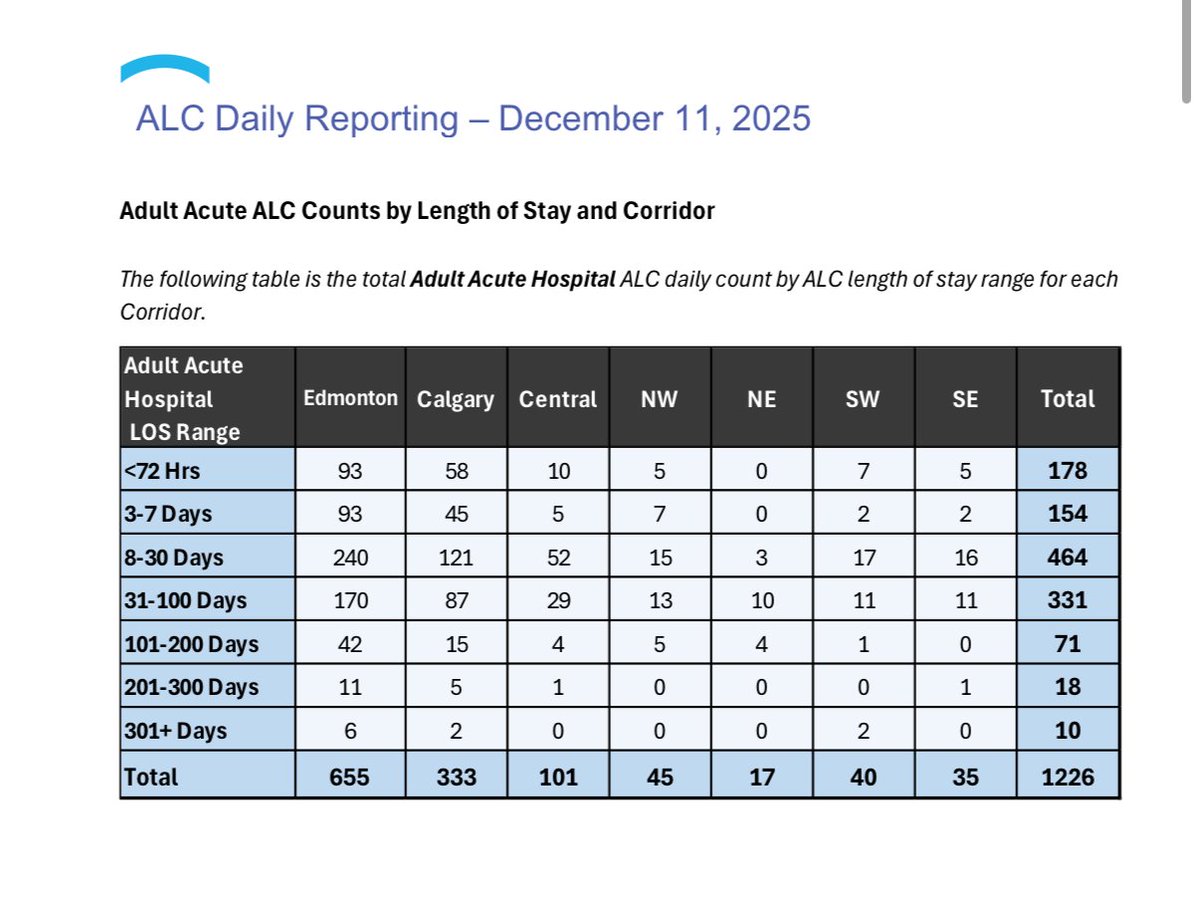
When residents’ needs increase, they are transferred to hospital by ambulance. In some cases the facility continues to hold the publicly funded bed while the patient becomes an Alternate Level of Care (ALC) patient occupying an acute care bed.
4. This contributes to hospital congestion and can mean taxpayers are effectively paying twice.
Government should audit every ALC patient in acute care to determine if this is occurring.
5. Policy balance matters. For-profit providers have a role for lower-needs, higher-income residents, but PUBLIC and NON-PROFIT care must remain the BACKBONE for seniors with higher medical needs.
6. Funding incentives are misaligned. Long-term care is funded per occupied bed, while hospitals absorb the cost of all admitted patients, including ALC patients.
7. When residents are transferred but their LTC bed remains funded, pressure shifts to acute care, contributing to surgery cancellations and the ER/EMS crisis we see today.
8. Premier @ABDanielleSmith and others often criticize AHS, but government sets these policies and AHS does not control hospital inflow or outflow.
9. Regulatory barriers also play a role. Many assisted living and LTC facilities cannot provide higher-acuity services such as IV antibiotics, oxygen therapy, or complex monitoring, even when these could safely be delivered outside hospital.
10. For example, a long-term care resident with osteomyelitis (bone infection) may require 4–6 weeks in hospital simply because the facility cannot administer IV antibiotics.
11. We should enable higher levels of care in assisted living, LTC and home care, including:
– 24/7 RN coverage
– Nurse practitioners on call
– Integration with family physicians and primary care network multi-disciplinary teams
– Mobile lab, x-ray and low acuity EMS support services
***This simple and inexpensive policy change can make a very big difference in the ER crisis we face today, reduce suffering AND save money***
12. Sending frail seniors to acute hospitals for relatively low-acuity problems makes little sense. Hospitals are the most expensive and often the least appropriate setting for these patients.
13. The old auxiliary hospital model addressed this gap better than our current system.
14. Intermediate and convalescent facilities (transition, subacute, rehab) once cared for patients needing more support than home but not full acute hospital care.
15. Seniors care now increasingly includes for-profit home care and private seniors housing. These services can play a role, but when profit incentives dominate system design, access and care levels can become uneven, especially for seniors with complex needs.
16. Many jurisdictions are moving toward a HOME FIRST MODEL, supporting seniors to remain safely at home with adequate home care and caregiver support before institutional care. Denmark does this well.
17. Properly funded home care is far less expensive than hospital or institutional care and often better for patients and families. When home care is inadequate, families are forced to rely on emergency departments and hospitals.
These low-cost initiatives improve system flow.
When seniors who no longer require hospital care remain in acute beds, admissions are blocked, emergency departments congest, and the ER/EMS crisis worsens.
My ICU doctor friends are discharging patients to their living rooms from the ICU as the step-down beds are occupied by ALC patients!
profit incentives → LTC transfers → ALC beds → ER crisis
FIX SENIORS CARE & HOME CARE , and you fix a large part of the hospital crisis.
Minister @JasonNixonAB , please address these issues (specifically #11 above) and Minister @MattJonesYYC can run our hospitals safely without resorting to the TLP disaster protocol.
@ABDanielleSmith@nenshi@AdrianaLaGrange@JMeddings@PfParks@NightShiftMD@TheBreakdownAB@cspotweet@ryanjespersen@UCPCaucus@Alberta_UCP@albertaNDP@Albertadoctors@BillKaufmannjrn
Below is data from August/25 on the left and Dec 11/25 on the right. Note ALC absolute numbers and days in hospital.
Dear Fellow Albertans,
This letter is written not as a partisan, but as an emergency physician who has cared for more than 100,000 Albertans, a former MLA, and someone who has devoted a working life to this province.
Across Alberta, the strain is obvious. Housing is scarce. Emergency rooms are overcrowded. Schools are stretched. The cost of living weighs heavily on families. Anxiety about the future is real and justified. This is not anger. It is concern, because moments like this demand leadership.
When people are under pressure, leadership is not just about solutions, but about direction: an honest explanation of what is actually going wrong, and reassurance about who we are as a society while we fix it.
In recent weeks, Alberta’s challenges have been framed by the Premier, Danielle Smith, in a way that has left many people angry, not at systems or long-standing policy failures, but at immigrants and other governments. That is deeply troubling.
The frustration people feel is understandable. But much of that anger is being misdirected at immigrants. With the exception of Indigenous peoples, all Albertans come from families that arrived here seeking opportunity.
Immigrants did not break Alberta’s healthcare system or tear up family doctor contracts. They did not close hospital beds or cancel planned hospital capacity. They did not under build housing, assisted living, long-term care, or schools. They did not dismantle community care. Politicians did.
Every day in emergency departments, the consequences are visible: acute-care beds occupied by patients who should be at home or in long-term care; ERs functioning as inpatient wards; and population growth encouraged without matching investments in primary care, continuing care, and hospital capacity.
In 1992, Alberta had approximately 11,700 hospital beds. Today, with nearly double the population and a much older demographic, we have roughly 8,800. This is not an Ottawa or immigration problem. It is a planning and capacity problem.
Many of the people caring for seniors, staffing hospitals, and holding the healthcare system together today are newcomers themselves. Blaming them delays real solutions and divides communities.
That lesson is personal. Growing up as a newcomer involved violence, black eyes and broken bones, and learning early what happens when fear is tolerated and adults look away. Home was not always safe either, shaped by alcoholism and domestic violence. Those experiences leave marks.
What mattered most was a mother who taught that anger shrinks a life, while forgiveness, discipline, and service strengthen it, and that opportunity carries an obligation to give back. That belief led to decades in emergency medicine, the training of thousands of doctors, and public service at personal cost.
Those experiences lead to a clear conclusion. Albertans deserve leadership that lowers the temperature, not raises it. Leadership that fixes systems, not finds scapegoats. Leadership that takes responsibility for planning failures and invests in capacity to match growth.
For these reasons, Alberta needs a change in direction and ultimately, a change in leadership, so the province can unite around practical fixes rather than division.
This is not about racism. It is about judgment, competence, and the ability to govern responsibly during difficult times. Alberta needs leadership that brings people together and focuses on solutions, not blame.
Premiers Lougheed, Klein and Stelmach have led through very difficult times and would not take our province to this sharp edge.
Albertans are much better than this.
I am a Canadian, an Albertan and I am an immigrant.
God bless Alberta.
Dr. Raj Sherman
@ABDanielleSmith@nenshi@FreeAlbertaRob@PfParks@NightShiftMD@Alberta_UCP@UCPCaucus@albertaNDP@TheBreakdownAB@ryanjespersen@cspotweet
#yeg #yyc #ABleg #cdnpoli
@albertaseparate Separation talk is hurting our economy. Don’t believe the separatists leadership lies promising unrealistic tax breaks and prosperity. They have never run anything as complex as a province or country and don’t know what they are talking about!
Dear Albertan Separatists,
Leaving Canada means losing immediately:
• Constitutional access to Canada’s internal market
• All trade deals (USMCA, EU, Asia: treaties don’t carry over)
• Bank of Canada backstop → higher interest rates
• Federal health, infrastructure, disaster & EI stabilization funding. (No maternity leave benefits, EI, sick benefits, ect)
• Charter mobility rights → You don’t have the right to move around Canada freely: borders, visas, work permits
• Defence, intelligence, protection (billions to replace)
• Legal & regulatory certainty markets require.
• Automatic continuity of Indigenous treaties (nation-to-nation with the Crown, UN ect)
Who benefits from selling this fantasy?
Outrage politicians. Media grifters. Click farmers. Foreign disinfo networks.
Independence doesn’t remove risk.
It concentrates it.
Now answer this. Trade deals take years to finalize. Does Danielle Smith have one, even one trade agreement lined up?
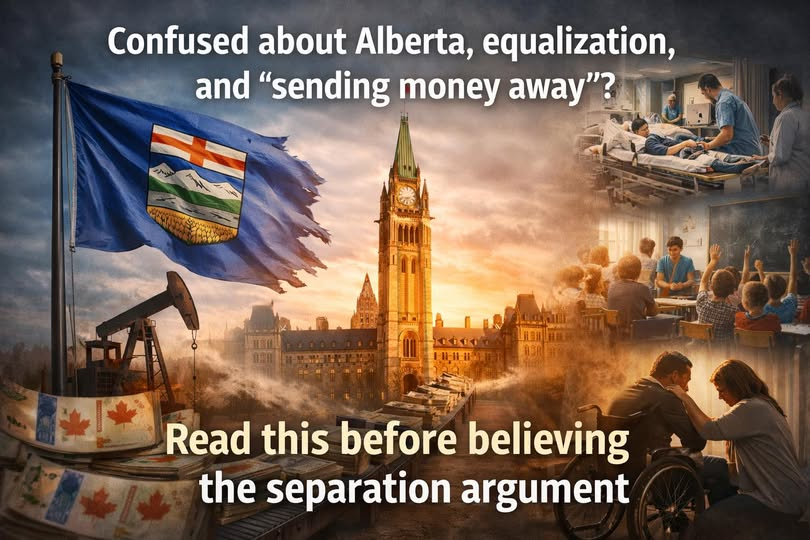
Very good post from Sharon Hayes...Worth your time.
Most Alberta separation arguments fail before they even get to equalization.
They start with the assumption that Alberta “sends money away” and would magically fix its problems if that stopped. That assumption misunderstands how federal taxes, equalization, and risk-sharing actually work.
From there, the entire argument collapses.
The pitch is simple and emotionally effective:
“Alberta pays billions in equalization and gets nothing back. We’d be better off on our own.”
That story only works if you isolate one program, blur how it actually functions, and quietly imply things that are not true.
Yes, Alberta pays more to the federal government than it gets back in equalization.
That part is true.
What’s misleading is treating that fact as evidence of extraction.
Here’s what equalization actually is.
Equalization is a federal program, paid out of general federal revenues. It is not a direct transfer from Alberta to Quebec. Alberta does not write an equalization cheque. There is no line item where “Alberta’s money” is sent east.
The federal government collects revenues nationally through:
- Personal income taxes
- Corporate taxes
- GST and excise taxes
- Other federal revenues
Those revenues go into a single federal pool. Equalization payments are then calculated based on fiscal capacity, meaning a province’s ability to raise revenue at average tax rates.
If a province has lower capacity, the federal government tops it up so it can provide reasonably comparable public services. If a province has higher capacity, it does not qualify.
That’s it.
Equalization is not:
- A refund program
- A reward or punishment
- A moral judgment
- A transfer from Alberta taxpayers to Quebec taxpayers
Alberta doesn’t qualify because its fiscal capacity is higher. British Columbia and Saskatchewan also receive zero. That distinction matters, and it is almost always missing from separation rhetoric.
Another implication that often sneaks into this conversation is that individual Albertans are personally paying higher federal taxes than people elsewhere.
That is also false.
Federal income taxes are set nationally. An Albertan and an Ontarian earning the same income pay the same federal income tax. Same brackets. Same rates. Same rules. There is no “Alberta surcharge” in the federal tax code.
When Alberta sends more to Ottawa, it is not because Albertans are taxed more harshly. It is because:
- Average incomes are higher
- Corporate profits are larger in boom years
- Employment rates are higher
- More people are working and earning taxable income
That’s arithmetic, not discrimination.
Demographics matter here too.
Alberta has a younger population than many provinces. Younger populations mean:
- More people in prime working years
- Fewer retirees drawing federal benefits
- Higher employment-to-population ratios
- More income tax collected relative to benefits paid
That demographic advantage boosts federal revenues flowing out of Alberta in good years. It also means Alberta draws less from age-related federal programs compared to older provinces. That is not a policy choice made in Ottawa. It is a population-structure reality.
More importantly, equalization is one program, not the totality of Alberta’s relationship with Canada.
Here’s the part the propaganda skips:
Alberta receives billions every year in federal transfers that have nothing to do with equalization.
Core transfers alone matter:
- The Canada Health Transfer
- The Canada Social Transfer
Together, these now total roughly $8–9 billion per year flowing to Alberta, rising over time. These funds support healthcare, post-secondary education, childcare, and social services. They do not disappear just because Alberta does not receive equalization.
Then there is stabilization:
Alberta is a high-income, high-volatility province tied to global oil prices. In boom years, Alberta sends more to Ottawa. In bust years, the federal government acts as a shock absorber.
That is not redistribution.
That is insurance.
We have seen this repeatedly.
In 2014–2016, oil prices collapsed from over $100 USD to under $30. Alberta lost more than 100,000 jobs. Provincial revenues cratered. Federal EI payments surged. Household incomes were stabilized by federal programs while Alberta absorbed the shock.
In 2020, oil prices briefly crashed at the same time COVID shut down large parts of the economy. Alberta still received $6.6B in core federal transfers that year, rising to $8.2B by 2024–25, with $9.2B projected. That is before counting pandemic programs.
Canada also has a Fiscal Stabilization Program specifically designed for sharp provincial revenue collapses. Alberta received hundreds of millions through this mechanism when oil revenues imploded. Alberta’s volatility is not ignored by the federation. It is explicitly planned for.
Now let’s talk COVID support, because this is where the “we get nothing back” claim really breaks.
Alberta received less CERB per capita than many provinces, although not dramatically so. Not because Ottawa singled it out, but because Alberta has higher wages and more EI-eligible workers. CERB flowed mainly to low-wage, service, tourism, gig, and seasonal work. Alberta has less of that.
Meanwhile, the real money was flowing elsewhere.
Through the Canada Emergency Wage Subsidy, Alberta businesses received roughly $14–15B, scaled to payroll size and wage levels. Add CEBA loans, liquidity programs, and sector supports, and Finance Canada estimates Alberta saw a net increase of roughly $10.9B in federal inflows in 2020 compared to 2019.
That matters when people cite figures like “$244B sent to Ottawa.”
Those numbers measure net contribution in good years, not what Alberta avoided losing in bad ones. Net contributor status is not proof of extraction. It is the arithmetic result of higher incomes during booms, paired with federal insurance during busts.
Now add the piece that separation rhetoric almost never confronts:
If Alberta were truly being starved of its own money, its provincial systems would reflect that. They don’t. They reflect provincial policy choices, even while federal money continues to flow.
Alberta’s health system has experienced repeated emergency department disruptions and closures, even as it receives billions annually through the Canada Health Transfer. The province is currently restructuring its entire healthcare system because the existing model is not functioning as intended.
Alberta’s education system has faced rapid enrollment growth, larger class sizes, and rising classroom complexity, culminating in a historic province-wide teachers’ strike. This is happening while federal social transfers continue to flow and while Alberta remains one of the wealthiest provinces in the country.
And Alberta is actively restructuring disability supports, reducing benefit levels under a new program while instructing recipients to apply for the federal Canada Disability Benefit, then clawing that federal money back. That is not Ottawa starving Alberta. That is Alberta choosing how to allocate support.
The claim that Alberta would thrive if it simply “stopped sending money away” collapses when you look at outcomes. Equalization is not draining Alberta’s budget. Federal money is already flowing in. The state of healthcare, education, and disability services reflects provincial governance decisions, not federal confiscation.
Now add the piece that is almost always left out entirely: oil industry support and cleanup costs.
In 2020, the federal government committed $1.7 billion to clean up orphan and inactive oil and gas wells in Western Canada, with Alberta receiving the largest share, including:
- Over $1 billion to the Alberta government
- A $200 million loan to the Orphan Well Association
This is direct federal spending inside Alberta to deal with oil industry liabilities.
On top of that, the federal government provides ongoing oil and gas subsidies, tax preferences, public financing, carbon capture incentives, and transition funding. A disproportionate share of this support flows to oil-producing provinces, primarily Alberta.
These are not symbolic amounts. They are material assumptions of environmental and financial risk by the federal government.
Now we have to talk honestly about Alberta’s dependence on oil prices, because this is where the independence fantasy quietly breaks.
“Oil is profitable” is not the same thing as “Alberta is fiscally stable.”
Alberta produces several types of oil, each with different economics.
For conventional light and medium oil, operating break-even costs are roughly $35–$50 USD per barrel. These wells can remain viable at relatively low prices, but they represent a shrinking share of production and no longer drive provincial revenues the way oil sands do.
For oil sands mining projects, operating costs once built can fall into the $30–$40 USD range. But when you include capital costs, financing, and long-term investment recovery, full-cycle break-even prices rise to roughly $60–$80 USD per barrel.
For in-situ oil sands (SAGD), operating break-even typically sits around $35–$45 USD, while full-cycle economics usually require $50–$65 USD oil.
Oil sands projects can keep pumping at lower prices once built, but new investment, expansion, royalties, and public revenues depend on much higher sustained prices.
For Alberta as a province, fiscal stability historically requires oil prices in the range of $75–$85 USD per barrel. Below that, royalty revenues fall sharply even if companies remain profitable. At $50–$60 USD, Alberta’s public finances deteriorate quickly. At $40–$50 USD, deficits become structural.
In other words:
- Oil companies can survive at $40
- Alberta’s public finances cannot
And volatility is the real problem.
Oil prices are shaped by OPEC decisions, wars, global demand cycles, financial speculation, and technological shifts. Alberta does not control these forces.
This leads to one unavoidable conclusion that rarely gets stated plainly:
Alberta is a price taker, not a price maker.
Alberta does not set global oil prices. It reacts to them.
Prices are influenced by:
- OPEC and OPEC+ production decisions
- U.S. shale output and U.S. domestic political priorities
- Global demand from China, India, and Europe
- Wars, sanctions, and shipping disruptions
Even the United States, the world’s largest producer, cannot fully control prices. Alberta, as a single producer within a global market, has even less influence.
That means Alberta’s fiscal health is structurally tied to decisions made outside the province, often for reasons that have nothing to do with Alberta’s needs.
Independence does not change that reality. It intensifies it.
Without federal risk-sharing:
- Volatility becomes fiscal crisis
- Downturns become deeper and longer
- Public services become harder to sustain
Oil doesn’t just fund Alberta.
Oil destabilizes Alberta.
Being part of a federation cushions that instability.
Independence would magnify it.
Much of the anger wrapped around equalization isn’t really about equalization at all. It’s about control over resources, regulatory friction, pipelines, and a feeling that decisions affecting Alberta are made elsewhere. Those are legitimate political debates.
But laundering those grievances through a misleading story about equalization distorts the problem and leads to bad conclusions.
Now ask the question separation advocates avoid.
What does an independent Alberta look like in the next oil crash?
No federal EI backstop.
No wage subsidies.
No national borrowing power.
No stabilization program.
No shared cleanup funding.
No national balance sheet absorbing risk.
An independent Alberta wouldn’t just “keep more money.” It would have to build its own EI system, its own stabilization fund large enough to absorb oil crashes, its own borrowing credibility, and fully assume oil cleanup liabilities alone.
Comparisons to Norway ignore the fact that Norway built its sovereign wealth fund before separating risk, runs massive trade surpluses, and taxes oil aggressively at the national level. Alberta has not done that at scale.
That doesn’t mean Alberta couldn’t survive.
It means the recessions would be deeper, the swings harsher, and the fiscal promises harder to keep.
You can argue for reform. You can argue for more autonomy.
But if the case for separation collapses once you explain equalization, federal transfers, stabilization, demographics, oil-sector risk sharing, oil-price dependence, price-taking reality, and the actual state of Alberta’s public systems, then equalization was never the real issue.
Sharon Hayes
Footnote: None of this even touches the legal and political reality that separation would require renegotiating Indigenous treaties, navigating constitutional law, and securing broad democratic legitimacy.
Alberta ERs are described as "death zones" in a shocking report leaked to #RealTalkRJ.
Dr. @PfParks calls out the province following six deaths and 30+ "near-misses" over two weeks.
👀 FULL: https://t.co/F5CfksdKYv
🎧 FULL: https://t.co/hRBwF5uzke #abhealth#abpoli#ableg#yeg