Greg Bock (@bockus) of Fidesium at our lightning talk last week: “Non-production is production.”
If your test environment is public, attackers can reach it too. A weakness they find there can be held back and used after launch, once real funds are in.
Thanks again to Greg for joining us!
Security usually gets a look the week before launch. That's when fixes cost the most.
Greg Bock (@bockus, @Fidesiumapp) on what it looks like during development. 15 min talk, 15 min live Q&A.
Wed Nov 4, 4:00 PM GMT. Hosted by @truscova.
https://t.co/lVJDnI35Nt
SemiIPHub reporting about our paper on "Automated Multi-Line Bug Repair Using Model Checker Aided LLMs: A Case Study on RISC-V Processors" https://t.co/lZT3KRRSrF @agra_uni_bremen@mdothassan@risc_v#riscv
After several years of research, we now succeeded to fully formally verify a multiplier within polynomial bounds; the paper on "Polynomial Formal Verification of Structurally Simple Multipliers" presented at #FDL2026 is now available #online https://t.co/p3GYjP33yw #PolyVer
One case from ack3’s H1 2026 report. Taiko’s bridge exploit traced back to an enclave signing key committed to a public repository, plus a check that failed to reject debug-mode enclaves.
The audited scope was four Solidity files: Bridge.sol, SignalService.sol, ERC20Vault.sol, SgxVerifier.sol. The repository with the key was not one of them.
https://t.co/nd4PJU244M
Plenty learned. Fresh insights gained. New questions to explore.
Our EFRE-funded Semantic Bug Hunter project ended on 30 September 2026. Thank you to the EU, Bremen and BAB for supporting this journey.
https://t.co/cOSLK78FJC
@Rolf_Drechsler@mnjalil#SmartContractSecurity #DeFi #BugHunter
#Blockchain #Security
An 18-month-old audit and a fresh one carry the same badge on a website.
The badge does not expire. The assumptions behind it do, quietly, as dependencies update, roles change, and new code ships next to the reviewed code.
Worth asking for any audit badge: what has changed since the review?
Three different incidents, three different attack surfaces (a repository, a front-end vendor, a credential chain), one shared pattern.
In each, the named contracts were reviewed and held up. The thing that broke was standing right next to them, outside the boundary someone drew before the review started.
Genuine question for teams that have been through an audit: did the scoping conversation ever cover infrastructure, keys, or front-end dependencies, or was it contracts only by default?
#IWSBP2026 - presentation of our paper on "PolySAT: A Fast Cache-SAT Implementation for Solving Boolean Problems with Parameterized Complexity" at the 17th International Workshop on Boolean Problems; paper available #online https://t.co/1Gk7yLqZsc @agra_uni_bremen#PolyVer
Second case from the same report. Resolv lost $24.50M in March through a path that started with a compromised credential, moved through GitHub and cloud infrastructure, and ended at the signing authority for their Counter contract.
The audit named that exact contract in scope. The credential chain that reached it was never something the audit was positioned to catch.
One case from ack3’s H1 2026 report. Taiko’s bridge exploit traced back to an enclave signing key committed to a public repository, plus a check that failed to reject debug-mode enclaves.
The audited scope was four Solidity files: Bridge.sol, SignalService.sol, ERC20Vault.sol, SgxVerifier.sol. The repository with the key was not one of them.
A security review answers a question about the system as it existed on a specific date.
The system rarely stays that way. Treating the review as a permanent answer is where the gap opens up, not necessarily the review itself.
For protocol teams: has anything shipped changed meaningfully since your last audit? New integrations, new admin roles, new dependencies? Genuinely curious how common drift is versus how often it gets re-reviewed.
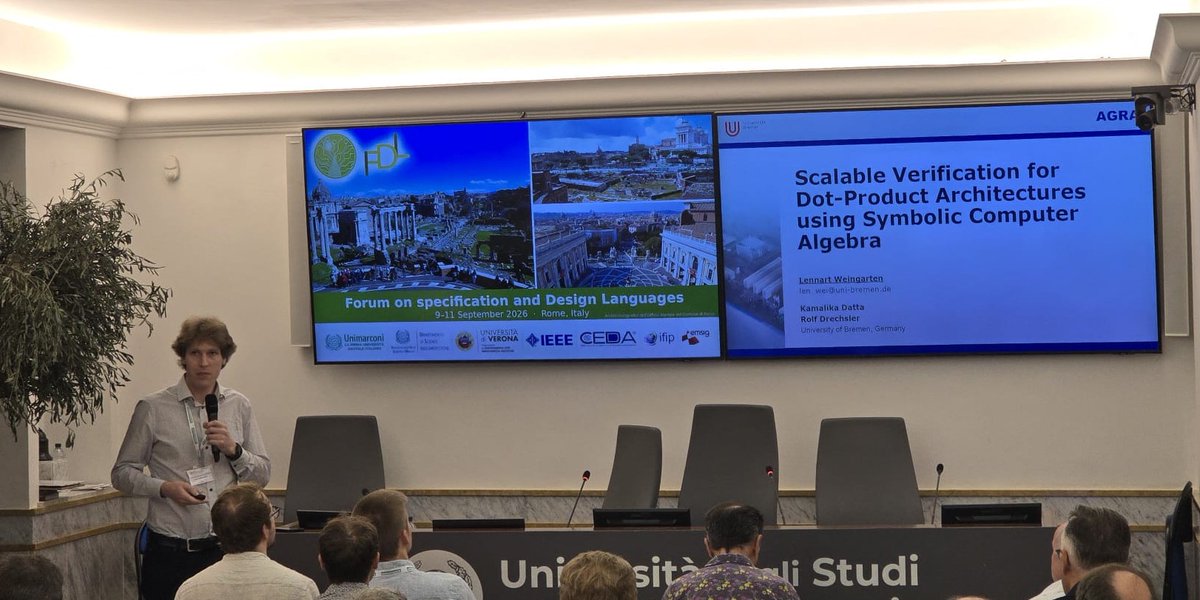
#FDL2026 - Lennart Weingarten presenting our paper on "Scalable Verification for Dot-Product Architectures using Symbolic Computer Algebra" at 29th Forum on specification and Design Languages (#FDL) in #Rome https://t.co/vojsLRnYG7 @agra_uni_bremen#formal#verification#SCA
An 18-month-old audit and a fresh one carry the same badge on a website.
The badge does not expire. The assumptions behind it do, quietly, as dependencies update, roles change, and new code ships next to the reviewed code.