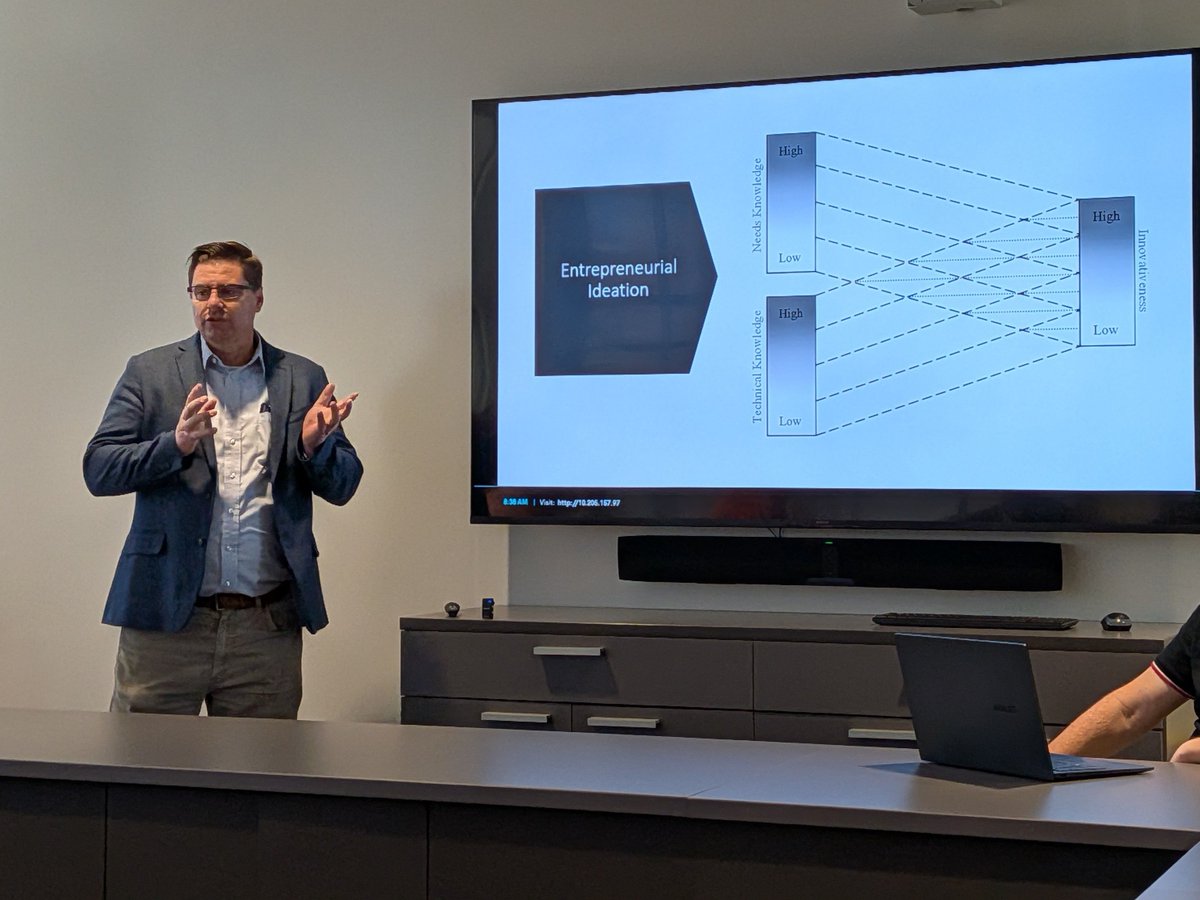
We often assume that institutional solutions are created and imposed top-down but history is full of examples of entrepreneurs creating solutions for other entrepreneurs. @mdpackard and I explain the how of entrepreneurial creation of private institutions. https://t.co/RTxd5gDG0W
Or... maybe the students need a lesson on diminishing marginal utility.
$1M would change every one of their lives.
$1B would certainly be better, but not 100x better. In terms of actual life improvement, it's not even 10x better for most of them.
Astro Teller used to give one-hour lectures on innovation. He stopped. Now he does it in 60 seconds.
"Choice A, $1M guaranteed. Choice B, $1B, one chance in a hundred."
"Everyone raises their hand for choice B. Big smile on their face because they've all passed the math test."
"Leave your hand up if in your most optimistic imagination of their best day, your manager, your CEO, your board of directors even remotely supports you choosing choice B."
"Every hand in the room goes down."
"You don't need a lecture on innovation. You need a new manager."
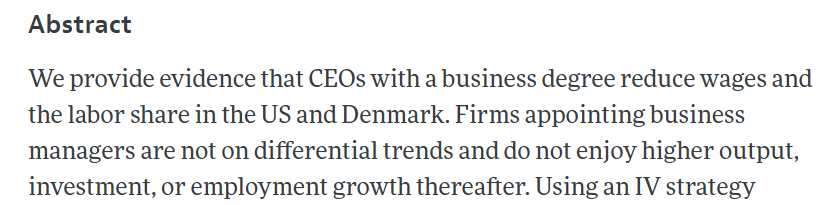
Fascinating new paper by Acemoglu, Xi He, & le Maire. Check out what they report finding in the abstract. If you want to understand why they find this, read my book with @hhhastings: Venture Mode.
https://t.co/fDWuutmqrD
Forthcoming in the AER: "Eclipse of Rent-Sharing: The Effects of Managers’ Business Education on Wages and the Labor Share in the US and Denmark" by Daron Acemoglu, Alex Xi He, and Daniel le Maire. https://t.co/rqXsAPk7KP
This is an important thread for both entrepreneurship scholars and economists.
Entrepreneurship is where all the most difficult, interesting, and important debates are happening because in entrepreneurship those persistent philosophical puzzles--about what is or isn't real, what can and cannot be know, what agency and choice are and mean--matter. If and to the extent that we get it "right" in entrepreneurship, the reverberations may be felt in all the social sciences. Because, arguably, the social sciences have all gotten their philosophy of science wrong to some degree.
In economics, very few care about these questions anymore because the way to think about and do economics has for over a century has been based in general equilibrium theory. But the general equilibrium model is very obviously wrong. While most argue that it's only simplistic, abstracting away some realism to allow the study of certain features of economies, I think Per rightly argues that the problem with GET is much more fundamental. The assumptions of GET are not just simplistic, they are WRONG.
If he's right, the whole economics paradigm is getting a lot wrong. Which shouldn't be a surprise, since the positivist criterion for theoretical validity is predictive accuracy. GET models have failed its own criterion for validity for a very long time. Yet there is still no stomach for philosophical debates.
My prediction is that entrepreneurship is going fix economics from the outside. Because we seem to be the only ones, other than philosophers (whom nobody apparently listens to), who care enough to figure these puzzles out.
What are the implications for economics of recognizing entrepreneurship? They are vast. Modern/mainstream economics is to a great extent the outcome of expunging the entrepreneur and forcing an entrepreneurless, mechanistic view onto the economy. This facilitates the use of mathematical analysis and quantitative predictions, but these will always be wrong to the extent that there is entrepreneurship. In a sense, mainstream economics is the science of a planned or plannable economy. And the basic models even assume that there is perfect information.
When we recognize that there is entrepreneurship, meaning the uncertainty-bearing pursuit of (new) value creation, the economy must be understood as a process whose content continuously evolves. But it evolves according to specific principles, which we often call "economic laws" (such as diminishing marginal utility, the laws of supply and demand, etc.). Economic theory cannot predict the content, but can explain the drivers and causalities behind observable outcomes.
But an economy with entrepreneurship is a much more radical take than simply introducing some dynamism or a largely independent error term to the model of perfect competition. Entrepreneurship fundamentally changes what we know and can know about the economy. As I show in my 2025 book, Entrepreneurship and Evolutionary Economics, by recognizing entrepreneurship we do not only get a process, often depicted as progressive or equilibrating, but one in which the causal direction is reversed. It is the expected (entrepreneurial) value outcome that drives pricing of factors and, thereby, directs the economy's production apparatus in toto.
In this sense, evolutionary economics as well as Joseph Schumpeter's work on which it claims to be based, got it wrong. It's not that the status quo is disrupted by innovations, but that the pursuit of innovations makes the status quo into a disequilibrium that is (often hopelessly) maladjusted to the future that is being created.
This does not thereby make Israel Kirzner's theory of equilibrating entrepreneurship accurate. It is just as wrong because it too assumes the wrong causal direction as entrepreneurs are assumed to react and respond to what is rather than pull the economy with them toward what they are about to create. Kirzner's (and Hayek's) entrepreneur deals with knowledge, not uncertainty, as I explain in my article "Austrian Economics and Knowledge" (QJAE, 2026).
Simply put, both Schumpeter and Kirzner misunderstand in a quite fundamental way the implications of recognizing entrepreneurship in the market economy.
The closest I have found to understanding how the uncertainty-bearing of entrepreneurs characterizes the market economy is in Ludwig von Mises's works (perhaps primarily in his Human Action). But Mises unfortunately did not elaborate on the "promoter" function of entrepreneurship, but erroneously concluded that it lies beyond what can be defined and understood using praxeology. I have addressed this in my article "Finding the Entrepreneur-Promoter: A Praxeological Inquiry" (QJAE, 2020), which shows that the promoter - the "driving force" in the market process - has a place in economic theory. Indeed, economic theory probably cannot be properly understood without it.
Adding the promoter does not actually change Mises's conclusions about the market economy, but only makes the claim that an economy cannot do without calculation even stronger. This suggests, at least to me, that Mises in fact recognized, albeit it is only implicit in his works, the fundamentally entrepreneurial nature of the market economy. Because without such recognition, how could Mises possibly have come up with the proper arguments and formulate an economic theory that, as far as I can tell, never contradicts the implications of the promoter entrepreneur - and the causal direction that it implies but that most economists do not recognize.
Granted, Mises is not alone. Much of this is also implied in the works by Carl Menger, although the extent to which the entrepreneur, in the uncertainty-bearing sense (which Menger did not accept), does not stand out until one considers the expanded framework of Mises and others (in particular, economic calculation).
I have of course only scratched the surface thus far in my works. Much more needs to be done, but I think it should already be clear that mainstream economics (and many heterodox schools) is not only severely defunct but also that Austrian economics deviates much more - and fundamentally - from what is taught in economics courses and textbooks than is visible on the surface. There is a proper and sound economics, which must understand the market economy from the perspective of entrepreneurship. And there is a mechanistic view of the economy that claims the same label but that is fundamentally flawed and gives false promises of being able to quantitatively predict outcomes and thus facilitating, by providing the tools for, central planning.
Planned or managed economies stifle entrepreneurship or send it underground (where prices are higher). The economy thereafter stays where it is (or declines), with no engine for growth.
Friedrich Hayek: “Whenever you have a community completely commanded by an authoritarian system, there is no evolution in a sense because better systems cannot prevail so long as the old system is maintained by force.”
"It turns out, of course, that Mises was right." - Robert Heilbroner (1990, "After Communism" in The New Yorker)
"All we know for certain is that the system deteriorated to a point far beyond the worst economic crisis ever experienced by capitalism, and that the villain in this deterioration was the central planning system itself. The conclusion one inevitably comes to is that to whatever extent socialism depends on such a system it will not work."
Hayek: “You cannot use statistics to explain the extremely complex structures of society.”
“While I value statistics as information about current events, I think its scientific value is much more limited than American economists have believed.”
Heading to #AOM2026?
Join Vishal Gupta and Per Bylund (@PerBylund) for a panel on how Austrian economics can shape management and entrepreneurship research.
Register: https://t.co/wUrFWHMMv1
Save 50% on the related Research Handbook with code AOM26: https://t.co/Eopgqy45vM
🚨 It's just over a month until the submission deadline for the special issue of Strategic Change on the continuing relevance of Frank Knight🚨
@CarmenDorobat@mdpackard
Please get in touch with the special issue editors with any questions you might have!
https://t.co/rylipUVkua
Social science remains in crisis.
It's time to reassess it's epistemic foundations. Modern realist philosophy of science is highly flawed and improving our methods is mere tinkering around the edges.
We need serious thinkers to do some serious thinking on the empirical nature of social science instead of persistently ignoring this.
A 7-year study of 3,900 social science papers found that only ~50% could be replicated.
There was significant variation across fields, however.
While more than 60% of political science & econ papers were replicated, only ~25% of sociology & 0% of education papers were.
Positivism was originally formulated much closer to subjectivism by Comte than Saint-Simon and disciples accepted. So yes, there are strands of positivism that take a more nuanced stance. But largely, when people rail against positivism, it is against the (more prominent) variant that accepts observation as the only source of knowledge. Is your assertion that this strand doesn't exist?
Also, Ayer's point amounts to an argument that we can refine our knowledge by thinking about it. Sure, I agree. But Ayer, like all other positivists, rejected the synthetic a priori, as I'm sure you do too. But I think Reinach made a compelling case why the synthetic a priori is not only valid but common. Arguably, hypotheses are generated as synthetic a priori claims.
@PerBylund@mises The empirical data do not support your assertion. All I can see is white. You could've taken that pic in your office for all I can tell.
I have a different take on the #USMNT scandal. The red card was bogus (Balogun's step was NOT a challenge, which was very clear in live play, and people showing the pic of the step as proof of a cardable offense don't know the rules). FIFA did the right thing to suspend the bad ruling (but Trump should never have gotten involved). FIFA needs a better mechanism to address bad on-the-field rulings, with a clear rules-based explanation for the adjudication. This suspension of the ruling is good enough, but I hope they make some changes for the next tourney.
BUT... people who think this is a big deal either way are ignorant. Pepi is not a sharp fall off from Balogun and I was actually kind of excited to see Pepi get a game. Their skill sets are different and I prefer Balogun, but Pepi is a very proficient scorer. I'm glad Balogun is playing, but the USMNT has a fair chance of winning either way.
Everyone needs to just chill out and have fun watching the games.