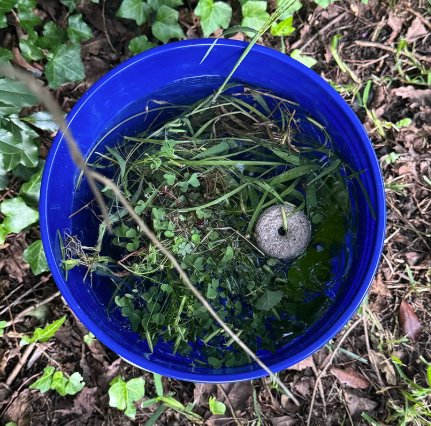
You can crash your yard's mosquito population without spraying a single chemical with a Mosquito Bucket of Doom.
Fill a 5-gallon bucket about two-thirds with water. Drop in a handful of grass clippings, leaves, or hay. Let it sit for a day, then drop in a Bti dunk (also called Bacillus thuringiensis israelensis, sold at any hardware store as "mosquito dunks," about $10 for six).
Mosquitoes are powerfully attracted to fermenting water and will lay their eggs in your bucket. Bti is a naturally occurring soil bacterium that produces a toxin that kills mosquito, blackfly, and fungus gnat larvae only.
This method doesn't harm bees, butterflies, fireflies, fish, frogs, birds, pets, or people. BTI dunks are EPA-approved for organic use and safe in animal water troughs and birdbaths.
One dunk lasts about 30 days. Top off the water as it evaporates. Cover with 1/2-in Mesh Hardware Cloth to prevent animals from getting trapped and put the bucket somewhere shady where pets and kids won't get into it.
The bucket becomes a mosquito magnet and a dead end. Compare that to fogging the entire yard with pyrethroids, which kills every insect in it, including the predators that eat mosquitoes.
Doug Tallamy's Homegrown National Park has been running the "Mosquito Bucket Challenge" since 2021. The more buckets in a neighborhood, the bigger the dent. One bucket per yard is a great start.
Progress to report - our rape gang inquiry debate is finally taking place in Parliament on Monday.
Evidently, Westminster has not given this cancer the attention it deserves. So we forced the agenda.
The British people backed our petition, and we have made it happen. A team effort. Thank you to everyone who supported it all those months ago - it worked.
We are welcoming survivors to Parliament who will sit in the debate as my guests.
Now, I need your help.
Please contact your MP and ask them to attend the debate.
16.30. Westminster Hall. Monday 1st of June.
The Rape Gang Debate.
I hope that MPs from all parties put aside any petty differences and come together to drive real change.
Progress to report - our rape gang inquiry debate is finally taking place in Parliament on Monday.
Evidently, Westminster has not given this cancer the attention it deserves. So we forced the agenda.
The British people backed our petition, and we have made it happen. A team effort. Thank you to everyone who supported it all those months ago - it worked.
We are welcoming survivors to Parliament who will sit in the debate as my guests.
Now, I need your help.
Please contact your MP and ask them to attend the debate.
16.30. Westminster Hall. Monday 1st of June.
The Rape Gang Debate.
I hope that MPs from all parties put aside any petty differences and come together to drive real change.
Need a fence? What you really need is a deadhedge.
It's a barrier made of dead branches stacked between two rows of posts. You feed it with branches, fallen limbs, and woody yard debris. Over a season it becomes denser than most commercial fencing. Over years, the bottom layers compost down and the top gets refilled with whatever you trim that week.
Wrens, robins, and ground-foraging birds nest in the structure. Hedgehogs, field mice, frogs, and toads shelter in the base. Solitary bees, ladybirds, and beetles overwinter in the cavities.
Germany has been planting deadhedges as wildlife corridors since the 1990s. The UK uses them for riverbank restoration.
A wood fence costs thousands of dollars and supports no wildlife. A deadhedge costs nothing, gets denser every year, and provides habitat for dozens of species you want in your yard anyway.
Rory Sutherland proposed a simple fix that could cut unnecessary GP visits by up to 50%.
Instead of the chaotic 8am scramble for appointments (a nightmare across the UK and much of Europe), let pharmacists book next-day GP slots.
People would see the pharmacist first, who could often hand out ointment, advice, or a delayed antibiotic prescription (“only fill it if you’re still ill next week”). Most would feel reassured, recover naturally, and never need the GP.
This one made me laugh because it’s so straightforward. We overcomplicate healthcare systems when small changes could relieve huge pressure.
Doctors are overwhelmed, waits are endless, and patients are frustrated. A smarter first filter could help everyone without extra cost or bureaucracy.
Would letting pharmacists act as the initial gatekeeper for GP appointments actually work, or would it create new problems?
Fatih Birol, boss of International Energy Agency:
“Electric cars are now - worldwide - 30% of new car sales. Five years ago, it was 5%”
It’s why fossil fuel lobbyists are so relentless right now. EVs are increasingly cheaper to buy, cheaper to fuel, cheaper to service and better to drive.
“15 years ago solar was a romantic story. Now it is everywhere… wind and nuclear will make a big contribution as well”
If you look outside the UK, these changes are everywhere and huge
I am disappointed by your argument whilst also convinced by it. I have spent most of my adult life on the left, but (through the sliding of the Overton Window) now find myself agreeing more and more with the “far right” (aka 1990’s liberal). The more the radical left dig in on their political positions, the lower they seem to sink.
I was their BIGGEST fan.
Panelist, Patreon supporter, event regular, even started my own channel partly because of them.
Now I finally had to speak out about what happened to Fully Charged / Everything Electric. The name change, the silence on Tesla, my call with CEO Dan Ceaser…
This one was hard to make. Watch below 👇
I was their BIGGEST fan.
Panelist, Patreon supporter, event regular, even started my own channel partly because of them.
Now I finally had to speak out about what happened to Fully Charged / Everything Electric. The name change, the silence on Tesla, my call with CEO Dan Ceaser…
This one was hard to make. Watch below 👇
lIf you do anything today, watch @MaeveHalligan at the Cambridge Union. I genuinely think this was the first time many people in that room were confronted with the hard reality of the trans debate, rather than the slogans that usually surround it.
@BuckAngel was exceptional: calm, articulate, humane. Ultimate respect.
And then there was Helen Webberley. I remember once thinking the criticism directed at her by GC women was excessive, especially the claim she was ‘pure evil’. After hearing her speak, I no longer think that. She is totally insincere. I can deal with hard ideologues- they believe they are telling the truth; they are genuine, @HelenWebberley is different.
One audience member, a trans-identified male and former patient of hers, stood to speak during points of information. His account of how he had been treated was deeply disturbing.
Watch the full debate. It is worth your time.
Kathryn Porter claims to be a & trustworthy commentator/advisor on energy matters.
We know she’s either a climate change denier or ignores it.
Here’s proof she’s untrustworthy from ofcom who upheld the Met Office complaint that she misled about Met office temperature records
It takes ~45 GWh to produce 1 GWh of battery, not 450 GWh.
More importantly, you can recharge a battery ~5000x. So that's 0.01 GWh per cycle.
And then you recycle the materials instead of burning them and emitting CO2.
Liars like this should not be admitted in polite company.
MIN: Do you know how much new energy China put online last year?
BURGUM: Intermittent or base load?
MIN: All energy. 543 GW. How much was renewable? 434 GW.
BURGUM: But only when the wind is blowing and sun is shining
MIN: Meanwhile, the US put up 53 GW of new energy last year -- less than 10% of China. You're clear bias against renewables is harming our national security.
the tricky recyclable part, but bans on landfilling are spreading).
• Upfront capital and supply-chain demands (copper, rare earths) can create bottlenecks if scaled globally very fast.
The actual truth: nuanced, not black-and-white
Wind energy is genuinely low-carbon, cost-competitive in the right locations, and a key tool for cutting emissions—its lifecycle advantages over gas/coal are massive and well-documented by independent experts. The anti-wind social media narrative often exaggerates downsides (100× copper is wrong; whale deaths from offshore wind have no credible evidence; “not truly green” ignores the orders-of-magnitude emissions drop).
However, pro-wind advocates sometimes downplay real challenges: higher material intensity, the need for firming/backup/storage in high-penetration grids, and the fact that it works best as part of a diverse mix (not a standalone baseload replacement). Scaling to replace all fossil generation requires massive mining (manageable with recycling/tech advances like larger turbines and non-rare-earth generators) plus grid/storage investments.
Bottom line: Wind is a net positive for the energy transition in most analyses, but it has genuine trade-offs that must be engineered around. Claims of “two orders of magnitude” more copper are false; the real multiplier is closer to 5–10× per unit energy (still significant). Data from IEA, NREL, and peer-reviewed LCAs consistently support this balanced view over polarized social-media soundbites. Advances in turbine size, recycling, and hybrid systems are steadily reducing the downsides. 2/2
From @grok, when I asked for some expertise in understanding these claims:
The copper claim is overstated by about an order of magnitude (or more). Expert analyses from the IEA, NREL, industry data, and lifecycle assessments (LCAs) show wind energy does require significantly more copper—and other materials—per MW of installed capacity than a natural gas plant, but nowhere near the “two orders of magnitude” (100×) often claimed on social media.
Copper (and broader mineral) requirements: the numbers
• Conventional plants (gas, coal, nuclear): ~1 tonne of copper per MW of capacity.
• Onshore wind: Typically 3–6 tonnes of copper per MW (IEA cites ~3 t/MW; other sources 3.5–5.6 t/MW including farm cabling/transformers). Offshore wind is higher (~9–11 t/MW or more) due to submarine cables.
• Result: 3–6× more copper per MW installed for onshore wind vs. a comparable gas plant. Total “critical minerals” or overall mineral intensity is often cited as ~9× higher for onshore wind vs. gas per MW (IEA data, excluding steel/aluminium in some charts).
This is per nameplate capacity, not per unit of actual electricity generated. Wind’s capacity factor (average output as % of max) is lower:
• US onshore wind: ~34–38% (2024 data).
• Natural gas combined-cycle (most common modern plants): ~55–60%.
To produce the same annual energy, you need roughly 1.6× more wind MW installed. Adjusting for that brings copper use to roughly 5–10× higher per MWh over the plant’s life (one detailed breakdown: ~39 t copper/TWh for wind vs. ~5 t/TWh for gas). Extra transmission lines for remote wind farms add more, but not enough to reach 100×. The 100× figure appears to be hyperbole or a miscalculation (e.g., comparing one turbine to a full plant without proper scaling, or ignoring that copper is highly recyclable).
Broader material footprint
Wind turbines are material-intensive upfront (steel towers, concrete foundations, copper wiring, rare-earth magnets in some designs, fiberglass blades). A typical 3 MW onshore turbine might use hundreds of tonnes of steel/concrete. Offshore adds more steel for foundations.
However, when normalized per unit of electricity generated over lifetime (accounting for capacity factor, 20–30+ year lifespan, and recycling):
• Onshore wind has a higher material use than solar or nuclear but still far lower total extractive footprint than continuing coal or gas, because fossils require ongoing mining/drilling for fuel (coal especially is 20×+ the mining footprint of wind infrastructure per kWh).
• Most materials (steel, copper, much of the concrete) are recyclable; blade recycling is improving rapidly.
Lifecycle emissions and energy payback
This is where wind shines:
• Lifecycle GHG emissions: ~11–20 g CO₂eq/kWh for onshore wind (manufacturing + construction dominate; operation is zero).
• Natural gas: ~400–500 g CO₂eq/kWh (mostly combustion). Coal: ~800–1,000 g.
• Energy payback time: Typically 6–18 months (energy to build is recovered quickly).
Emissions from building wind are paid back in months; the rest of its life is near-zero carbon.
Economics and reliability (the real trade-offs)
Pro-wind expert consensus (IEA, IRENA, NREL, IPCC-aligned LCAs):
• Onshore wind has among the lowest levelized costs of new electricity in many markets (~$20–40/MWh in good sites).
• Zero fuel cost, energy security benefits, rapid deployment.
• Excellent for decarbonization when paired with other sources.
Critic/expert concerns (valid points from engineering/economic analyses):
• Intermittency: Wind isn’t dispatchable. Grid integration requires backup (often gas peakers), overbuild, transmission upgrades, or storage—raising total system costs. Capacity credit (how much “firm” power it provides) is low.
• Land use: Higher per MWh than gas (though often compatible with farming).
• Other impacts: Bird/bat collisions (mitigable; far lower than cats/cars/buildings), visual/noise, decommissioning (blades are 1/2
@TomLondon6@MarinaPurkiss Or:
2) I oppose all war crimes, including GENOCIDE.
3) If the (fiercely denied) GENOCIDE is being seen as stoking antisemitism, I will wait for independent legal experts to fight it out before I pour petrol onto the inferno.