Shenzhen just held the world’s first humanoid robot MMA event. This is absolutely the most futuristic city.
The white one even kicked the black’s head clean off in a spinning high kick! Brutal!
Mansion tax. You have a £2m house. You add a £10k annual liability to it. Now it is no longer worth £2m. So not liable for the mansion tax. How does this work?
Extremely excited to announce our first air-to-air kill of a flying moth by an autonomous micro-drone. This is a big step towards completely eradicating mosquitoes.
A college economics professor stated that he had once failed an entire class. That class insisted that socialism is functional and that no one should be poor and no one rich, that everyone is equal...
The teacher told them, "OK, we will do an experiment on socialism in this group.
All grades will be averaged, and everyone will get the same grade, so no one will fail and no one will get a 10."
After the first test, the grades were added up and divided by the number of students, and everyone got an 8.
The students who studied intensively were upset, but those who studied less were overjoyed.
As the second test approached, the students who had studied a little learned even less, and those who had studied more intensively told themselves that they also wanted a "handout", so they also studied less.
The average of the second test was 6.
When the third test was given, the average score was 4. To the great surprise of all the students, they all failed.
The teacher told them that socialism will eventually fail because when half the population sees that they cannot work, because the other half will take care of them, and when the half that worked realizes that there is no point in working anymore, because others are the beneficiaries of their labor, then that is the end of any nation
The story may be a fable not a fact but the moral is real
Get it?
@RapidResponse47@POTUS At last! Although it's easy to say when I don't run the world. At least DJT gave then every chance. But now they must be finished.
@AndreaGuglieri To be fair, whatever he had in his veins, was then, and not now. BUT a rule is either a rule, or it is not. Tennis knows it is dying in the age of mass immigration, so they are trying to keep their heads above water... Sadly only so may years left ...
For over a thousand years, historians thought the Viking "sunstone" was nothing more than a myth, until the ocean gave up its secret...
The Norse sagas repeatedly referenced a mysterious object called a "sólarsteinn" or sunstone, a navigational tool so powerful that Viking sailors could locate the exact position of the sun even on the most overcast and cloudy days. For centuries, scholars debated whether this was real technology or simply folklore embellished over generations of retelling. Most assumed it was legend. They were wrong.
In 2013, marine archaeologists excavating a British warship that sank near the Channel Islands in 1592 made a stunning discovery buried among the wreckage. Alongside navigational instruments including a pair of dividers and a slate, they found a rectangular chunk of translucent crystal. Testing confirmed it was Iceland spar, a remarkably pure form of calcite with extraordinary optical properties. The fact that it was found stored alongside other precision navigation tools was not a coincidence.
Iceland spar possesses a property called birefringence, meaning it splits a single beam of light entering the crystal into two separate beams. When you hold the crystal up toward the sky and slowly rotate it, the two beams will vary in brightness independently until, at one specific angle of rotation, they become perfectly equal in intensity. That precise angle points directly toward the sun, regardless of whether the sun is visible to the naked eye. Cloud cover, fog, and even twilight conditions cannot defeat it.
Researchers from the University of Rennes in France conducted extensive testing and published their findings in the Proceedings of the Royal Society A. Their experiments demonstrated that Iceland spar could locate the sun's position with an accuracy of within one degree, even under completely overcast skies. For Viking navigators crossing the North Atlantic toward Iceland, Greenland, and eventually North America, this accuracy would have meant the difference between a successful voyage and sailing hopelessly off course into open ocean.
The Viking Age spanned roughly 793 to 1066 AD, and during this period Norse sailors were completing oceanic crossings that would not be replicated by other European cultures for another 400 years. Historians had long puzzled over how they achieved such consistent navigational precision without magnetic compasses, which did not reach Europe until the 12th century. The sunstone appears to be a significant part of that answer.
What makes the Channel Islands find especially compelling is that the 1592 shipwreck is far outside the traditional Viking era, suggesting that knowledge of this navigational technique survived and was still being used by European sailors centuries after the Viking Age officially ended. The crystal was not a relic or a curiosity on that ship. It was working equipment.
The sagas specifically describe King Olaf consulting a sunstone on a cloudy day to verify the position of the sun, with a separate observation then confirming the stone's accuracy. For generations this was dismissed as poetic invention. Science has now confirmed that every element of that description is physically possible and practically achievable with a simple piece of Icelandic calcite.
The Vikings were not lucky explorers stumbling across new lands by accident. They were sophisticated navigators armed with technology so elegant and effective that it required no moving parts, no maintenance, and no power source beyond the sky itself.
📷 : the original calcite crystal alongside Elizabethan navigation dividers next to a cannon
Alderney Museum
#archaeohistories
@ArchRose90@yuilly12 This is a defining moment for the British police. Do they impartially investigate Ann's murder, no matter where it goes....., or do they reveal themselves to be just another organ of "The Blob"..
Burger King was one of the few fast food chains who refused to disclose their ingredients
They just quietly released them this year and it’s so much worse than anyone could have imagined
- 120 ingredients in The Royal Chicken Spicy Sandwich
- 85 ingredients in their Whopper
The Whopper’s 85 different ingredients include multiple seed oils, processed sugars, preservatives
In the bun, you have things like potassium iodate, banned in Europe, UK, Australia, New Zealand. Also in the bun, you have mono and diglycerides, which are a preservative and dough conditioner which cause gut inflammation
The Royal Chicken Spicy Sandwich’s 120 ingredients include
- Multiple dough conditioners, which can lead to gut issues
- Silicone dioxide, the nanoparticles of which may be inflammatory in the human gut, multiple seed oils
- A piece of processed chicken coated in flour and food starches, battered, fried in rancid oxidized seed oils
- It contains antifoaming agents that are also found in Silly Putty, like dimethylpolysiloxane
- 3 different types of sauces, one of which has over 25 different ingredients.
“Burger King might just be the worst fast-food restaurant I've ever seen”
This is not food. It’s a chemical science experiment engineered to be as addictive as possible
No sandwich should ever include 85-120 ingredients
@butteryballs2@JamesEsses I can see a new game.
Which great brand is a young white liberal female going to mess up next ? Bud Light, Cracker Barrell, Cadbury's and now, of all sacred brands, Waitrose.
@kimmonismus The problem isn't surveillance, the problem the everyone's, perhaps well founded, lack of trust in the governments doing this surveillance. If they were going to use this to find terrorists, we would have no problem. But we all know they will use this for more nefarious purposes.
Taiwan solved tax evasion in 1951 with a trick so cheap it should embarrass every tax authority on the planet.
The problem was an all-cash economy full of small shops. A merchant pockets the cash, skips the receipt, and the sale never existed. Auditors can't catch what was never recorded, and hiring enough of them to watch every noodle stand costs more than the missing tax.
So finance chief Ren Xianqun flipped the incentive. Print a lottery number on every receipt. Draw winners every two months on live TV. Top prize today: NT$10 million, about $310K.
Suddenly the customer and the shopkeeper want opposite things. The merchant wants the sale off the books. The customer wants the ticket. And there are millions more customers than merchants. Every transaction now carries a built-in witness demanding the paper trail.
Year one, reported tax revenue jumped 75%, from NT$29 million to NT$51 million. Seventy-five years later, roughly 70% of Taiwanese still play. Convenience stores redeem the smallest NT$200 prizes at the register, so even a coffee receipt feels like a scratch card.
The elegant part is what the audit force costs. The prize pool runs about NT$7 billion a year, roughly $20 million. In exchange, the government gets 23 million unpaid auditors working every checkout line in the country, forever. No inspector general on earth delivers that coverage at that price.
Greece, Italy, Portugal, and Slovakia all copied it. The most effective compliance tool ever built looks like a game, and that's exactly why it works.
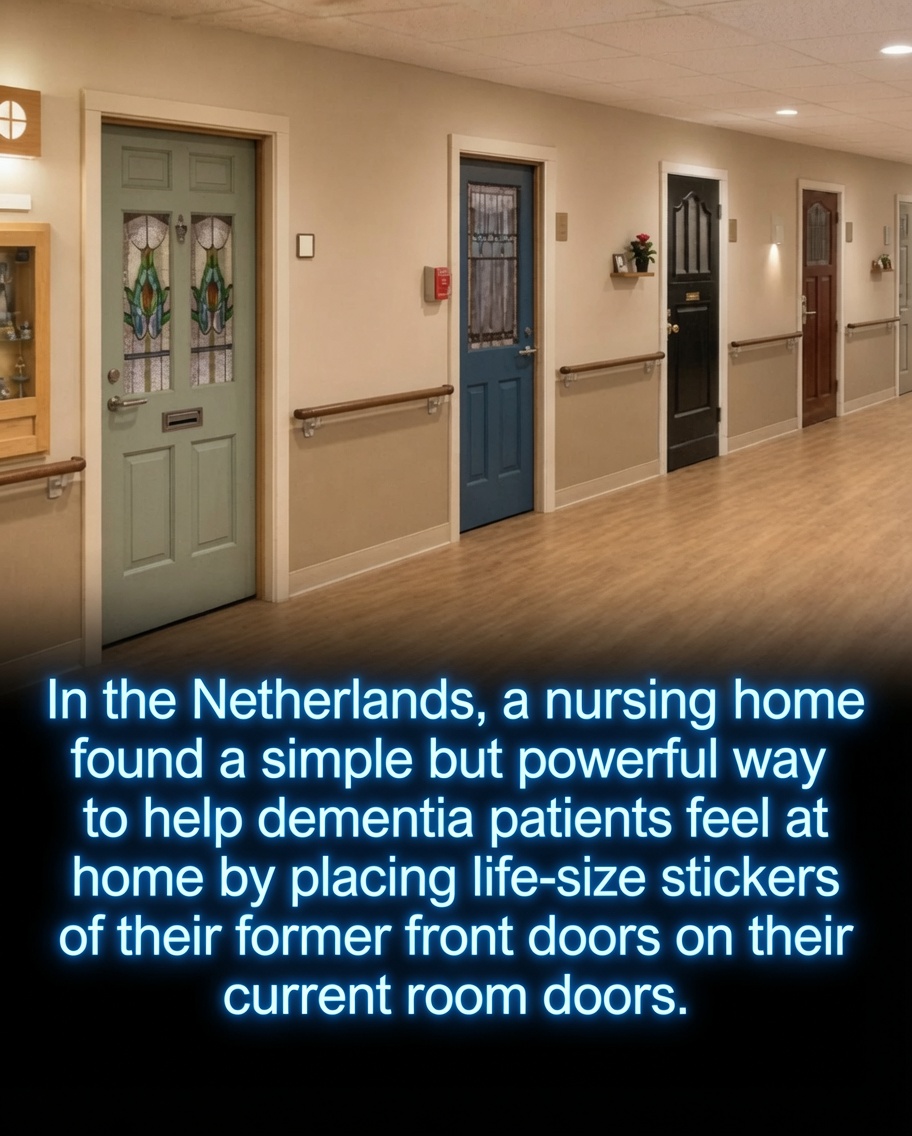
They changed the doors and gave dementia patients a piece of home back.
In the Netherlands certain nursing homes discovered a straightforward yet meaningful solution to help residents with dementia feel safer and more at ease. Staff place life size stickers depicting each person’s original front door on the entrance to their current room.
Instead of facing hallways of nearly identical doors residents now recognize something deeply familiar. The specific color the shape and the unique details of the home they once lived in stand out clearly.
These custom decals known as True Doors reduce disorientation make individual rooms simpler to identify and help preserve important personal memories.
The approach restores dignity for family members. It encourages greater independence for residents according to caregivers. Most importantly it transforms a standard room into a warmer more comforting space that genuinely feels like home.
Compassion does not always demand elaborate measures. In many cases it can begin with something as simple as a familiar door.
Image created using artificial intelligence for illustration purposes only.