Mythos / Sol cybersecurity capabilities are equally useful in an offensive as well a defensive capacity.
If adversaries get ahold of an equivalent offensive capability, it poses a serious threat to US companies that remain unaware of latent vulnerabilities.
In the meantime, I strongly recommend running deepsec[1] or similar harnesses with the available frontier models.
[1] https://t.co/Wh4QVGDFnm
SITUATION DETECTED: Anthropic has disclosed to the U.S. Government that Alibaba executed the largest known distillation attack on Claude to date, generating 28.8 million exchanges through nearly 25,000 fraudulent accounts between April and June 2026.
This is a niche take but Jony Ive is the Arctic Monkeys of design.
Pre 2012: absolute bangers. After that it got stylish, self-indulgent, and increasingly annoying to actually use.
Pooshit — a thing I built.
`npx pooshit` in any folder → live URL on *.pooshit.dev in ~60s. No signup, no dashboard.
The fastest way from "works on my machine" to "open this on your phone."
https://t.co/VSD16hdx0u
How it works: detect your stack, tar the folder (gitignore-aware), upload, return a URL.
Supports:
• static HTML
• Node apps with `start`
• Vite/React (build → cd dist)
• Dockerfile
Free tier: 50MB, 24h. Save the deploy token to update the same URL later.
We’ve agreed to a partnership with @SpaceX that will substantially increase our compute capacity.
This, along with our other recent compute deals, means that we’ve been able to increase our usage limits for Claude Code and the Claude API.
We replicated Mythos findings in opencode using public models, not Anthropic's private stack.
The moat is moving from model access to validation: finding vulnerability signal is getting cheaper; turning it into trusted security
A better way to read Anthropic's Mythos release is not "one lab has a magical model."
It is: the economics of vulnerability discovery are changing.
We took the patched public Mythos examples and tried to reproduce them with GPT-5.4 and Claude Opus 4.6 in an open-source harness. Every run stayed below $30 per file.
AI models are already good enough to narrow the search space, surface real leads, and sometimes recover the full root cause in battle-tested code.
The takeaway: model access is not the moat anymore. Validation is. Finding vulnerability signal is getting cheaper; turning it into trusted security work is still hard.
Co-authors: @KlaKlo_, Amadeusz, Marek, Kuba, Mikolaj
Quick PSA about Opus 4.7:
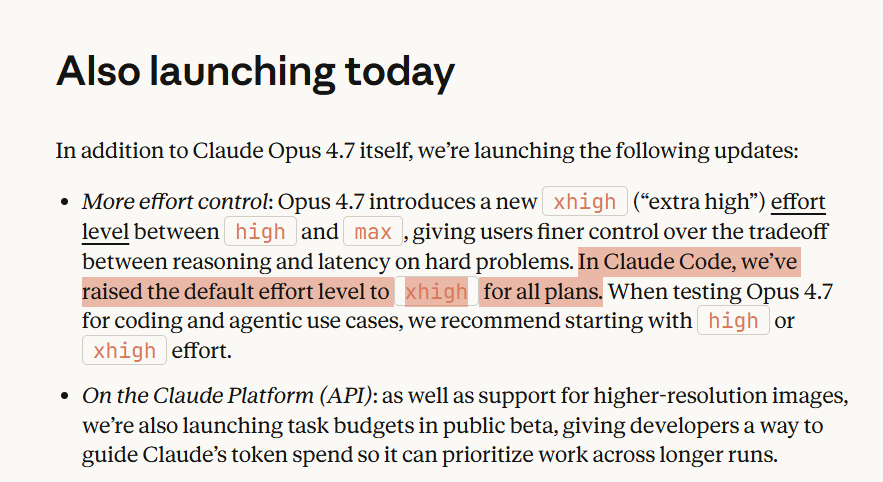
Anthropic have raised the default effort of Claude Code from medium to xhigh.
This will likely burn more tokens by default.
Switch off the defaults and experiment to see what effort level suits your work best.
This kills the illusion that AI can be sold like SaaS.
Flat pricing worked for Slack, Figma, Notion.
But AI is compute-heavy, variable cost.
You can’t “unlimited plan” when you're selling GPU-time usage.
Before you had
- $200/user/month with bundled usage
Now:
- low seat cost ($20)
- BUT you pay for usage
Power users get expensive fast.
Source: https://t.co/IMfF0hNO0d
I don’t think the new Claude desktop app is a direct threat to Cursor.
Cursor’s moat is the fact you can choose whatever model to use, which makes “plan with x and code with y” a breeze.
Also, Composer 2 AKA tuned Kimi K2.5 is very good.
@twentyvisionai Really interested to see different perspectives.
Had a bad time with with Claude Max. Swapped to Codex and now Kimi and it’s been great.