Kernel-Exploit-Dojo 📍
Curated archive of 100+ Linux kernel exploitation CTF challenges, organized by bug class, exploitation primitive, final technique, difficulty, and solve count.
The goal is to organize practical kernel pwn techniques such as UAF, heap spraying, pipe_buffer abuse, msg_msg, modprobe_path overwrite, and cred overwrite.
Resource: https://t.co/h1F2CD70Oc
This article is literally wow.
i read it 2 years ago, and coming back to it today, it still feels new.
few tutorials teach computers in a way that permanently changes how you think. this is one of them.
If you've never built a VM before, you're missing one of the biggest "aha" moments in computer science.
Reverse engineering Linux anti-RE tricks: malformed ELF headers, segment gaps, XOR layers, and RC4 encryption. By Xusheng Li
https://t.co/8q27Cvi2zL
#infosec
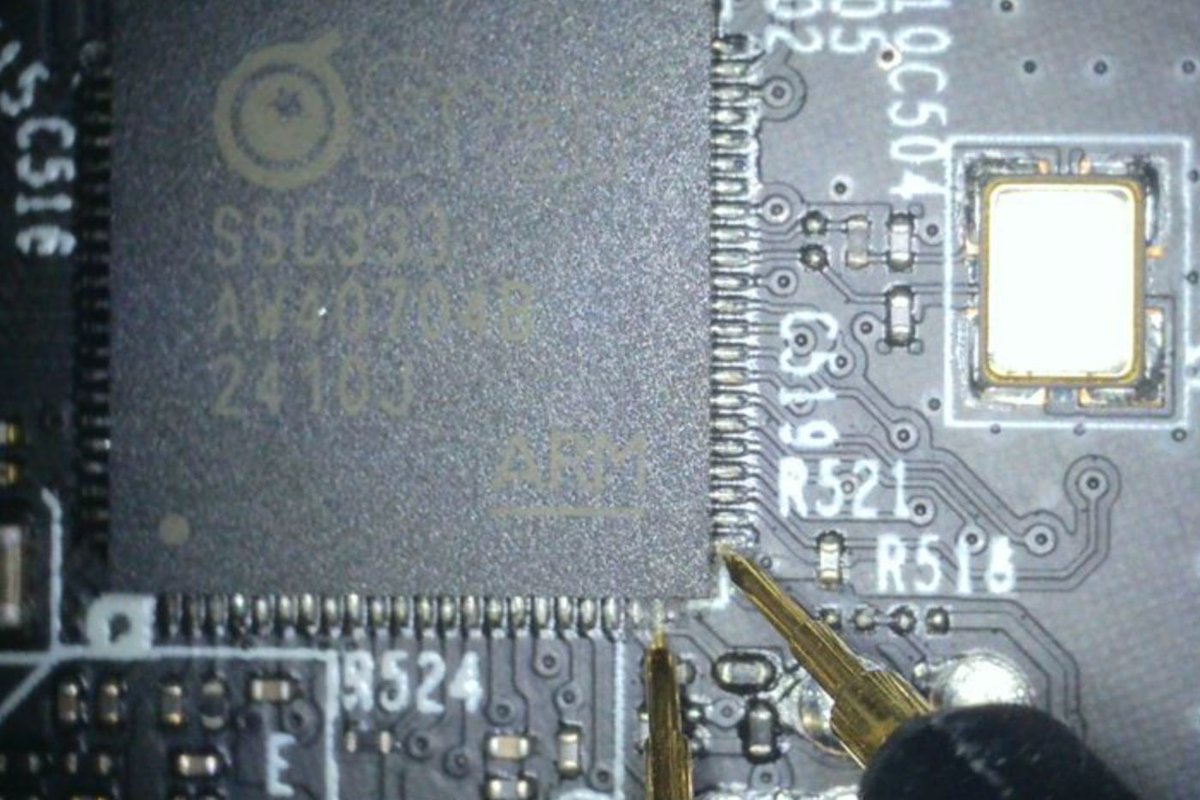
Hacking firmware using Ghidra: tips and tricks for smarter reverse engineering. 🐉🗡️🧙♂️💎✌️
More details on:
LinkedIn: https://t.co/AUnIJDqnYz
Substack: https://t.co/BzH3CGdtCS
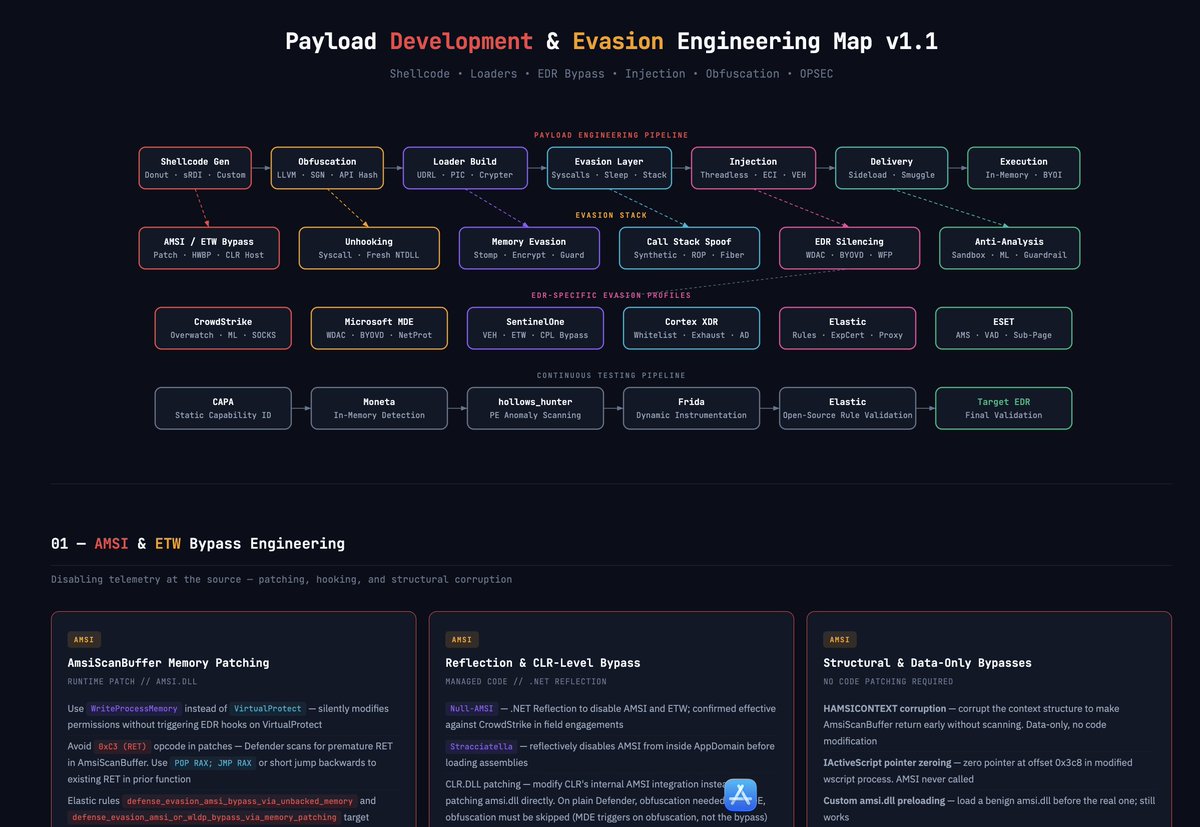
Payload Development & Evasion Engineering Map
70 technique cards across 16 categories covering the full payload lifecycle from shellcode generation through delivery. 20 attack flow chains showing real-world operator workflows like Node.js Sideload → DLL Hijack, BYOVD EDR Blinding → Kernel R/W, WASM HTML Smuggling → MOTW Bypass, and Polyglot LNK → ZIP Sideload. Dedicated EDR-specific evasion profiles for CrowdStrike, Defender, SentinelOne, Cortex XDR, Elastic, and ESET — covering what each product actually hooks, where the detection gaps are, and what triggers memory scans. 100+ tools catalogued across shellcode loaders, injection frameworks, obfuscation, and testing pipelines.
https://t.co/Ly63orEMTG
#CyberSecurity #RedTeam #MalwareDevelopment #EDREvasion #OffensiveSecurity
I am excited to release the seventh article in the Exploiting Reversing Series (ERS). Titled “Exploitation Techniques | CVE-2024-30085 (part 01)” this 119-page technical guide offers a comprehensive roadmap for vulnerability exploitation:
https://t.co/h18hZC0azl
Key features of this edition:
[+] Dual Exploit Strategies: Two distinct exploit versions using Token Stealing and I/O Ring techniques.
[+] Exploit ALPC + PreviousMode Flip + Token Stealing: elevation of privilege of a regular user to SYSTEM.
[+] Exploit ALPC + Pipes + I/O Ring: elevation of privilege of a regular user to SYSTEM.
[+] Solid Reliability: Two complete working and stable exploits, including an improved cleanup stage.
[+] Optimized Exploit Logic: Significant refinements to the codebase and technical execution for better stability and predictability.
The article guides you through the two distinct techniques for exploiting the CVE-2024-30085 Heap Buffer Overflow vulnerability.
I would like to thank Ilfak Guilfanov (@ilfak on X) and Hex-Rays SA (@HexRaysSA on X) for their constant and uninterrupted support, which has helped me write these articles over time.
I hope this serves as a definitive resource for your research. If you find it helpful, please feel free to share it or reach out with your feedback!
Enjoy your reading and have an excellent day.
Three-part series by @binarly_io on Supermicro BMC firmware authentication bypasses
Part 1: https://t.co/a44M8ce5YN
Part 2: https://t.co/DJsZWEl3tN
Part 3: https://t.co/8P8f598qGo
#infosec
Improve Your Windows Registry Forensics Skills: Extract OS version, control sets, network history, and much more.
https://t.co/yvHgwZsQgF
@three_cube @Di025 @co11ateral
🚨 New Writeup Alert! 🚨
"React2Shell (CVE-2025–55182) explained for mere mortals" by Fady Othman is now live on IW!
Check it out here: https://t.co/FXo1LD1KSL
Fuzzing 15 commercial cellular basebands: 9 vulnerabilities & honest errors from Google Tensor. 👨🏽🏭❯❯📱🫨🪲
More details on:
LinkedIn: https://t.co/dAhFalR6ev
Substack: https://t.co/j59AxHihgv













![ale_sp_brazil's tweet photo. I am excited to release the seventh article in the Exploiting Reversing Series (ERS). Titled “Exploitation Techniques | CVE-2024-30085 (part 01)” this 119-page technical guide offers a comprehensive roadmap for vulnerability exploitation:
https://t.co/h18hZC0azl
Key features of this edition:
[+] Dual Exploit Strategies: Two distinct exploit versions using Token Stealing and I/O Ring techniques.
[+] Exploit ALPC + PreviousMode Flip + Token Stealing: elevation of privilege of a regular user to SYSTEM.
[+] Exploit ALPC + Pipes + I/O Ring: elevation of privilege of a regular user to SYSTEM.
[+] Solid Reliability: Two complete working and stable exploits, including an improved cleanup stage.
[+] Optimized Exploit Logic: Significant refinements to the codebase and technical execution for better stability and predictability.
The article guides you through the two distinct techniques for exploiting the CVE-2024-30085 Heap Buffer Overflow vulnerability.
I would like to thank Ilfak Guilfanov (@ilfak on X) and Hex-Rays SA (@HexRaysSA on X) for their constant and uninterrupted support, which has helped me write these articles over time.
I hope this serves as a definitive resource for your research. If you find it helpful, please feel free to share it or reach out with your feedback!
Enjoy your reading and have an excellent day.](https://pbs.twimg.com/media/HClMY-QawAEOPBP.jpg)