Zyxel DX3301-T0/EX3301-T0 Router Post Auth Vulnerability for root shell.
Bootloader vulnerability for full debug commands access.
General Notes
#infosec#zyxel#iot
https://t.co/zMKi8TfVxX
@0xor0ne "I thoroughly enjoy my hobby, and I don’t want automation to rob me of those hours spent banging my head against the wall trying to figure something out, or that moment of pleasure when the penny drops and I have a “eureka” moment."
@AdeptsOf0xCC Same my friend :)
@UAVHive@SchizoDuckie Try https://t.co/CTtrkprLdP - yes I know it's not the same model but it's a G5 camera. The camera will reject the firmware if doesn't match the correct platform/version.
This vuln I reported has been disclosed by #zyxel today:
CVE-2026-1460 7.2
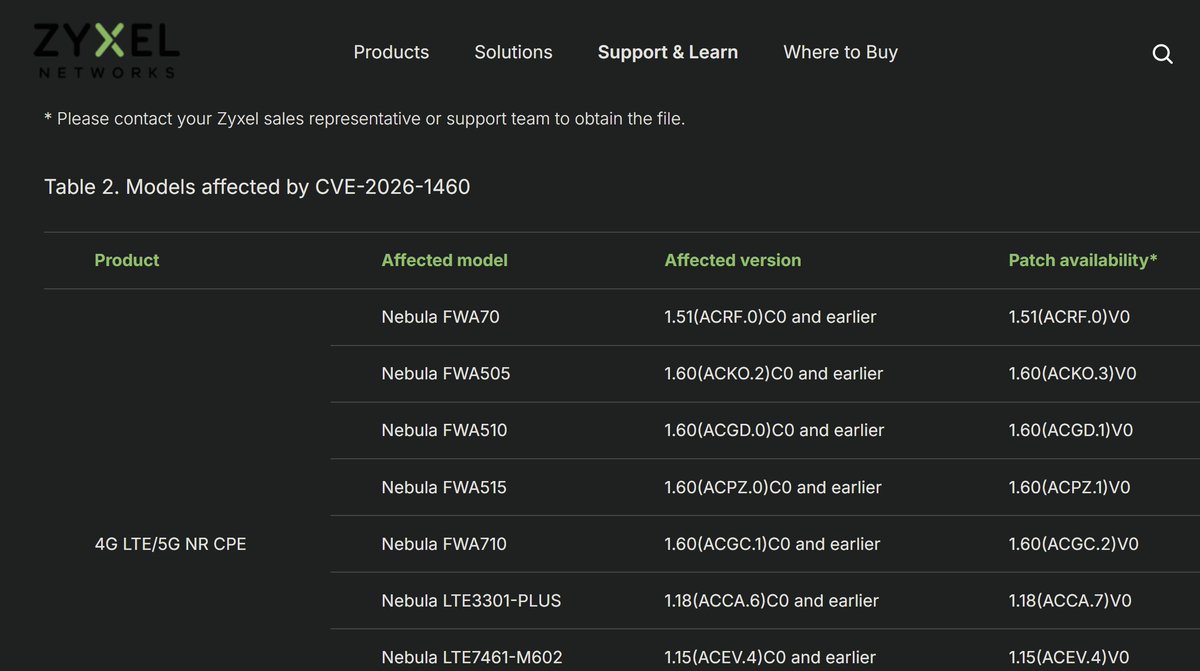
Post auth command injection for 45 platforms (4G LTE/5G NR CPE, DSL/Ethernet, CPE Fiber ONTs, Wireless Extenders)
Details and affected listed here:
https://t.co/Vy1qiZyM11
Zyxel has published 2 CVEs for some vulns I found :D
CVE-2025-13943: Authenticated command injection in log export CGI
CVE-2025-13942: Unauthenticated command injection in UPnP daemon
I will blog about this in the coming months. Meanwhile, exploits here: https://t.co/CbVHekdN5q
@WeldPond There are of course exceptions.
Should it work this way? Probably not - but at the same time security researchers spend many hours finding a vulnerability or doing contracted security testing and have to earn a living.
Anything important I find I make sure it gets fixed.
@WeldPond In my experience this is usally how it works which is why my disclosure blog stays mostly silent unless it's a personal project or the vendor has a no bug bounty policy.
If the vendor does publically disclose at all there is often a tendancy to downplay the impact/severity.
@AIengineerlife@0xor0ne I'm not aware of in the wild exploitation - Zyxel PSIRT were sent my formal report (linked in my blog post) ahead of publication.
The FW of other platforms I checked appear to no longer be vulnerable, with one exception they are actively reviewing (not yet confirmed vulnerable).
@evilsocket You are more than welcome my friend - as security researchers we all know exactly how fun those rabbit holes can be or what treasures we might find :)
For the embedded security enthusiast,
here’s a list of resources of vuln researchers inspecting the TP-Link security camera(s):
>By @evilsocket : TP-Link Tapo C200: Hardcoded Keys, Buffer Overflows and Privacy in the Era of AI Assisted Reverse Engineering : https://t.co/Iv5rjtZkqH
>By (me🤓): Exploiting n-day in Home Security Camera: https://t.co/pu03e6NV3L
>By @Watchful_IP : Link (Tapo) C210 cloud camera: bootloader vulnerability and firmware decryption : https://t.co/7Dt8GcvF8s
>By @two06 : Hacking a Tapo TC60 Camera : https://t.co/Q1DdIZrHvZ
>By @drmnsamoliu : Tapo C200 IP camera research project : https://t.co/pmgPsK8dFZ
@kindnessuae@0xor0ne Totally valid point.
Unfortunately in many cases if you want to collect a bug bounty you have to sign an NDA/contract which prevents you from publishing or CVE assignment etc.
The vast majority of my finds will never therefore be known except to the relevant vendor.
@kindnessuae@0xor0ne Thank you my friend - I appreciate those kind words.
This was just a fun personal project for me which meant I didn't have to write a dry confidential formal report that very few people would actually read. Made a nice change to share for once.
@0xor0ne@qkaiser Interesting!
Very different than the TP-Link (Tapo) C210 V2 target I looked at.
@qkaiser Surpised yours still let you get uboot shell using 'slp'
https://t.co/bjgVeOA6R2