Spring AI 1.0.8, 1.1.7, and 2.0.0-M7 are out now! 🚀
2.0.0-M7 highlights:
🔧 ToolCallAdvisor is now the default
✨ New ToolSpec fluent API
along with important improvements, stability enhancements, and bug fixes on 1.1.7 and 1.0.8: https://t.co/7NPfeTNeeF
@dzamsgaglo@tonux_samb Ah d'accord, je comprend. J'ai fait le lien avec le besoin de Ndongo il parlait juste d'un llm installé en local pour des usages de workflow agentic poussé.
Tu as raison pour ces uses cases. Mais partage master 😀.
Tu pourrais nous en parler à un meetup DRB ! Un petit REX.
@dzamsgaglo@tonux_samb 😂 ça m'étonne que ce soit un cheat code. 6000 balle la boite. et la conso en éléc ? Si tu veux des models plus performants tu risques d'augmenter le flouss. A ce rythme prend l'abonnement claude. Tu en as pour 5 ans avec le prix de la boite 😂 et plus avec openrouter.
‼️🇫🇷 Mistral AI allegedly breached: ~5GB of internal source code and ~450 private repositories exposed from the French AI company by TeamPCP
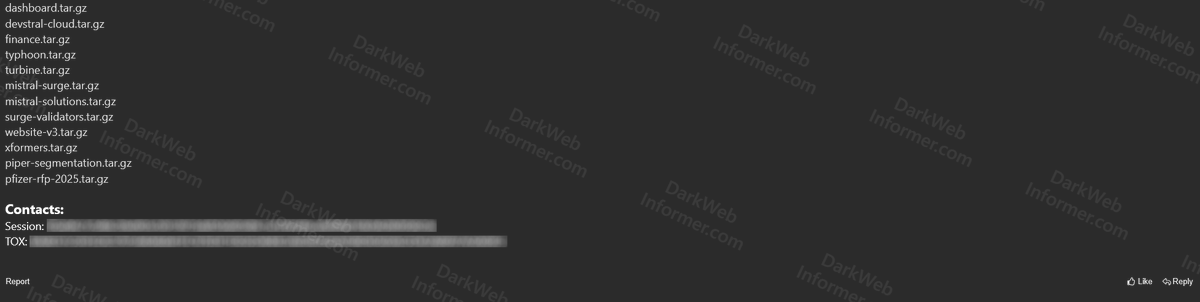
A threat group is selling approximately 5GB of internal repositories and source code allegedly belonging to Mistral AI and Mistral Solutions, covering training, fine-tuning, benchmarking, dashboard/platform, model delivery and inference, experiments, and future projects.
The actor is demanding a $25,000 BIN, stating they will shred the data permanently and sell to one buyer only, and threatening to leak all ~450 repositories for free to the forums within a week if no buyer is found.
▸ Actor: TeamPCP
▸ Sector: Artificial Intelligence / Source Code
▸ Type: Data Sale (with leak threat)
▸ Records: ~450 internal repositories, ~5GB total
▸ Country: France
▸ Date: 11/05/2026
Compromised data:
▪ mistral-inference-internal.tar.gz
▪ mistral-inference-private.tar.gz
▪ mistral-lawyer-internal.tar.gz
▪ mistral_finance_agent.tar.gz
▪ mistral-compute-poc.tar.gz
▪ mistral-fabric.tar.gz
▪ finetuning-feedback.tar.gz
▪ mistral-finetune-internal.tar.gz
▪ cma-customer-care-internal.tar.gz
▪ mistral-common-internal.tar.gz
▪ chatbot-security-evaluation.tar.gz
▪ kyc-doc-agent.tar.gz
▪ dashboard.tar.gz
▪ devstral-cloud.tar.gz
▪ finance.tar.gz
▪ typhoon.tar.gz
▪ turbine.tar.gz
▪ mistral-surge.tar.gz
▪ mistral-solutions.tar.gz
▪ surge-validators.tar.gz
▪ website-v3.tar.gz
▪ xformers.tar.gz
▪ piper-segmentation.tar.gz
▪ pfizer-rfp-2025.tar.gz
▪ Internal repositories tied to model training, fine-tuning, benchmarking, dashboard and platform code, model delivery and inference systems, experiments, and future project work
Stop guessing what's redacted. Subscribers see everything → https://t.co/281Qjc6p2J
@tonux_samb Honnêtement j’ai arrêté de vouloir installer en local. J’ai une M1 full dédié avec 16g de ram. J’ai install qwen2.5-coder:7b. les temps de réponse laisse tomber. Si je branche à openclaw ou simplement mon appli spring ai, je peux prendre un café le temps d’iune reponse 😂
@tonux_samb Sur ce coup c’est étonnant qu’ils n’aient pas pris de l’avance sur ça durant toutes ces années. Après tout c’est figma qui a la connaissance.
@tonux_samb J’aurais nuancé un peu ces propos. Tu as oublié l’expérience. Figma est en avance et a tjrs une carte à jouer. Claude n’a que la machine à prédiction. Et ça figma peut le construire je pense et de manière plus poussée. Je ne tiens pas compte des investissements à faire 😂.
Introducing Claude Design by Anthropic Labs: make prototypes, slides, and one-pagers by talking to Claude.
Powered by Claude Opus 4.7, our most capable vision model. Available in research preview on the Pro, Max, Team, and Enterprise plans, rolling out throughout the day.
LLM Knowledge Bases
Something I'm finding very useful recently: using LLMs to build personal knowledge bases for various topics of research interest. In this way, a large fraction of my recent token throughput is going less into manipulating code, and more into manipulating knowledge (stored as markdown and images). The latest LLMs are quite good at it. So:
Data ingest:
I index source documents (articles, papers, repos, datasets, images, etc.) into a raw/ directory, then I use an LLM to incrementally "compile" a wiki, which is just a collection of .md files in a directory structure. The wiki includes summaries of all the data in raw/, backlinks, and then it categorizes data into concepts, writes articles for them, and links them all. To convert web articles into .md files I like to use the Obsidian Web Clipper extension, and then I also use a hotkey to download all the related images to local so that my LLM can easily reference them.
IDE:
I use Obsidian as the IDE "frontend" where I can view the raw data, the the compiled wiki, and the derived visualizations. Important to note that the LLM writes and maintains all of the data of the wiki, I rarely touch it directly. I've played with a few Obsidian plugins to render and view data in other ways (e.g. Marp for slides).
Q&A:
Where things get interesting is that once your wiki is big enough (e.g. mine on some recent research is ~100 articles and ~400K words), you can ask your LLM agent all kinds of complex questions against the wiki, and it will go off, research the answers, etc. I thought I had to reach for fancy RAG, but the LLM has been pretty good about auto-maintaining index files and brief summaries of all the documents and it reads all the important related data fairly easily at this ~small scale.
Output:
Instead of getting answers in text/terminal, I like to have it render markdown files for me, or slide shows (Marp format), or matplotlib images, all of which I then view again in Obsidian. You can imagine many other visual output formats depending on the query. Often, I end up "filing" the outputs back into the wiki to enhance it for further queries. So my own explorations and queries always "add up" in the knowledge base.
Linting:
I've run some LLM "health checks" over the wiki to e.g. find inconsistent data, impute missing data (with web searchers), find interesting connections for new article candidates, etc., to incrementally clean up the wiki and enhance its overall data integrity. The LLMs are quite good at suggesting further questions to ask and look into.
Extra tools:
I find myself developing additional tools to process the data, e.g. I vibe coded a small and naive search engine over the wiki, which I both use directly (in a web ui), but more often I want to hand it off to an LLM via CLI as a tool for larger queries.
Further explorations:
As the repo grows, the natural desire is to also think about synthetic data generation + finetuning to have your LLM "know" the data in its weights instead of just context windows.
TLDR: raw data from a given number of sources is collected, then compiled by an LLM into a .md wiki, then operated on by various CLIs by the LLM to do Q&A and to incrementally enhance the wiki, and all of it viewable in Obsidian. You rarely ever write or edit the wiki manually, it's the domain of the LLM. I think there is room here for an incredible new product instead of a hacky collection of scripts.
@grafikart_fr Le patron d’Anthropic Europe disait dans un podcast que 90% de Claude est écrit par Claude malgré ça ils ont recruté beaucoup plus de dev. Cela dit ta phrase est vrai. L’IA est un outil de pair programming. Et pour travailler ave lui efficacement il te faut les fondamentaux.
My takeaways about this article :
AI isn't replacing one specific skill. It's a general substitute for cognitive work. It gets better at everything simultaneously.
Have no ego about it.
Be part of the early
Lecture recommandé.
🚀🇮🇷🇺🇸🇹🇭 WATCH: Shocking footage of a member of the crew of one of the ships targeted in the waters of the Persian Gulf was filmed moments after it was hit by an Iranian missile