Unconventional AI has reached a definitive agreement to acquire @NeuReality_AI , whose team and technology will play a central role in advancing our mission to make AI compute radically more efficient.
Unconventional is building a 4-dimensional substrate targeting a 1,000x improvement in AI compute efficiency over conventional architectures. Reaching that target requires co-design across device physics, silicon architecture, and the models themselves. @NeuReality_AI brings seven years of work on purpose-built AI inference silicon and infrastructure, plus an engineering team spanning system architecture, silicon design, and AI systems software. Together that materially compresses our timeline to production systems, and it establishes our engineering presence in Israel.
We're excited to welcome @MosheTanach , @tzshmueli , @YossiKasus , @LiorKhermosh , @iritfast83 , and the NeuReality team to Unconventional. Together we'll build a next substrate for intelligence, and the systems to put it into production.
Learn more: https://t.co/PottTJDMAF
"Every technology disruption, every one over history, has created more jobs than it destroys."
@NaveenGRao and @PGelsinger in @FortuneMagazine on why the AI transition will be no different, and why the real constraint is people.
https://t.co/dynNQMFm5V
At the @theallinpod Summit, our cofounder and CEO @NaveenGRao shared new details on our first test chip tape out:
"This is the first physical dynamical computer ever built. We did it in five months."
@chamath joins him to discuss the path to product.
https://t.co/BiwQLXnADJ
I made some public disclosures about our hardware at the @theallinpod conf this week and wanted to share the progress here. Earlier this summer we got hardware back! The execution was madness…we went from no team in Jan to a tape out in 5 months. AI enabled MUCH tighter loops of research and our execution speed shows the results.
This is the first large-scale demonstration of a causal, physical dynamical system to do real compute. 🚀
We released the Un-0 model (see link) in June and it runs on this physical system; the images below come from the actual hardware. What’s more, this chip requires <900 nJ to generate an image; this is many orders of magnitude less energy than conventional machines.
https://t.co/zYU0ezXJUq
Unconventional AI was founded on a suspicion: that more parameters and more attention is one path among several, and that the alternatives stay underexplored not because they are less promising but because they are harder to fund.
The Unconventional Grant exists to fund those alternatives. We said plainly that we would rather back a well-posed risk than a safe increment.
Today we are announcing our first cohort. Five projects, each receiving $100,000:
- Thierry Tambe (Stanford) is treating data retention as an architected resource, so processors stop spending area and energy preserving information long after the computation stops needing it.
- William Gilpin (UT Austin) is testing whether the slowdown in reasoning models is transient chaos, the same phenomenon that governs turbulent flows, and looking for the fractal traps in latent space that delay convergence.
- Logan Wright (Yale) is asking what neural scaling laws become when the neural network is a physical analog machine rather than a digital simulation of one, noise, drift, and energy budgets included.
- Yoon Kim (MIT) is pushing looped Transformers past the tens of loops where gains have appeared to saturate, into the hundreds and thousands, with primitives designed to keep parameters on-chip.
- Wanyu Lei, Daniel Kunin, and Friedrich T. Sommer (UC Berkeley) are deriving recurrent architectures directly from the mathematics of state updates, on the premise that efficient state tracking is not one capability among many but a foundational design principle.
To the five teams: congratulations. Each team describes its own project, in its own words, in the full announcement. https://t.co/rb3BU3KpIG
Introducing our first model, Un-0!
We trained an image generator powered by a backbone of coupled oscillators in place of a more traditional conventional neural network.
Did you know this wiggly thing can be a computer?
We think of computation as symbolic: add, subtract, multiply....
…but…you can also compute directly with voltage, current, charge, waves, materials (octopus arms…look it up)...or wiggles.
Today, we’re (@unconvAI ) sharing Un-0: our first step toward scaling this idea to modern AI workloads.
🧠 Today we introduce Un-0 from @unconvAI : the first large-scale generative model build on physics as a compute primitive. This represents a “hello world” moment for physics-based models. We use the inherent time-varying behavior of physical systems to do compute for us. The result is a new way to build a computer that can be VASTLY more power efficient. 🧵
https://t.co/zYU0ezXJUq
Most real-world systems are dynamic.
So why do we still treat computation as static?
Our latest blog explores computation through motion using gyroscopes, rods, springs, and ordinary differential equations to perform handwritten digit classification.
A deep dive into:
• dynamical systems as compute
• differentiable ODE solvers
• physics-inspired machine learning
• emergent computation through interaction
Read here: https://t.co/pIwwvT72Bw
Getting to 1000x energy efficiency in AI isn’t about one breakthrough.
It’s about solving two hard constraints:
1. Data movement dominates energy
2. Amdahl’s Law caps system-level gains
Which means you have to rethink everything: models, hardware, and how they’re designed together.
If this kind of problem excites you, you’ll enjoy our latest blog: https://t.co/3FFKWIm1nc
Analog is dead in today's AI stack.
At Unconventional AI, we think the next era of compute can be mixed-signal. Not analog vs. digital, but a new system that brings out the best of both.
Analog vs. digital. Which is actually better?
As AI systems hit efficiency limits, it might be time to rethink the abstractions we’ve taken for granted and focus on using the right tool for the job.
Explore the case for a mixed-signal future in our latest blog post “Analog is dead, long live analog.”
https://t.co/wnwafD16qq
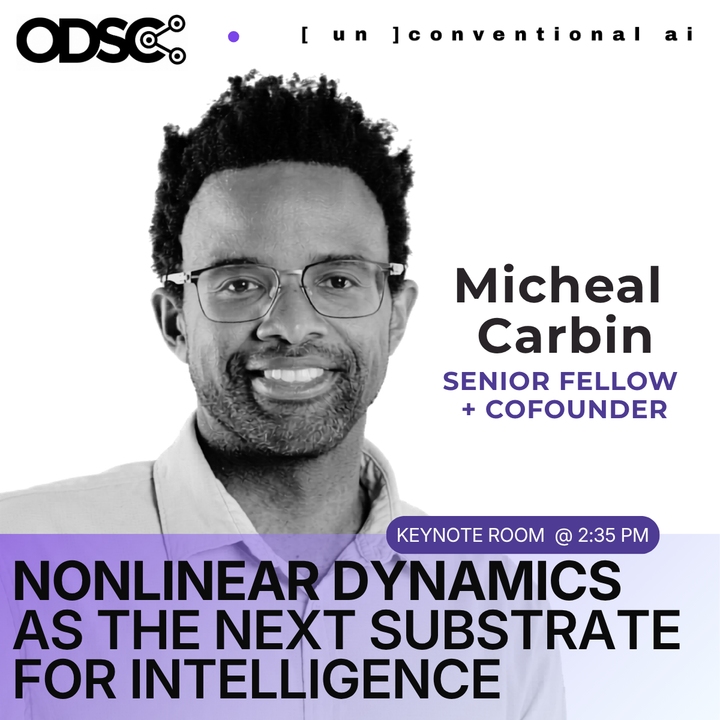
Attending #ODSCAIEast today? Join our cofounder @mcarbin at 2:35 PM ET in the Keynote Room.
“Nonlinear Dynamics as the Next Substrate for Intelligence” explores a fundamental idea: we may be building AI on the wrong substrate.
The human brain runs on ~20 watts. Today’s AI systems require orders of magnitude more. That gap isn’t just engineering, it’s architectural.
Michael will share why moving beyond digital computation toward nonlinear physical dynamics could unlock a radically more efficient path to intelligence.
We’re introducing the Unconventional Grant.
A new research grant program supporting bold, unconventional ideas in AI.
We’re allocating $500,000 in total funding, awarding up to five $100,000 grants to researchers exploring new paradigms in efficient, scalable, and biologically inspired AI systems.
We’re especially interested in ideas that challenge how AI systems are built today, from unconventional circuits and architectures to new approaches in neural networks and theory.
Not incremental work.
Not safe bets.
Ideas that push the field forward.
https://t.co/nkSvjhZE12
The biggest problem for AI in 2026 is not prompts or architectures. It is energy, throughput, latency, and scale.
Unconventional AI is solving that.
https://t.co/YoKB4oSVwq @lightspeedvp@NaveenGRao
[x(t_0) = x_0]
———————
import time
from math import prod
print("--- Initiating Dynamical System Simulation ---")
# The Attractors
Y = [104, 101, 108, 108, 111, 32, 119, 111, 114, 108, 100]
# The Analytic Evolution Function x(t): Lagrange Interpolation governing the dynamics
f = lambda t: sum(y * prod((t-k)/(j-k) for k in range(len(Y)) if k!=j) for j,y in enumerate(Y))
# Time Evolution: Step through discrete time t, observing state x(t)
acc = ""
for t in range(len(Y)): c=chr(int(round(f(t)))); acc+=c; print(f"Time t={t:2} | x(t): '{c}' | Trajectory: {acc}"); time.sleep(0.2)
At Unconventional, we’re building the computational substrate for the AI era.
Scientists and SWEs interested in dynamical systems (Diffusion, Neural ODEs, Deep Equilbrium Models, and Energy-based models) DM or email [email protected] (subject: dynamics). Things are getting really interesting really fast…
Hello world Unconventional, Inc.
I’ve gotten a new company off the ground. It’s a big swing…rethinking the foundations of a computer to build a new substrate for intelligence that is as efficient as biology. Brain Scale Efficiency without the biological baggage!
We CAN do it. We have to think differently from existing dogma. The computer in our heads proves it’s possible. 20 watt brains are within our reach with the right research and beautiful engineering.
Can you think differently? Do you want to be Unconventional? If so either drop me a DM or email at [email protected]