@CSIsolutions Agree the relationship is the edge. One gap we see a lot: a business owner asks ChatGPT which local bank handles SBA loans or payroll, and the bank's own site barely mentions either, so the branch never gets the visit. Did the survey ask where SMBs look before they walk in?
@iPullRank Good comparison. For a bank the safe route is also the plain one: answer the common questions on your own site under your own name, and earn mentions on pages that really are independent, like local news and review sites. Does the policy also cover agencies writing for a client?
@brian_armstrong@coinbase Curious how you measured the win on fraud prevention. Did the smaller model catch more fraud at the same false-positive rate, or mainly lower the cost of reviewing each case? That distinction matters for a bank deciding what to test first.
@FirstOhioCFCU How does a member link the outside account, and how long does the first transfer take? A short walkthrough covering those two steps would be handy alongside the app link.
@ramiakeela Member data needs that care. A smaller first project can use only public pages: check whether AI gives the right eligibility, fees and branch details when someone asks about the bank. That gives marketing a useful test without touching customer records.
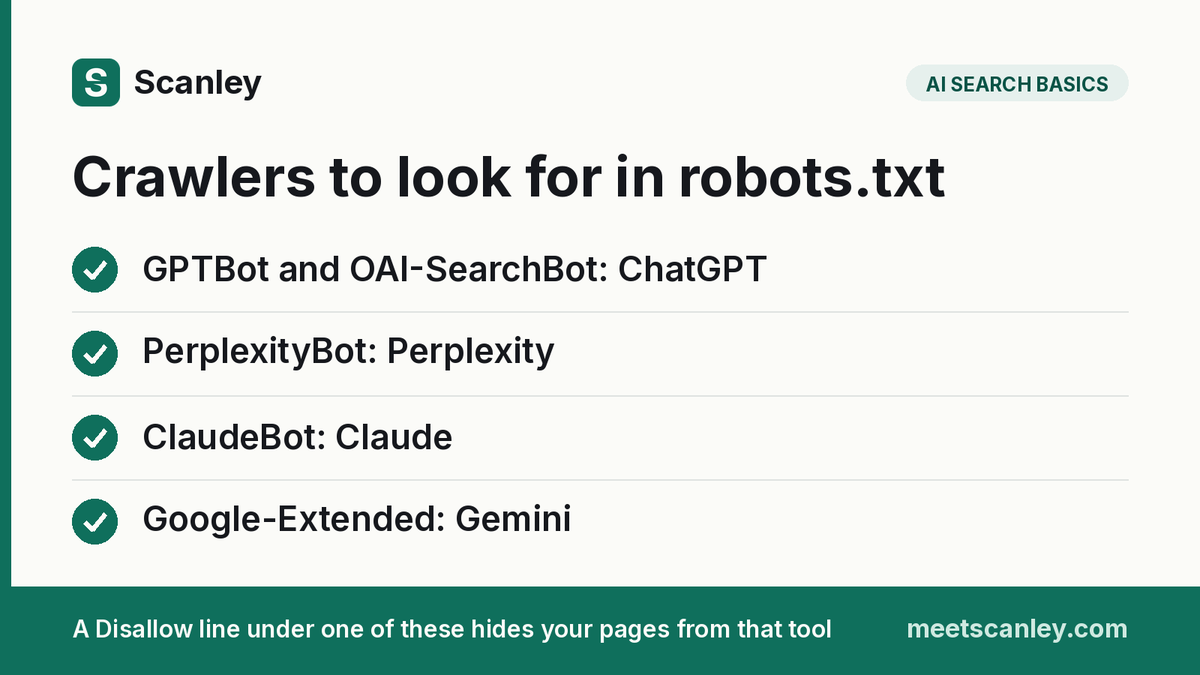
A 5 minute check that AI tools can read your site
1. Open /robots.txt on your website
2. Look for Disallow lines under GPTBot or PerplexityBot
3. Check that rate and branch pages are not blocked
4. Ask your web vendor before changing anything
A blocked crawler cannot cite you.
@CUbroadcast App ratings now show up in more places than the app store. When a member asks ChatGPT which credit union card to get, the app reviews are part of what it reads. Does the Elan report get into how members find the card before they ever download the app?
@WAGSNexa Good test, and the list of what it reads matches what we see: reviews, local press, awards, directories. One step worth adding is asking the same tool to show its sources, since those are the pages to keep current. Curious which sites it cited for you.
@GlassCityFCU Those reviews do double duty now. When someone asks ChatGPT or Perplexity about a credit union in northwest Ohio, reviews are part of what it reads before it names anyone. Worth linking the review page from the website too, so the two tell the same story.
@rexsalisbury Extinction is a big word, but one piece of it is easy to check today. Ask ChatGPT for the best checking account or auto loan near a bank's main branch and see whether the bank gets named. The pages it cites show what it reads, and those pages are fixable.
@ClintRising One question that is hard to answer from internal data: what ChatGPT or Perplexity says when a prospect asks who to bank with nearby, or asks about the institution by name. Pairing that outside view with call center and branch questions would be a strong signal. Is it in scope?
@MyCommBank Good timing. A lot of people now start that planning by asking ChatGPT how much to keep in savings or whether to pay down a card first. If the bank's own planning tips sit on a plain page like this one, those tools have something to point back to. Is there a page behind the post?
@FreedomBankNJ Good reminder for Cybersecurity Awareness Month. One addition that helps in the moment: a short page listing what Freedom Bank will never ask for, like a code or a password. When someone pastes a suspicious text into ChatGPT to check it, a page like that is what it can cite.
@KHCreditUnion Nice topic for members, since a lot of them already ask ChatGPT what to buy. Money questions go the same way now: people ask it where to get a car loan or how to join a credit union. A plain page like this one is exactly what those tools pull from, so it does double duty.
@DMGMarketers Agreed, and the same habit now runs through ChatGPT and Perplexity. A quick check for a credit union: ask one of them for a credit union near its main branch and see if it gets named. Pages that rank well in Google are usually the ones AI cites too, so the SEO work carries over.
@BankingJournal For a lot of banks, getting AI ready starts with the public site. If fees, rates and how to open an account are written plainly, both staff tools and outside tools like ChatGPT have something accurate to work from. Will the workshop cover that side?
@ABABankers@Kitboga A small step any bank can take: a plain page listing what it will never ask for, like codes, passwords or a transfer to a safe account. When a customer pastes a suspicious text into ChatGPT and asks if it's real, that page gives the answer something solid to cite.
@creditodds@Discover Notable that all five are national issuers. Plenty of credit unions offer secured cards too, but if the card details sit in a PDF or rate sheet, AI tools have little to cite. Did any credit union cards show up further down the list?
@Talkdesk Better access to information for agents usually means the answers are already written down somewhere. Worth checking how many of them are on the public site too: fees, who can join, how to open an account. Members ask ChatGPT those questions before they ever call.
The join page AI tools need from your credit union
Put who can join on one plain page:
1. Counties, employers or groups that qualify
2. What it costs to join
3. How to join online
4. The date it was last updated
Ask ChatGPT who can join your credit union and see if it matches.