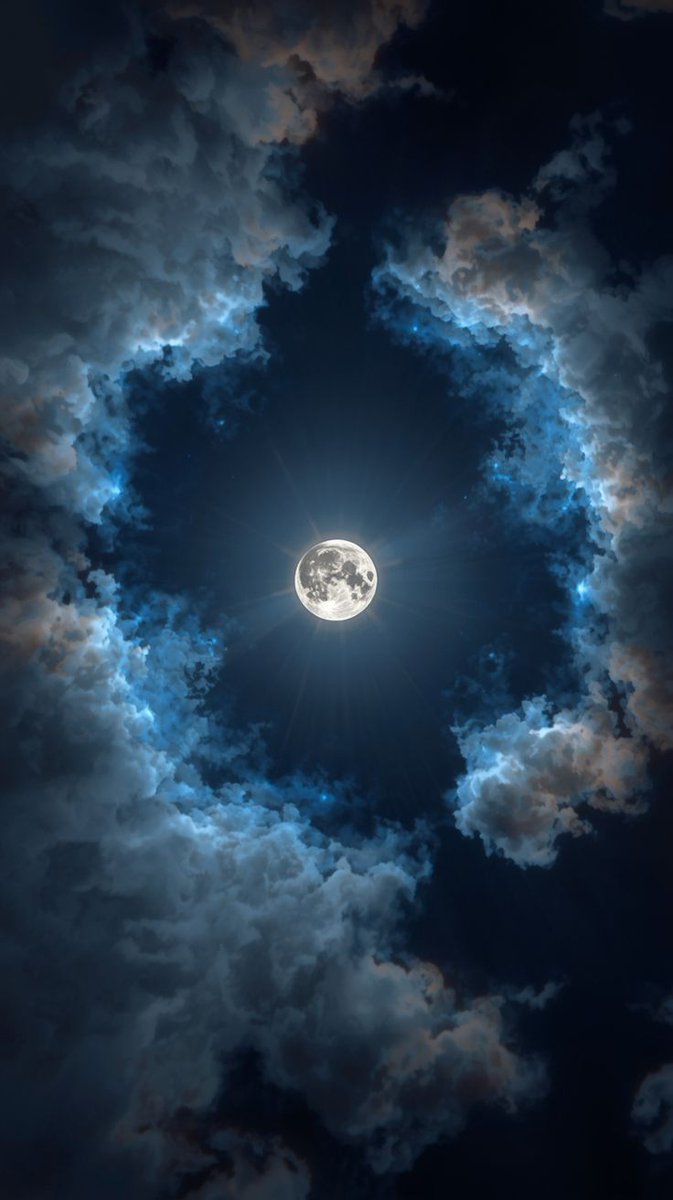
May 30, 2026. Look up.
As the rare Blue Moon rises above the ancient stones of Stonehenge, and planets align in the evening glow, we are reminded of a profound truth: We are small, yet deeply connected.
Thousands of years ago, others stood on this very ground, watching these same celestial lights dance across the night. Tonight, we share their view. We share their wonder.
A moment where history and astronomy breathe together.
#
🚨 JWST detected dimethyl sulfide in its atmosphere, which on Earth is produced by life.
K2-18b is potentially habitable super-Earth about 2.6 times the size of our planet. It is located 124 light-years from the Solar System.
Saturn doesn’t just have rings — it rules an entire miniature solar https://t.co/MrqpkqJLDA of 2026, the ringed giant boasts 292 confirmed moons, far more than any other planet, with the number still climbing as astronomers keep spotting tiny new ones. Dominating them all is Titan, a colossal world larger than the planet Mercury. With a thick nitrogen atmosphere, rivers and lakes of liquid methane, and a diameter of 5,150 km, Titan feels more like a planet that got captured than a mere moon.Titan orbits Saturn at a safe distance of about 1.2 million kilometres — well beyond the outer edge of the famous ring system. Those dazzling rings, made of countless icy particles and moonlets, are confined much closer to the planet, while Titan sails majestically around the entire sprawling family of satellites. The sheer crowd of moons — from planet-sized Titan down to kilometer-scale irregular rocks — reveals just how gravitationally chaotic and crowded Saturn’s neighborhood truly is. It’s a dynamic, ever-evolving system where collisions, captures, and gravitational dances continue to shape one of the most spectacular regions in our Solar System.
Artemis II: Closing in on the MoonThe astronauts of Artemis II are now truly venturing into deep space — and the Moon is getting closer every hour.They have already traveled more than 200,000 miles (about 320,000 km) from Earth. With every passing moment, our home planet grows smaller in their windows, while the Moon looms larger ahead. Soon, the Moon’s gravitational pull — its “sphere of influence” — will begin to dominate, gently tugging the spacecraft into its embrace.Right now, the crew is fully immersed in the demanding routines of deep-space flight: Running critical checks on the life support systems that keep them alive
Testing communications with Earth across vast distances
Practicing manual flight maneuvers
And carefully preparing for the dramatic lunar flyby that lies just ahead
This is the moment Artemis II transitions from leaving Earth behind to preparing for humanity’s return to the Moon — not just orbiting it, but getting ready to push the boundaries of exploration once again.The journey is entering its most exciting phase.
🚨 The Universe Has a Point With No Time, No Space, No Rules
There is a place in the universe where space has no size, time has no meaning, and the laws of physics simply collapse. Scientists call it a cosmic singularity—but that name barely hints at how strange it truly is. Imagine everything that exists… stars, galaxies, even time itself… crushed into a single point with infinite power. No light escapes it. No equation can fully explain it. And no one knows what truly happens there.
This is where our universe may have begun. Before stars, before atoms, before seconds could even tick forward, everything was packed into one impossible point. There was no “before” it—because time itself started there. That idea alone is unsettling. How can something begin without a before? What caused it? Or was it always there, waiting?
Cosmic singularities may also hide inside black holes, sealed away behind darkness. Once something falls in, it never comes back out, carrying secrets we may never recover. Inside, gravity becomes endless, space folds into itself, and reality tears apart. Our best theories fail completely at this boundary, as if the universe is telling us: you are not meant to see beyond this.
Some scientists believe singularities are real. Others think they are warning signs—proof that our understanding of the universe is still broken. Maybe reality doesn’t end there. Maybe something new begins. A bounce. Another universe. Or laws of physics we haven’t discovered yet.
One thing is certain: cosmic singularities sit at the edge of human knowledge. They are the deepest mystery we have ever faced. And the closer we look, the more the universe seems to whisper that its greatest secrets are still hidden… just beyond what we can understand. 🌌
🚨 What Happened Before the Big Bang? 🤯
What if the universe didn’t begin with a slow expansion… but with a violent, mind-bending growth spurt that happened in less than a blink of an eye? Scientists believe that right after the Big Bang, the universe suddenly expanded at an unbelievable speed—stretching space itself faster than light. This mysterious event is called Cosmic Inflation, and it may explain why the universe looks so calm, balanced, and strangely familiar today.
Here’s the eerie part: regions of the universe that are billions of light-years apart look almost identical, as if they once whispered secrets to each other. But how could they, when there wasn’t enough time for light—or anything—to travel between them? Inflation offers a chilling answer: long ago, everything was tightly packed together… and then space itself exploded outward, tearing the universe apart while keeping its hidden order intact.
The idea was first proposed by physicist Alan Guth, and it changed cosmology forever. According to this theory, tiny quantum ripples—smaller than an atom—were stretched across the universe, becoming the seeds of galaxies, stars, and even us. That means every galaxy you see tonight may have started as a random quantum twitch in the newborn universe.
Even more unsettling? Inflation suggests the universe was designed to look flat and smooth, like a cosmic illusion. And some versions of the theory hint that inflation never truly ends… that it keeps creating new universes endlessly. If that’s true, our universe might be just one bubble in an infinite cosmic ocean.
We can’t see inflation directly—but its fingerprints are everywhere, written into the faint glow left behind by the Big Bang. The deeper scientists look, the more it feels like the universe is hiding a secret from its very first second.
So the next time you look up at the night sky, ask yourself this:
Are we living in the quiet aftermath of the most explosive moment reality has ever known? 🌠