Coding is basically the pinnacle of what you could reasonably automate with AI, and yet we still need human engineers to oversee agents for them to be effective.
The AI models are trained on an incredible amount of sophisticated code. The users are highly technical and can use the latest tools quickly. The work is “verifiable” because you can test an app. The outcomes are often removed from the quality of the code (you can have sloppy code but the app can still work). And the context for the agent is often already digitized and sitting in the codebase.
That’s an incredible amount of benefits that AI coding agents get to work with. Some of those apply to knowledge work, but most don’t in areas where the work needs to be fully reviewed to be useful, or where data isn’t as abundantly digitized. This makes the job for agents in knowledge work more complicated.
So if with all of that, engineers still remain in very high demand, the risks are going to be less than what’s perceived for other areas of knowledge work. Agents will let people do far more than they did before, but the people don’t go away.
At this point, fairly solid evidence of a reacceleration in payrolls. Unclear how long it will last or if it will be revised, but 1) QCEW so far hints at relatively low revisions for 2025; 2) in a low-labor-supply-growth environment, a +172K print is stronger than treading water.
It’s really incredible the absolute AI GARBAGE that people are comfortable sending to their coworkers and bosses
There’s a good chance productivity will actually *decrease* as AI adoption increases because everyone is busy wading through AI slop
Professional/business services job openings surged — at least while the AI capex boom is going on there isn’t going to be mass labor disruption (kind of by definition):
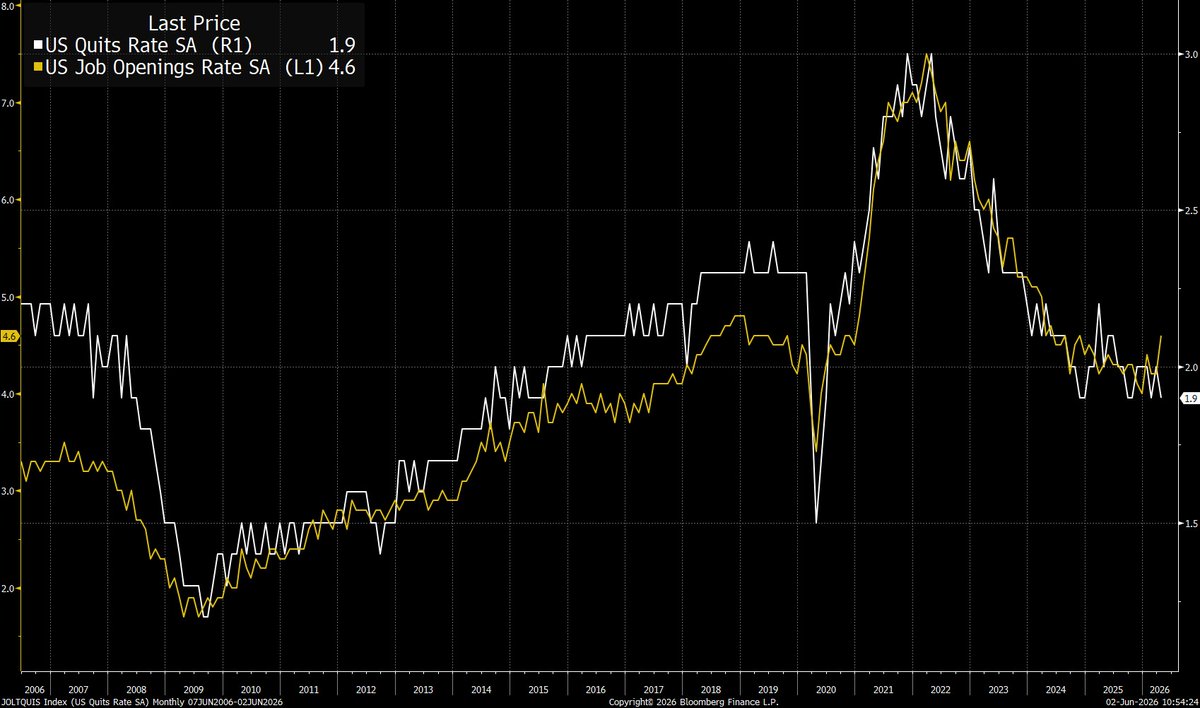
I wouldn't put much stock on one noisy chart, but...
There may be a divergence brewing between job availability and worker perception of job availability.
Job openings (yellow line) have been rising all year. The QUITS rate is back at post-COVID lows.
New: Kevin Warsh has tapped two outside associates as advisers—in as temporary contractors for now.
Both are budget policy specialists, and one wrote the Fed chapter of Project 2025, which endorsed a radical restructuring of the central bank. https://t.co/iJnZBQjC8f
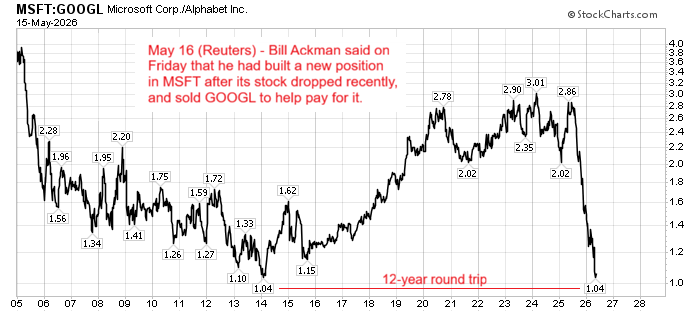
Google is fighting every final boss at once:
OpenAI & Anthropic in models, Nvidia in chips, AWS & Microsoft in cloud, Meta in ads, Tesla in self-driving, Apple in phones and OS.
At $4.6T, it feels weirdly undervalued.
$MSFT canceled its AI coding licenses over cost. $NVDA found AI was more expensive than headcount for months. The case for hiring humans back may be building faster than anyone expected. Fundstrat weighs in: https://t.co/iA7ONmKVPM
We're getting another round of THE AI BUBBLE IS POPPING stories, with the news about Uber/Microsoft pulling back on AI subscriptions bc their agent costs went crazy.
Maybe. But, per below, GPU rental prices are still up 2x from where they were four months ago. It doesn't seem like demand is slowing down, at all. When, eg, NYC hotel prices are twice as high as they were last year, you shouldn't believe people telling you that nobody is going to NYC anymore.
Maybe someone smarter than me can correct me on this logic, but if the price for accessing AI compute is skyrocketing, that's because demand is still significantly outrunning supply, which sounds to me like the opposite of the beginning of the end of a bubble.
Job switching is low, the hiring rate is low, housing turnover is low, migration is low — it’s a really great time to be settled but a difficult time to make any kind of major job/housing change.
But why WFH? We also propose a stylised model to explain the mechanism: WFH makes supervision, monitoring, and on-the-job learning harder, all of which hit junior-workers more. Firms less willing to invest in junior talent when these frictions rise.
BUT when we control for WFH exposure, this effect all but disappears in our baseline results. This is NOT the case with WFH exposure, which is a robust predictor of the fall in junior-share of hiring with or without AI
This has been shown to be concentrated in routine-cognitive white collar occupations. The challenge we highlight is that GenAI exposure is super strongly correlated with WFH exposure, posing a challenge for empirical analysis.
The US has now had 55 consecutive months of the unemployment rate below 4.6%, more than the GFC recovery (37) & the dot com boom (40), & 2nd only to the 1965-70 expansion (59).
One possibility is that NAIRU has risen, maybe because reservation wages higher or greater mismatch.