$QCOM investor day setup. We see a low single digit (1-5%) market share opportunity over the next few years. Translating to about $10 Billion of incremental revenue per 1%. This isn’t an $NVDA compete story. It’s an execution story vs. deals we expect to be announced today. 👀
@NoContextHumans Japan is meticulous about minor rules and proprieties, yet often evasive when it comes to fundamental questions of moral responsibility.
That’s how they make money. Think about it: Robinhood received an allocation of 1 million shares from SpaceX, but Robinhood users submitted requests for 10 million shares. Robinhood can earn interest on the funds associated with those 10 million requested shares while only needing to commit to the 1 million shares it was actually allocated.
Am I only one listening to $CRM’s earnings call? Their CEO just said $CVS and Salesforce are working on something and will do a press release tomorrow.
My guess is that CVS signs a large multi-year Salesforce expansion with Agentforce.
Not financial advice.
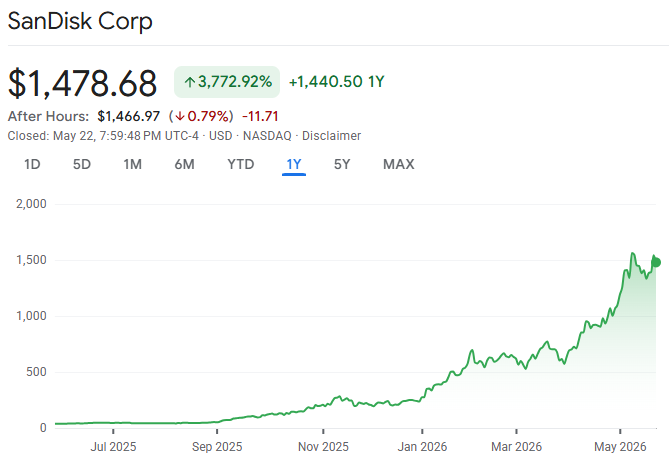
Do you want to know how to find the next $SNDK?
Listen to the hyperscalers' earnings calls and pay attention to what the CEOs are complaining about. Focus on the infrastructure problems those companies cannot solve fast enough, because that is where the asymmetry lives.
In early 2024, Jensen Huang and the broader NVIDIA ecosystem started openly discussing supply constraints around HBM, packaging, and memory availability.
One of the clearest early signals came during NVIDIA's February 2024 earnings call, when Huang repeatedly emphasised that demand was exceeding supply and that next-generation systems were incredibly complex to manufacture because of advanced memory and packaging requirements.
Plus, in March 2024, SK Hynix said HBM would become a double-digit percentage of DRAM sales as AI demand exploded, with initial shipments going directly to NVIDIA.
By March and April, Micron disclosed that its HBM capacity was essentially sold out through 2025. Around the same time, reports surfaced that Samsung was struggling to qualify HBM products for NVIDIA because of heat and power consumption issues.
To put it simply:
> NVIDIA cannot ship AI systems without HBM.
> HBM supply is constrained.
> Memory suppliers are sold out years ahead.
That last point was the clearest sign that the entire advanced memory and storage ecosystem was about to rerate.
Now apply the same lens today. Hyperscalers are deploying AI infrastructure regardless of cost, and they are telling you exactly where the bottlenecks sit if you listen.
Pull up the earnings calls from Microsoft, Amazon, Alphabet, Meta, and Oracle, and pay attention to:
> What they are complaining about.
> Repeated bottlenecks.
> Phrases management keeps repeating quarter after quarter, like "demand exceeds capacity."
That is the simple roadmap to the next big runner.
A few years ago the bottleneck was GPUs, then it became networking, then memory and now, increasingly, it is power, cooling, storage, interconnects, and physical data centre capacity.
Hyperscalers are openly telling investors they cannot get enough electricity, enough cooling infrastructure, enough grid connectivity, or enough high-performance storage fast enough to satisfy AI demand.
These companies are effectively telling you where hundreds of billions of dollars are about to flow. Microsoft, Google, Amazon, and Meta will collectively spend over $320 billion on AI infrastructure in 2026, and more than 60% of that is going into power infrastructure, cooling, and data centre construction.
I am betting on $IREN.
Note that you'll be wrong on most of these. The point isn't to nail every pick, it's to set up a portfolio where one or two big winners more than pay for the misses.