Google just automated the PhD.
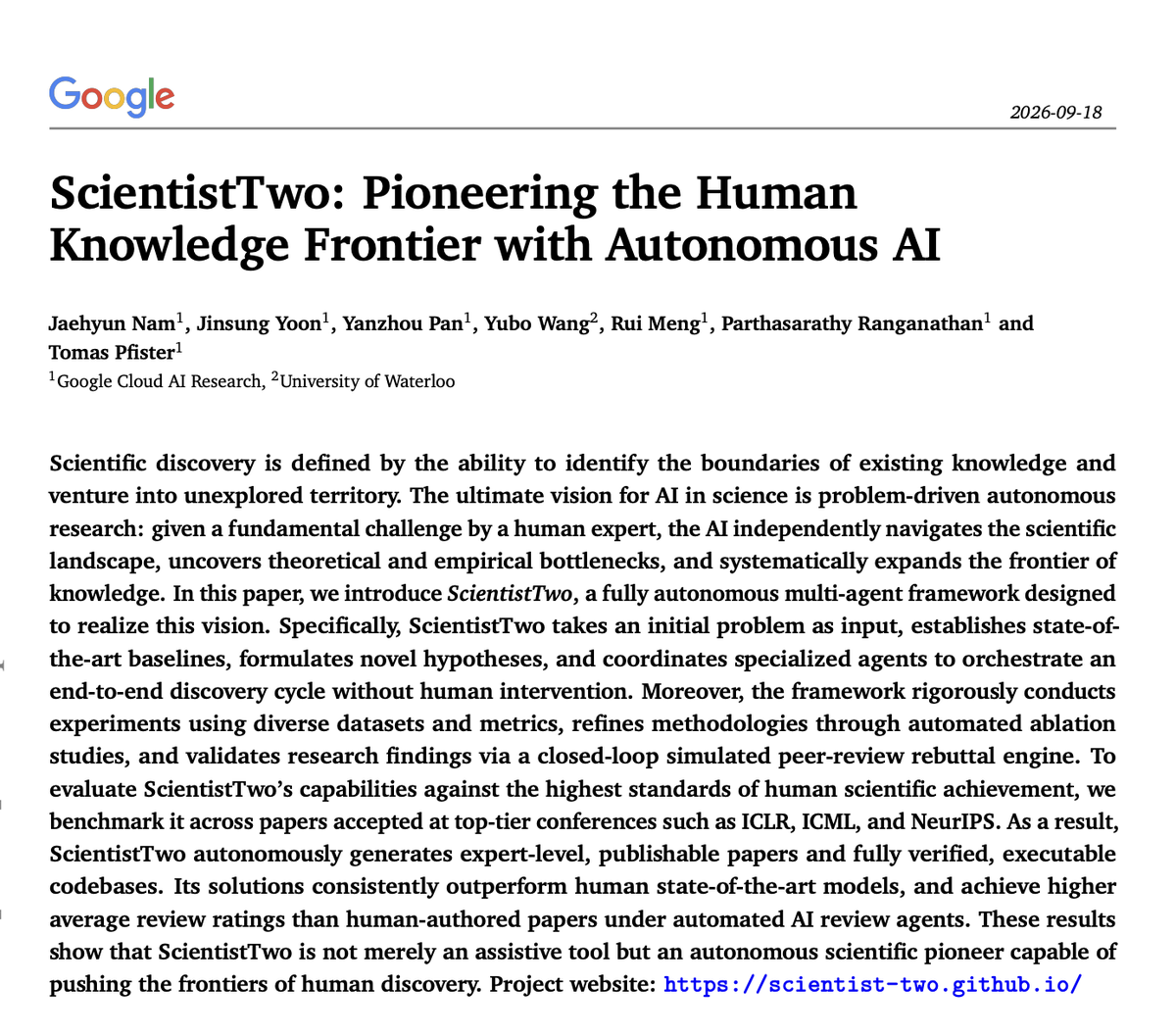
They built an AI that reads a problem, forms hypotheses, runs experiments, writes the paper, AND simulates its own peer review. no human touches it.
It’s called “ScientistTwo”
It is a fully autonomous multi-agent framework that executes end-to-end machine learning research.
Without a single human in the loop.
You give it a fundamental challenge. That’s it.
The AI independently navigates the literature. It establishes the baselines. It formulates novel hypotheses.
Then it writes the code. It runs the experiments. It conducts its own ablation studies.
It even argues with a simulated peer-review engine to refine its work before submitting.
The results are staggering.
Researchers tested ScientistTwo against the highest standards of human scientific achievement—papers accepted at top-tier conferences like NeurIPS and ICML.
The AI improved human state-of-the-art results on 86 different tasks.
It generated an average performance gain of 25.2% over the absolute best human models.
It didn't hallucinate a single citation. It wrote fully executable, verified codebases. And it autonomously generated expert-level, publication-ready papers.
We’ve spent the last two years using AI as a highly advanced intern to help us write code and summarize data.
That era is over.
ScientistTwo isn't an assistant. It is an autonomous scientific pioneer.
It doesn't just summarize the frontier of human knowledge. It expands it.
If an AI can autonomously hypothesize, test, and publish breakthroughs in machine learning...
How long until it discovers something we don't even have the math to understand?
Read this paper (ACL 2026 Outstanding Paper) which exploits the overthinking capabilities of LMs and tricks them into establishing improper causal links between true facts (hallucination hello?) Guess when push comes to shove even LMs overthink Must read! https://t.co/EY8CtHIm37
Claude Opus 5.5 dropping with Fable 5.1 intelligence levels is crazy.
We went from "too powerful for public release" from 2025 as a standard model in late 2026.
Introducing Claude Opus 5.5, the first model in our new Claude 5.5 family.
It performs at the level of Claude Fable 5.1 for most tasks, and costs 40% less to run than Opus 5.