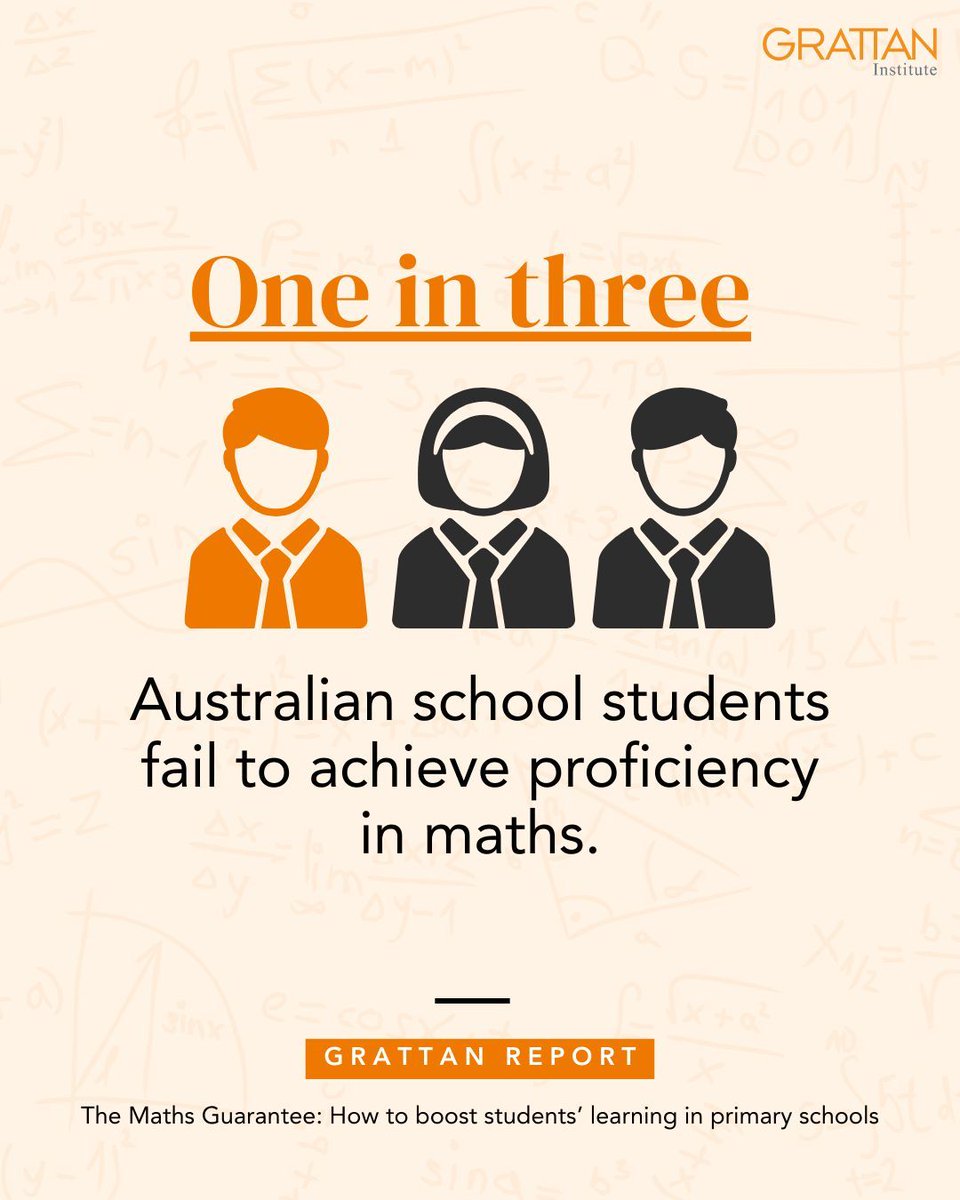
Australia has a maths problem.
1 in 3 Australian school students fail to achieve proficiency in maths.
Our new report by @hunter_jordana@Amy_L_Haywood@NickJParkinson and Dan Petrie shows how to lift maths achievement in primary schools. https://t.co/kZ2BABKT3s #auspol
𝗙𝗹𝗮𝘄𝗲𝗱 𝘁𝗵𝗶𝗻𝗸𝗶𝗻𝗴 𝗶𝗻 𝘁𝗵𝗲 𝗺𝗮𝘁𝗵𝘀 𝗰𝗹𝗮𝘀𝘀𝗿𝗼𝗼𝗺
This week, the Federal government sealed a blockbuster deal with Western Australia in which they agreed to additional taxpayer funds for WA’s public schools in return for them meeting certain conditions. One of these eminently sensible conditions is to commit to evidence-based teaching reforms. You may be forgiven for thinking schools are already obligated to follow the evidence, but you would be wrong, as the story of an extraordinarily fashionable approach to teaching mathematics shows.
Building Thinking Classrooms is the invention of Peter Liljedahl, a Canadian education professor. It does not derive from principles of cognitive science, but rather from a sequence of interventions Liljedahl has trialed in various classrooms. Eccentrically, it involves students working in groups and writing their answers to problems on vertical surfaces i.e. whiteboards mounted on the walls or walls covered in whiteboard paint.
In one section of Liljedahl’s popular book on the subject, he advises maths teachers against answering students’ questions when they are working on problems. Instead, teachers should walk away. He mentions that when he asked teachers to experiment with this approach on primary school students, the students would follow the teacher around or prod them in the arm, thinking the teacher had not heard the question. So now he advises teachers to smile before they walk away so students know the teacher has heard the question but has decided not to answer it.
“There were still a few students who were frustrated by these encounters,” he acknowledges. I’ll bet there were!
Why follow this approach? As Liljedahl argues elsewhere in the book, students who have mathematical tasks explicitly demonstrated to them by the teacher may initially perform better than students taught using his method, but that’s because they are “mimicking.” According to Liljedahl’s definition, “mimicking is not thinking are therefore not learning.” It’s a neat bit of wordplay.
Essentially, anything that does not involve students figuring out mathematical problems for themselves does not fit Liljedahl’s definition of thinking. This implies that any strategies taught by the teacher to the students are ruled out. Our superpower as a species – our ability to communicate and understand complex ideas – is off the table. Instead, as students fumble around for solutions and potentially become frustrated, teachers smile, refuse to answer their questions and walk away.
Not only is this bizarre, but it is also not aligned with the vast body of evidence that supports the explicit teaching of mathematics. See, for example, Emeritus Professor John Sweller of the University of New South Wales and his work on cognitive load theory. This suggests students will rapidly become overwhelmed by implicit teaching methods in which they are asked to figure things out for themselves.
This is confirmed by a different avenue of research, where investigators observe teachers and match teaching practices to outcomes. This supports a system of teaching which starts with the teacher clearly and fully explaining all concepts and demonstrating all procedures to students before gradually releasing control to them in a staged manner. This type of explicit teaching is the kind of evidence informed practice Western Australia will need to commit to, and New South Wales and Victoria have already chosen to focus on.
Liljedahl’s approach is also at odds with common sense. I have been teaching physics and mathematics for 27 years in England and Australia. When my teenage daughters come to me with a homework question they don’t understand, I do not smile and walk away, I explain it to them. If they still don’t understand it, I break it down further and explain it some more. Skilled teachers know there is always a doorway to understanding and it is their job to find it, not to walk away.
You may be thinking that in Australia, we are too grounded to fall for teaching crazes of this kind. Unfortunately, we are not. Just last month, the Australian Association of Mathematics Teachers held an event in Canberra for teachers and school leaders on Building Thinking Classrooms, presented by Peter Liljedahl. There are Facebook groups, discussions on Reddit and anecdotally, signs Australian schools are beginning to commit to the method.
If we have ambitions to be a science and mathematics superpower then let’s hope common sense and evidence prevail and let’s hope they prevail soon.
I’ve been seeing a lot of attempts at group assessment in classrooms lately. How do you know an individual student has mastered the material by looking at a product that was developed by five kids, two of which did all the work and two who were dragged along doing nothing?
"When asked to engage in more complex math tasks, students reported higher levels of math anxiety....
educators should focus on building student's complex computation skills" https://t.co/yBYad3EMHq
If you tailor a curriculum solely to children's current interests and experiences, you overlook a crucial goal of education. Schools should expose them to the vast and varied wonders of the world, including those they have never imagined.
Its out! Overall students report higher math anxiety on complex math tasks and no differences on overt or covert timed conditions. Students with med/high math anxiety report more math anxiety on complex tasks under covert timing. @kathrinmaki
https://t.co/ZTdpoKYFaj
"Explicit and direct instruction is trauma informed practice. It's predictable and they experience a high success rate" - Cranbourne Primary principal Lachy Yeates on the wellbeing benefits of shifting to explicit teaching
NEW: Article via @feistyredhair
Improving Student Math Skills: Math Professor POV
Dr. Anna Stokke @rastokke, professor of mathematics @uwinnipeg shares proven tips for parents/educators to sharpen kids' #math skills w/ @liannecastelino.
https://t.co/xc5C0L7isk
#parenting
“We must refrain from falling prey to educational fads fuelled by collective hype within educational circles, which often disregard scientific evidence published in journals focusing on cognitive science."
Great work @DrTanyaEvansNZ! https://t.co/bd1LfsBuaY
If I create a world in #MinecraftEdu for my class, am I able to share ownership with a co-teacher so that Ss can access the world when I'm not working? @PlayCraftLearn
#whatif instead of having reading because it’s 9:00am, we read because we have something we want to learn about. #whatif instead of writing because it is 9:50am we write because we have something to communicate #ToddleTIES@whatedsaid#sogood
Now is the perfect time to let go - let life be our curriculum. “There is no doubt that there’s far too much stuff in our curriculum...developers cannot bear the thought that any children might have spare time on their hands”. @dylanwiliam https://t.co/XDnGUAW6Y6