Tired of not knowing where to farm an item?
Copy any build Loot Filter that highlights Uniques, paste it into our Boss Loot Tables tool, and click "See Where to Farm." Every matching item will be highlighted, so you instantly know which bosses to target.
Don't have a Loot Filter? No problem. Open any build on and click "See Where to Farm" below the gear section. The tool will automatically highlight every required item and even let you track your farming progress.
https://t.co/kVU1mmAvhu
This case study explains how Groww built an internal chaos engineering platform on Kubernetes to run controlled failure drills like network faults, dependency outages, and traffic replay before real incidents hit production
➜ https://t.co/e2uJdEgBJK
PostgreSQL on Kubernetes is no longer “can we?” but “how?”
This guide covers the architecture choices that matter: operators, HA, PgBouncer, storage, monitoring, backups, and PITR
https://t.co/q2xHpc8Y2x
Working on a detailed prompt? 📝
Press Ctrl+X to open and edit the prompt in your preferred editor like @antigravity for example.
When you are done, your prompt will be waiting for you back in Gemini CLI 🪄
kubectl-ip-check plugin checks whether pod IPs are reachable and correctly routed from cluster nodes, helping you quickly detect basic Kubernetes networking and CNI issues before deeper debugging
➤ https://t.co/lAsIf0QrRV
New Engineering blog: We tasked Opus 4.6 using agent teams to build a C compiler. Then we (mostly) walked away. Two weeks later, it worked on the Linux kernel.
Here's what it taught us about the future of autonomous software development.
Read more: https://t.co/htX0wl4wIf
helm-unittest is a tool that allows you to write unit tests for Helm charts in YAML, ensuring your charts are consistent and robust
➤ https://t.co/K3RWfOYJ0j
4 architectures to help you connect intelligence with infrastructure to build gen AI solutions:
1) Personalized retail recs
2) Dynamic marketing campaigns
3) Multi-modal automation for podcasts
4) Intelligent+grounded customer support
Check them out → https://t.co/9VelNko0Dg
I'm Boris and I created Claude Code. Lots of people have asked how I use Claude Code, so I wanted to show off my setup a bit.
My setup might be surprisingly vanilla! Claude Code works great out of the box, so I personally don't customize it much. There is no one correct way to use Claude Code: we intentionally build it in a way that you can use it, customize it, and hack it however you like. Each person on the Claude Code team uses it very differently.
So, here goes.
This tutorial walks you through setting up Google Cloud IAP for Kubernetes services, using CDKTF (TypeScript) to configure OAuth, BackendConfig, and service annotations so your internal tools are protected behind identity checks
➜ https://t.co/c20evq8q8w
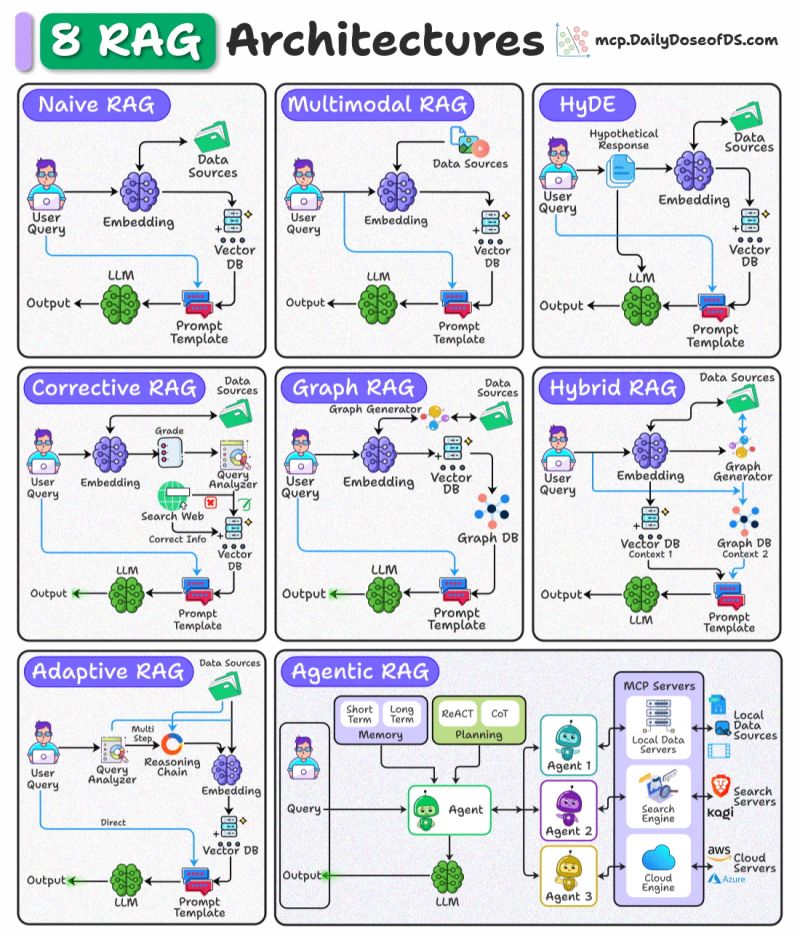
8 RAG architectures for AI Engineers:
(explained with usage)
1) Naive RAG
↳ Retrieves documents purely based on vector similarity between the query embedding and stored embeddings.
↳ Works best for simple, fact-based queries where direct semantic matching suffices.
2) Multimodal RAG
↳ Handles multiple data types (text, images, audio, etc.) by embedding and retrieving across modalities.
↳ Ideal for cross-modal retrieval tasks like answering a text query with both text and image context.
3) HyDE (Hypothetical Document Embeddings)
↳ Queries are not semantically similar to documents.
↳ This technique generates a hypothetical answer document from the query before retrieval.
↳ Uses this generated document’s embedding to find more relevant real documents.
4) Corrective RAG
↳ Validates retrieved results by comparing them against trusted sources (e.g., web search).
↳ Ensures up-to-date and accurate information, filtering or correcting retrieved content before passing to the LLM.
5) Graph RAG
↳ Converts retrieved content into a knowledge graph to capture relationships and entities.
↳ Enhances reasoning by providing structured context alongside raw text to the LLM.
6) Hybrid RAG
↳ Combines dense vector retrieval with graph-based retrieval in a single pipeline.
↳ Useful when the task requires both unstructured text and structured relational data for richer answers.
7) Adaptive RAG
↳ Dynamically decides if a query requires a simple direct retrieval or a multi-step reasoning chain.
↳ Breaks complex queries into smaller sub-queries for better coverage and accuracy.
8) Agentic RAG
↳ Uses AI agents with planning, reasoning (ReAct, CoT), and memory to orchestrate retrieval from multiple sources.
↳ Best suited for complex workflows that require tool use, external APIs, or combining multiple RAG techniques.
👉 Over to you: Which RAG architecture do you use the most?
KubeElasti lets your Kubernetes services scale to zero when there’s no traffic by sitting behind a proxy that queues incoming requests, and then spins up pods when traffic arrives again
➤ https://t.co/LHhTPIDKdQ
Kueue is a set of APIs and controller for job queueing. It is a job-level manager that decides when a job should be admitted to start (as in pods can be created) and when it should stop (as in active pods should be deleted). https://t.co/MI2hBgH2c0