The biggest zero-sum game in tech right now? The Memory Market.
Memory production for AI is completely cutting off the "oxygen supply" for standard DRAM and NAND. Prices are skyrocketing, and tech giants are scrambling.
Get all your memory market intel in one place.
Welcome to The Memory Report.
Nothing in the supply picture argues for a top.
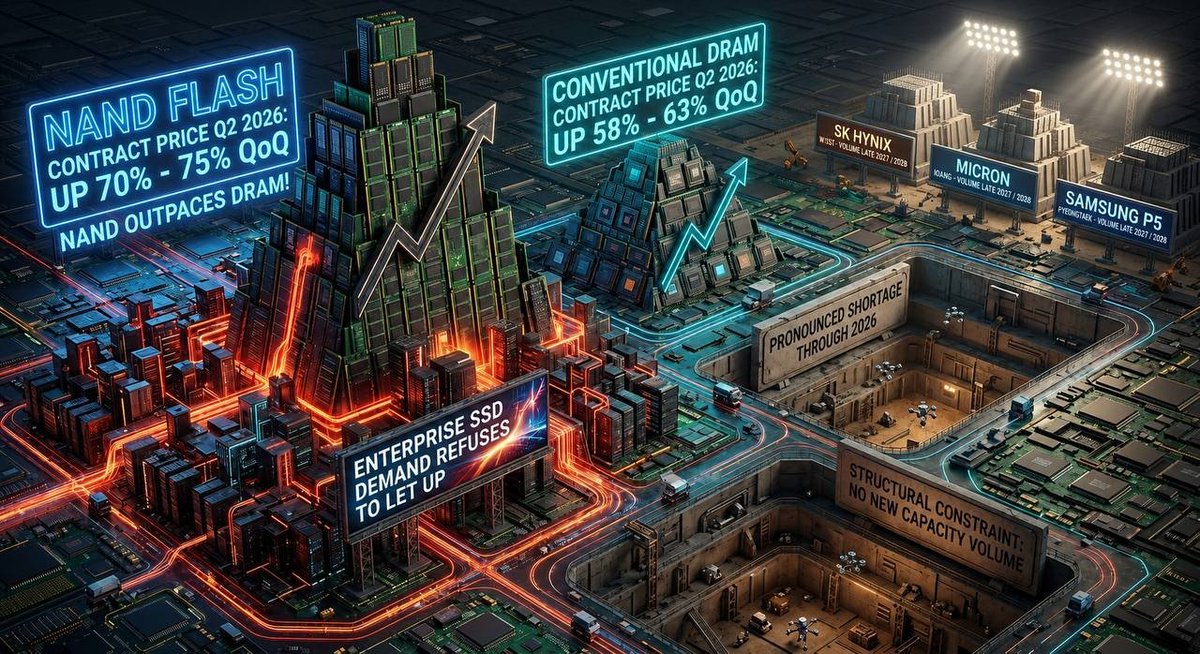
Contract prices are still climbing. TrendForce's latest survey has conventional DRAM contract prices rising 58% to 63% quarter-over-quarter in Q2 2026, with NAND Flash up 70% to 75%. NAND's roughly 75% increase outpaces DRAM for the first time in this cycle as enterprise SSD demand refuses to let up.
The structural constraint is unchanged: TrendForce expects a pronounced shortage through 2026, with new fab capacity unlikely to arrive in volume before late 2027 or 2028. New wafer lines at SK Hynix's M15X, Micron's Idaho fab, and Samsung's Pyeongtaek P5 don't move the needle on bit supply until mid-2027 into 2028.
SK Hynix, the most profitable memory maker on earth and supplier of over half the world's HBM, just removed the price ceiling from its long-term contracts.
The new structure: when spot prices rise, contract prices rise with them, fully. No cap.
Hynix may now be the only major supplier without one, while Micron's deals still carry a ceiling tied to market levels alongside a price floor across the term. Note the asymmetry. These contracts run three to five years, keep floors under prices, and now have no ceiling above them. Customers signed anyway.
That's the deal you get to write when both sides know the shortage outlasts the contract.
Today Sony announced they're killing physical discs. From January 2028, every new PlayStation game ships digital only.
Now do the storage math. New releases regularly run past 100GB and the base PS5 gives you 667GB of usable space, so that's six big games before you're deleting titles or buying an M.2 stick. With no disc fallback, every install has to live on TLC NAND, and analysts already expect the base PS6 to skip the disc drive entirely.
The part Sony didn't mention: this lands in a NAND market that suppliers are tilting toward AI data centers, the same squeeze that already pushed the PS5 to $649.99. Every extra gigabyte Sony has to solder in gets priced into the console, which means gamers end up paying the bill.
Both suppliers Apple is reportedly courting, CXMT and YMTC, sit on a Pentagon warning list. That Apple would even weigh that political risk tells you how tight and how costly AI-driven memory has become. Talks are ongoing and nothing is final, but the mere consideration is the story: scarcity is forcing supply chains into places they'd rather avoid.
What is a hyperscaler?
It's a company that runs massive data centers at planetary scale, renting out computing and storage to everyone else. Think Amazon, Microsoft, Google, and Meta.
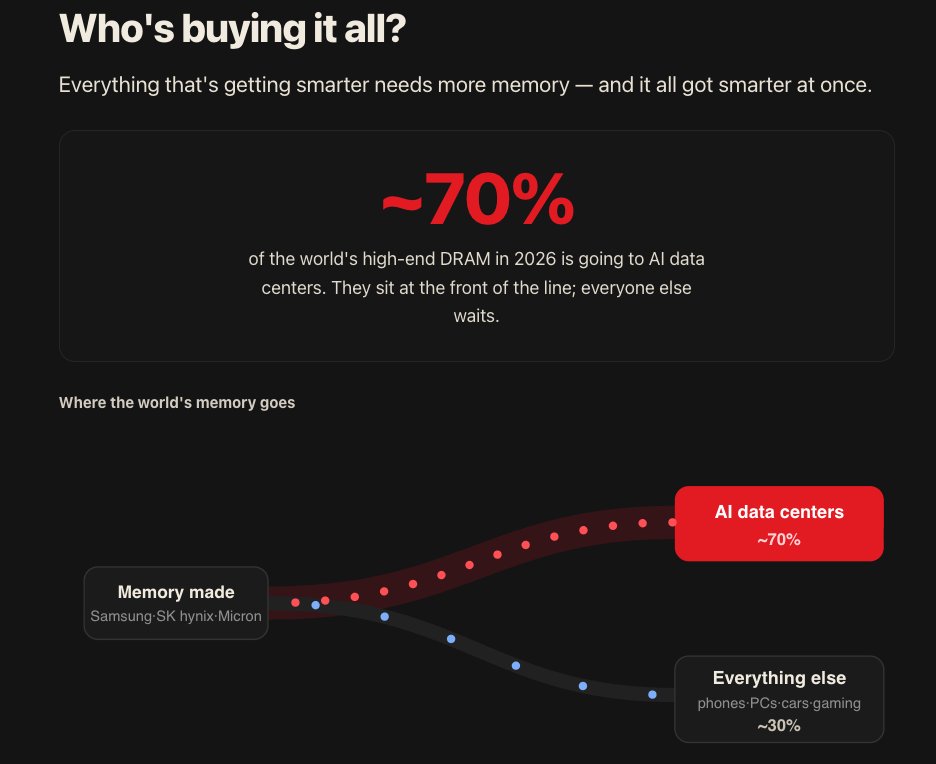
They buy chips by the truckload to power AI and cloud services. Their capex is up 60% as the AI buildout accelerates, and that spending flows straight into $memory. Data center DRAM already makes up 70% of the DRAM market.
When hyperscalers build, the whole memory shortage tightens.
A million-GPU cluster runs at 10 to 20% utilization because the GPUs are starving for data. Compute has raced ahead for a decade while memory bandwidth crawled, so the chips now burn most of every cycle waiting on HBM instead of doing math.
Those idle cycles are stranded capex, billions in silicon sitting dark.
You don’t fix that by buying more GPUs. You fix it by feeding the ones you already own.
The bottleneck was never compute.
It’s $memory.
That’s why memory is the AI trade, not a supplier to it.
The average new car ships with about 16GB of DRAM today. Tesla's HW4 computer already runs 64GB, GM's Ultifi platform sets a 48GB floor, and Level 4 robotaxis are pulling HBM, once a datacenter-only part, onto the board.
Every rung up that ladder is volume for Micron, Samsung, and SK Hynix, and automotive content gets specced in, not out.
And there's no slack to absorb it, SK Hynix is sold out through 2026 and buyers are already reserving 2028.
Selling memory on an efficiency rumor has, so far, been a losing trade.
Every efficiency scare of the past year produced a sharp, shallow dip, and every one of them reversed. The names at the center of the panic went on to print all-time highs, with the major memory makers crossing a trillion dollars in market value this spring and one of them climbing more than 700% in a year.
Even if there's truth to the architecture rumors, cheaper access to memory does not shrink the memory market, it enlarges it.
Drive the cost of context down and you make long-context models, persistent agents, and deeper reasoning economically viable, and those workloads consume memory at a scale that swallows whatever any single efficiency gain saves.
Demand chases falling cost, it does not retreat from it.
I'm posting this prediction now so I can quote it later. There has been a significant breakthrough in architecture - specifically around memory efficiency - not by one of the big labs, but by a team that was spun out of OpenAI (not SSI). They will probably announce it soon.
Samsung $SSNLF Q2 2026 prelim guidance drops in 6 days on July 7 during Seoul hours, and it's the cleanest first read on whether the memory supercycle is still accelerating.
For context, Q1 prelim pointed to ~₩133T in sales and ₩57.2T operating profit, up more than 800% YoY and far above consensus.
The bar is now sky-high. Samsung guided that overall earnings should improve sequentially even as DX profits decline on cost pressure, with HBM sales rising meaningfully. A print north of ~₩57T says contract DRAM pricing and HBM mix are still compounding; a miss would crack the "decoupled from boom-bust" thesis the Street has been pricing.
The real tell isn't the headline: it's the DS/Memory split and any read on HBM4 ramp, since HBM4 mass production has begun and is expected to exceed 50% of HBM sales from Q3.
A million-GPU cluster runs at 10 to 20% utilization because the GPUs are starving for data. Compute has raced ahead for a decade while memory bandwidth crawled, so the chips now burn most of every cycle waiting on HBM instead of doing math.
Those idle cycles are stranded capex, billions in silicon sitting dark.
You don’t fix that by buying more GPUs. You fix it by feeding the ones you already own.
The bottleneck was never compute.
It’s $memory.
That’s why memory is the AI trade, not a supplier to it.
Micron's earnings are set to grow faster than Apple's this year. Faster than Google, Amazon, Microsoft, Meta, and Tesla too. Every one of them. The most underestimated company in tech isn't flying under the radar anymore. $MU
@Jeremybtc The $memory supply shock will catch many off guard.
People think the situation will resolve soon...
Little do they know it's only getting worse.
SK Hynix has set July 10 for its $29.65 billion Nasdaq ADR debut. The largest listing of its kind in history, and the biggest equity event the $memory sector has ever produced.
70% of the world's high end memory is going to AI Data Centers. And the AI build out isn't slowing down any time soon.
Process the full picture at https://t.co/tOBisQASXt
SK Hynix is slowing HBM4 line conversions and shifting capacity back to commodity DDR5. The reason is simple math: DDR5 operating margins are projected near 90% this year. Even the AI memory leader now sees richer profits in the shortage it helped create.
The opening this creates is real, and the challengers are ready. Samsung is telling customers "Samsung is back," with HBM4 qualifying and its share projected to clear 30%. Micron has climbed to roughly 20% of NVIDIA's HBM4 allocation. The HBM race Hynix dominated just cracked back open.