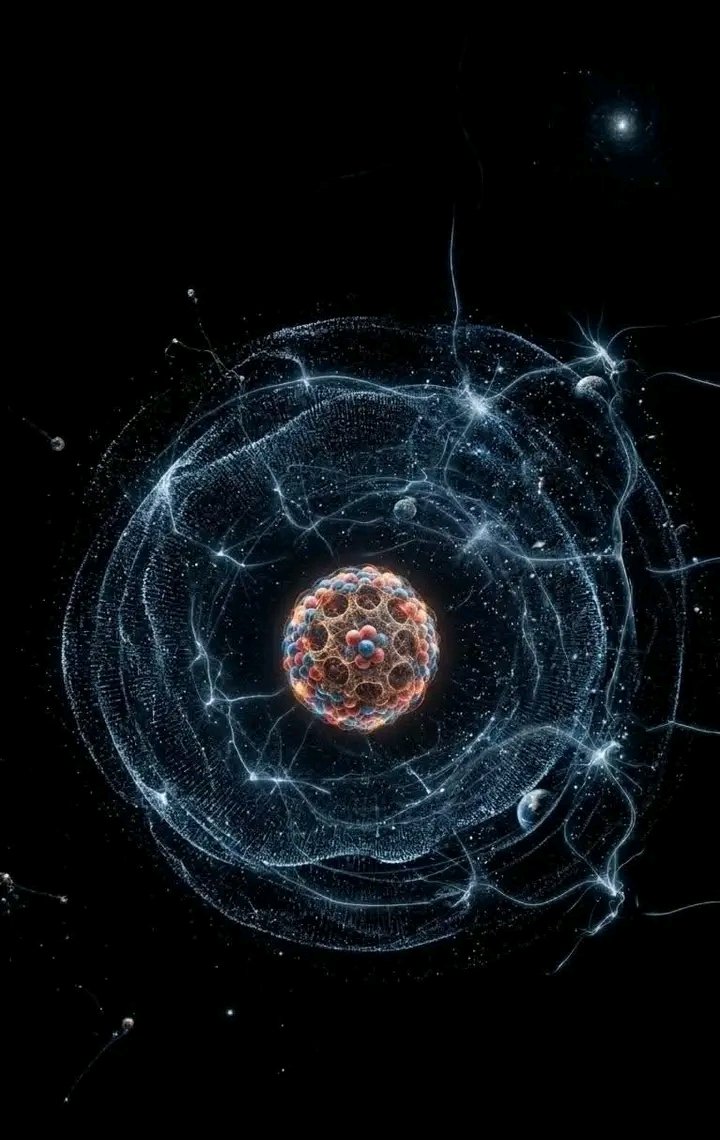
The electron has no surface. When you imagine an electron… You probably think of a tiny sphere orbiting a nucleus. But that's an outdated image. In modern physics, the electron has no boundary. It has no "skin." It has no measurable surface. As far as we've been able to measure… It behaves like a point particle. With no detectable size. With no known internal structure. It's not a little ball. It's an excitation of a quantum field that exists throughout the universe. That means something unsettling: When you "touch" something… There's never actually any solid contact. It's electric fields repelling each other. So, here's the thing: If the electron has no surface… What exactly are you touching right now?
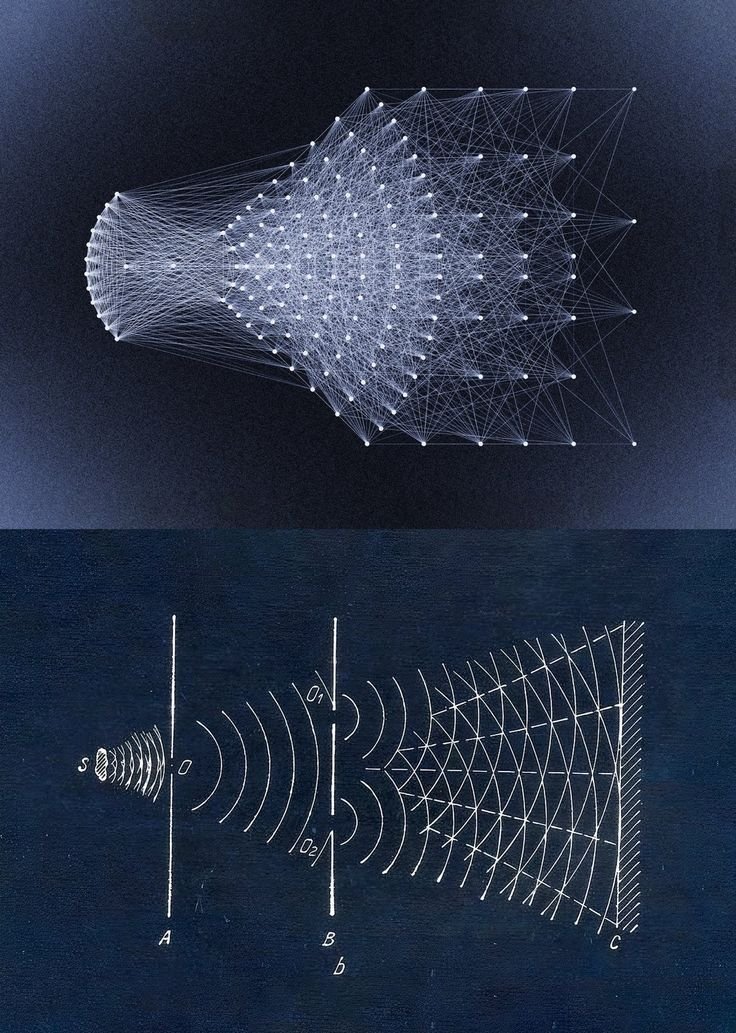
🚨: Scientists perform first ever double slit experiment in time sending light through temporal slits to reveal wave and particle behavior in a whole new way
⏳ Scientists say time may not be one-dimensional!
A new theory suggests time flows in *three* directions, shaping space itself — and it could finally bridge relativity and quantum physics.
A bold new theory from Dr. Gunther Kletetschka at the University of Alaska Fairbanks proposes that time itself has three dimensions — not one. According to the research, space isn’t the foundation of reality at all, but rather a byproduct of multidimensional time — like a picture painted onto a temporal canvas. The framework suggests a universe built from six total dimensions: three of space and three of time.
Unlike many speculative theories, this one makes testable predictions, including precise calculations for the masses of fundamental particles such as electrons, muons, and quarks — a mystery that has puzzled physicists for decades. If correct, it could help unify Einstein’s relativity with quantum mechanics, bridging the gap between the cosmic and quantum realms for the first time.
In this model, one time dimension represents our familiar forward flow, another allows for alternate versions of the same moment, and the third governs transitions between those realities — potentially enabling movement across timelines. Crucially, it still preserves cause and effect. Though speculative, this theory could mark a step toward the long-sought “Theory of Everything.”
📚 Source: “Three-Dimensional Time: A Mathematical Framework for Fundamental Physics,” Reports in Advances of Physical Sciences, 2025.
A Galactic Year is the time it takes for the Solar System to complete one full orbit around the center of the Milky Way galaxy and it's ~ 250 million years.
[🎞️ thebrainmaze]
Mathematics, physics, beauty.
Dots in simple, circular orbits create larger wave patterns.
By @beesandbombs, Source: https://t.co/IQ4xGDfrbT, Used with permission.