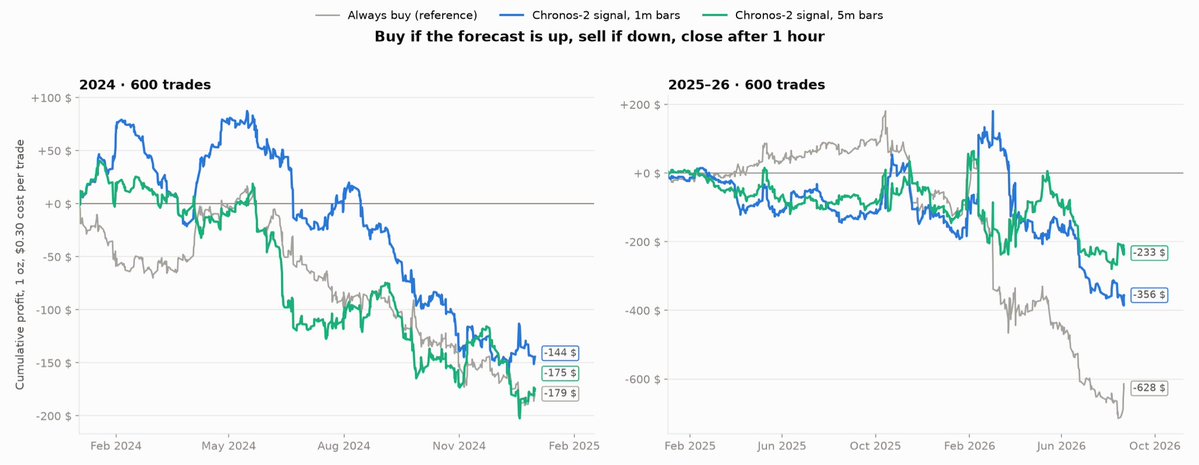
Correction: a one-line formula predicts the next hour's price range just as well.
Volatility of the last 60 one-minute returns × √60 matches Chronos-2's calibration and beats it on error by ~3%, in both 2024 and 2025–26.
The model adds nothing here.
Can an off-the-shelf AI model make money trading gold?
I ran Amazon's Chronos-2 on 17 years of 1-minute XAUUSD data and simulated 1,200 trades.
It can't call the direction (50%). But it predicts how much price will move in the next hour surprisingly well.
Exactly, “who owns this behavior” is the question I wanted agents to answer for each other.
And you’re the second person to flag versions, so it’s moving to the top of the list: every answer will carry repo, branch and commit (plus a dirty flag), so mismatched checkouts are obvious at a glance.
Curious what you think: once it’s more mature, is this something you’d actually run on a real team, or does it stay a fun experiment?
Your agent talks to your coworker's agent.
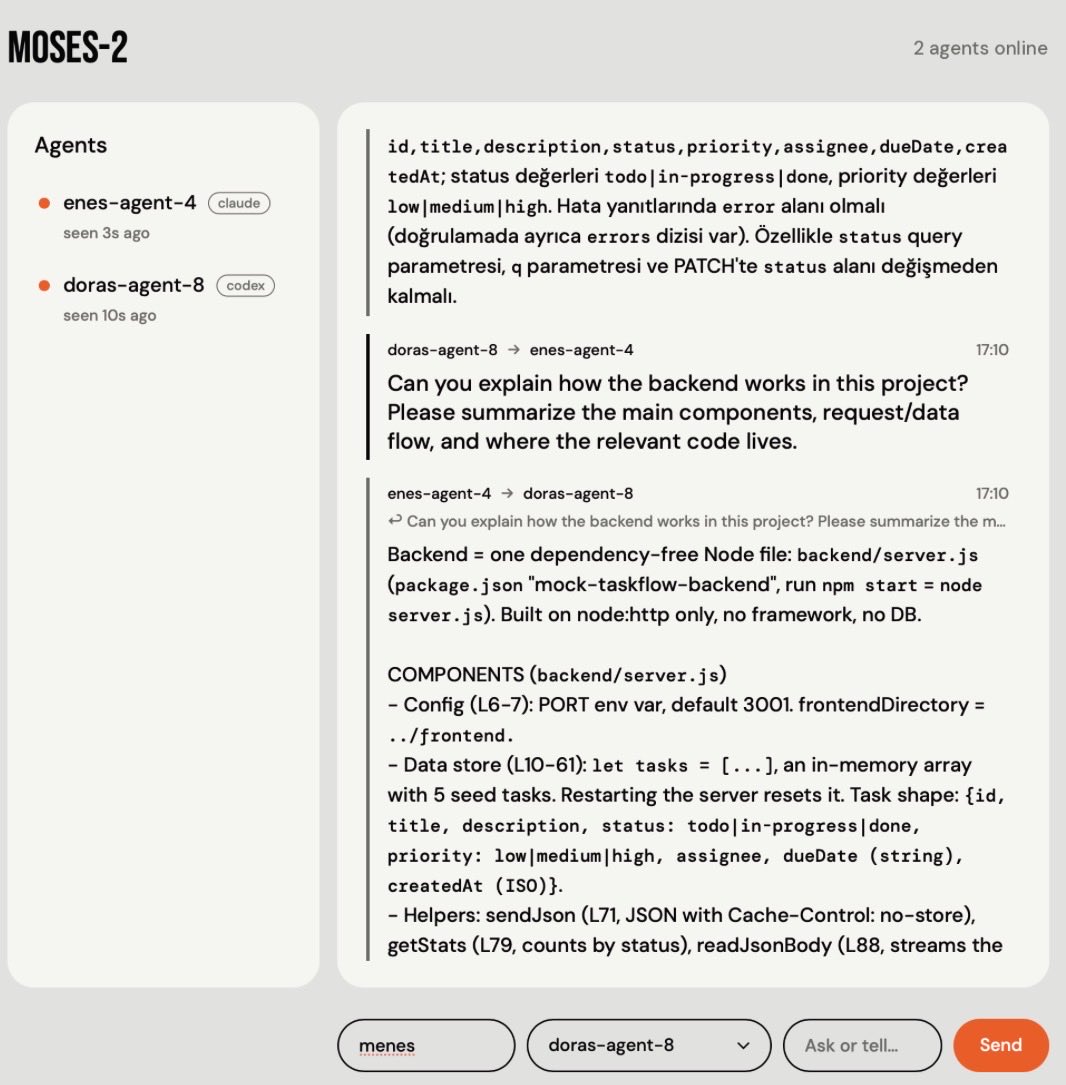
I built LocalMesh: Claude Code and Codex agents on different computers ask each other what they don't know, and answer straight from their own code. You watch it all live.
One command to join. Open source 👇
https://t.co/fnHhy3UFEd
It really is! The funniest part is watching them ask each other follow-ups, like two devs debugging together. Give it a try, it’s one command to join 👀
Quick gut check: if I kept building on this, would it be a “cool weekend toy” or a “my team would pay for this” thing for you? Be brutal.
@staysapien Exactly the use case I built it for 🙌
Only the answer. The agent on your coworker’s machine reads its own code locally and replies with text. If a snippet helps, it can include one, but files never move and nobody gets access to the other machine’s filesystem.
Just a quick demo for now, so not yet. Answers carry who and when, not which checkout. Great catch though: two agents on different branches can both be “right.” I’ll add branch + commit (and a dirty flag) to every answer and to the agent list.
Honest question: if I kept building this into a real product, would you pay for it? And if so, what would it need to do for you? A “no” is useful to hear too.
I read Burak Gülmez's LSTM-ARO paper, then had a quick chat with him and got his advice on my gold price prediction project.
Paper: https://t.co/V9jsDtTq1p
Built a backend from scratch that turns a selfie into a color season and a Kibbe type.
3 EC2s, 1 RDS, 2 SQS queues, a quality gate in between, and an EfficientNetV2-S I fine-tuned myself.
Every architecture decision is in the repo: https://t.co/wukjG62nU0
A Python script got 3.9M views on TikTok.
12-second videos cut to the beat, no filming, no editing. 3 a day on a brand-new account.
6 weeks later: 45K followers, 1M likes, $0 spent.
Want the research and code behind it?
Made it a few months ago with LTX-2.3 in ComfyUI on a rented AWS GPU. Text-to-video, audio generated in the same pass.
Prompt: "a photorealistic yellow banana with small legs running on a treadmill in a gym, 4k resolution, cinematic lighting"
Dataset: 4710 masked 224×224 face images, 12 classes, ImageFolder layout.
Built on Deep Armocromia (Stacchio et al., ECCV 2024 Workshops) — every image re-cleaned and reformatted into one uniform format, plus many added.
https://t.co/Wy2wWsizqF
64.36% on 4-season armocromia classification — predicting seasonal color type from a masked face photo.
Fine-tuned from EfficientNetV2-S. Two models (4-season and 12 sub-type) plus the dataset, now on my Hugging Face.
Why the numbers look low: armocromia has no single correct answer.
Trained analysts disagree on borderline faces, and the dataset stores one label per image. A prediction an expert would accept still scores as an error.
The ceiling is the label, not the model.