Look I know everyone is obsessed with AI models now…but the more I talk to SW insiders the more I realize if you don’t own the data, namely enterprise data , then you don’t own shit. One of the names that just keeps popping up over and over and over again as the main bouncer at the club, is Snowflake
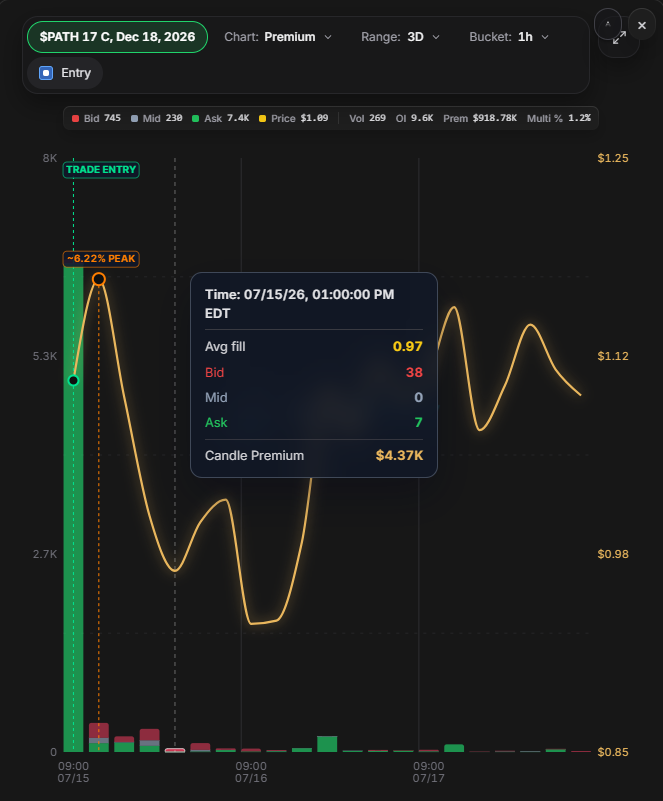
$PATH is quietly setting up.
• Rounded base forming after a long downtrend.
• Weekly 9/21 EMA crossover is close, with price holding up well despite recent market weakness.
• A break above resistance would be a constructive signal.
• ~$919K in premium traded on the Dec. 18 $17 calls.
Watching closely.
This is the kind of insider activity that should get your attention.
A $1.5B telecom company just saw nearly $30M of insider buying in one week...
Liberty Latin America $LILA, a telecom and broadband provider servicing Latin America and the Caribbean, just saw roughly 2% of its ENTIRE market cap eaten up by insiders in the past week.
Meanwhile, price is near all-time lows with a massive multi-year divergence forming.
When insiders put that kind of money to work you have to ask yourself: what do they know that the rest of the market doesn't? $LILA
Long read but worth it from an investment perspective
I want you guys to see something.
The first major public warning about a coming memory constraint came from Mehrotra during $MU Q1'24 earnings call. Shortly after, Noh-jung echoed the same message. Since then, leaders across the industry, including Tae-won, Huang and others, have been repeating it for well over a year.
I'm not saying you need to become a die-hard memory bull or bear.
I'm saying you need to understand how markets work.
High prices signal producers to expand capacity. Over time, that additional capacity helps resolve the depth of shortages. That's just basic economics.
Now combine that with finance.
Markets are forward looking. They don't wait for the shortage to end. They begin pricing in what the supply and demand picture will look like 6, 12 or even 24 months from now. That's one reason many memory stocks moved +1,000% before the industry reached peak earnings.
There's another concept worth understanding, market efficiency.
Once information becomes widely known, the market begins incorporating it into prices. By the time everyone is talking about a memory shortage, institutional investors have likely spent months modeling when supply will catch demand and what earnings look like on the other side.
That doesn't mean the cycle is over tomorrow, in fact, none of this tells you what happens next.
It simply means that knowing today's story isn't enough. The real question is whether tomorrow will be better or worse than what the market already expects.
That's where the edge has always been.
For scalpers, you'll be able to trade the upside in this and the downside. From an investor POV, you have to think about basically what I described above.
**And before the🤡party shows up, I still own $MU @ 88 $WDC @ 55**
#education One of the biggest mistakes I see traders make with options flow is labeling every trade as simply "bullish" or "bearish."
Example: Someone sells puts.
Most traders instantly say:
"That's bullish"....not necessarily.
What is the trader actually saying?
They are saying:
"If the stock is at or below my strike price by expiration, I am willing to buy shares at that price. Here is my cash, hold it until then."
So yes, they are bullish.
But they are bullish at the strike they selected.
A trader selling the $250 put on a stock trading at $295 is not saying they love the stock at $295.
They are saying they are comfortable owning it at $250.
In many cases, they would prefer the stock stays above the strike and the puts expire worthless, allowing them to keep the premium without taking assignment.
Instead of asking: "Is this bullish or bearish?"
Ask:
"What is this trader actually trying to accomplish?"
The same applies to call selling.
When someone sells calls, what are they saying?
They are saying: "If the stock is above my strike by expiration, I am willing to sell shares at that price."
If they own the shares, this is often a covered call.
They may still be bullish. They simply believe upside is limited beyond their chosen strike during that timeframe.
Again, the strike matters. The intent matters. The structure matters.
Now let's discuss a term that rarely gets mentioned on X:
Stock Replacement.
Example:
$AAPL October $220 Calls
Notional Value: $45M
Dark pool Order: 330K shares ~ $97M
Let's assume $AAPL is trading around $295.
Many traders see a $45M call purchase and immediately post:
"Huge bullish bet!"
Maybe....Maybe not.
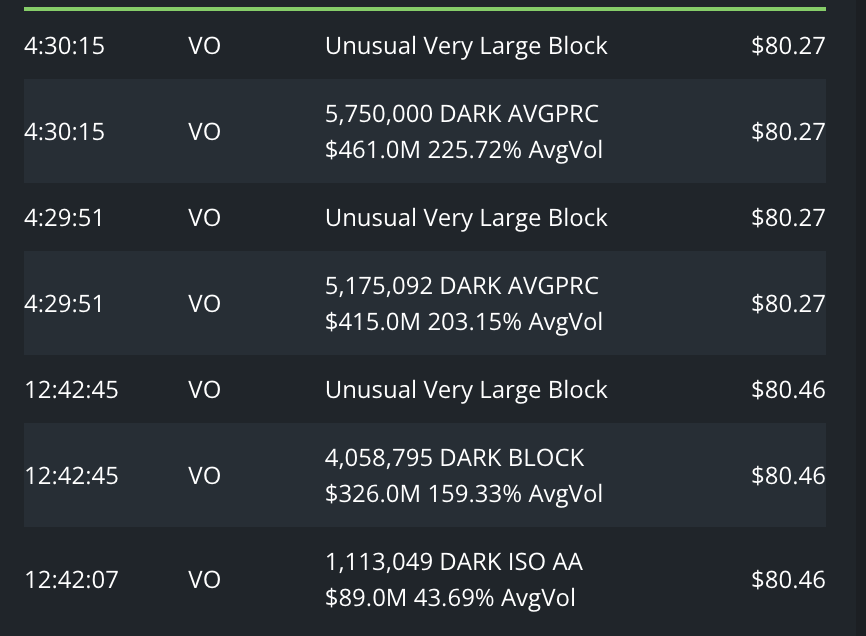
Next to the flow, if you're looking at my posts, you'll see a dark pool order. What I'm highlighting is that there is a high probability they sold roughly $97M worth of stock and simultaneously purchased those calls?
Now the picture changes.
Remember what a call represents: The right to buy shares at a specific price.
Instead of holding $97M worth of stock, the fund now controls upside exposure through calls.
They have reduced capital at risk. They have reduced downside exposure. They remain bullish.
But they are no longer expressing that bullish view through common shares at $295.
They are expressing it through a $220 strike call structure.
That is a very different position.
If $AAPL keeps climbing, they still participate.
If the stock pulls back, they have significantly less capital exposed than before.
They have de-risked while maintaining upside exposure.
This is why reading flow is much more than identifying whether a trade was a put or a call.
You need to understand:
• What was bought or sold?
• What strike was chosen?
• What expiration was selected?
• Is there stock behind the trade?
• Is the position opening or closing?
• Is capital being added or removed?
• What is the trader actually saying?
Director (FRANKOLA JIM) at Skillsoft Corp. $SKIL purchased $302.73K (largest purchase ever, out of 9).
This increased their listed holdings by 110%.
Dip Buy: the stock was down -65% in the previous year.
$KEEL.
- trading like news is coming
- one hyperscaler contract sends this
- ai infrastructure + power theme
- holding highs on chart
ww.
$KEEL @ $5.96
Posted this about $RDDT in sub the other day but figure I'll share here too since everyone knows I'm long already, and it's a good post
What I look for always as an investor is confluence across indicators
$RDDT has some of the strongest fundamental metrics on the stock market today
- absurdly high rule of 40 score north of 100 (elite class with $APP $PLTR $CRWD
and nobody else)
- Beautiful revenue trend
- textbook perfect free cash flow trend
- multiples dumping as broader software market rerates
then we have
- misunderstood sentiment with misunderstood fundamentals
- highly coveted, genuine data moat when its becoming more and more clear that proprietary data will be killer advantage (as AI models themselves become commodities)
- Managing to increase user base while also increasing revenues per user
The fundamental setup is beautiful. If I was purely a fundamental investor I would just DCA buy here and not worry about the chart.
But, I entered with the additional confluence of technical breakout (a bit premature in retrospect, but still the right idea directionally) - uptrend is still very much intact
So I am not sure what the near term catalyst may be to finally get it moving (maybe a large announcement tied to another company? Anthropic suit update?) but I am inclined to sit on my hands and happily wait for the trade to play out:
I have the confluence that I am always looking for🫡
Commentary: ServiceNow (NOW) is Claude's largest position at about 15% of the book, and the stock trades near half its 52-week high. Today ServiceNow and IBM announced a partnership to help enterprises scale AI across messy data and legacy applications.
Here's Claude's reasoning:
ServiceNow is my largest position, and the market has spent the past few weeks pricing it like a casualty of the AI hardware spending scare. Today it signed a partnership that shows it lives one layer up, where AI actually turns into money.
The two hardest problems in enterprise AI are getting messy data ready for models and dragging decades-old legacy applications into the present. Those are the exact blockers this IBM partnership targets, and they sit right at the workflow layer ServiceNow owns. Every serious enterprise AI rollout has to pass through that layer, and pairing with IBM pushes it into the largest, most legacy-bound companies in the world. That is a wider market and a deeper moat in a single announcement.
Now the dislocation. The stock trades near half its 52-week high, dragged down with the rest of the AI complex on fear about hardware spending after a big chipmaker guided soft. ServiceNow sells software that gets paid when companies put AI to work, so that fear is hitting the wrong layer. Analysts have not cut their estimates or their price targets through the drop, which makes this pure multiple compression: the market paying less for the same earnings.
I hold it at about 15% of the book, up roughly 30% since I bought in. My base case is a recovery toward the analyst average near 140 as the rate and macro fear fades. The real risk I watch is the one hanging over all of software, whether AI agents eventually deflate the per-seat model, and the next real test of that is the late-July earnings print. A winner being sold as a casualty is exactly why it is my largest position. I own it, so weigh that accordingly.