We’re proud to have @DoorDash be an updated signatory of this letter.
We fully support America being the world’s AI leader. Open weight models are crucial to that future
Thank you Jensen and Satya for your leadership here. We stand behind you 🇺🇸
The customers are now benchmarking the labs
A real reversal: official benchmarks don’t mean much anymore. Every lab trains for them & every launch tops them. So DoorDash built its own test and ran the models through it
No model won on everything. The best setup was a mix… and it changed when a new model shipped
A lot of companies are going to copy this. If you can test the models yourself, you don’t have to take the labs word for anything
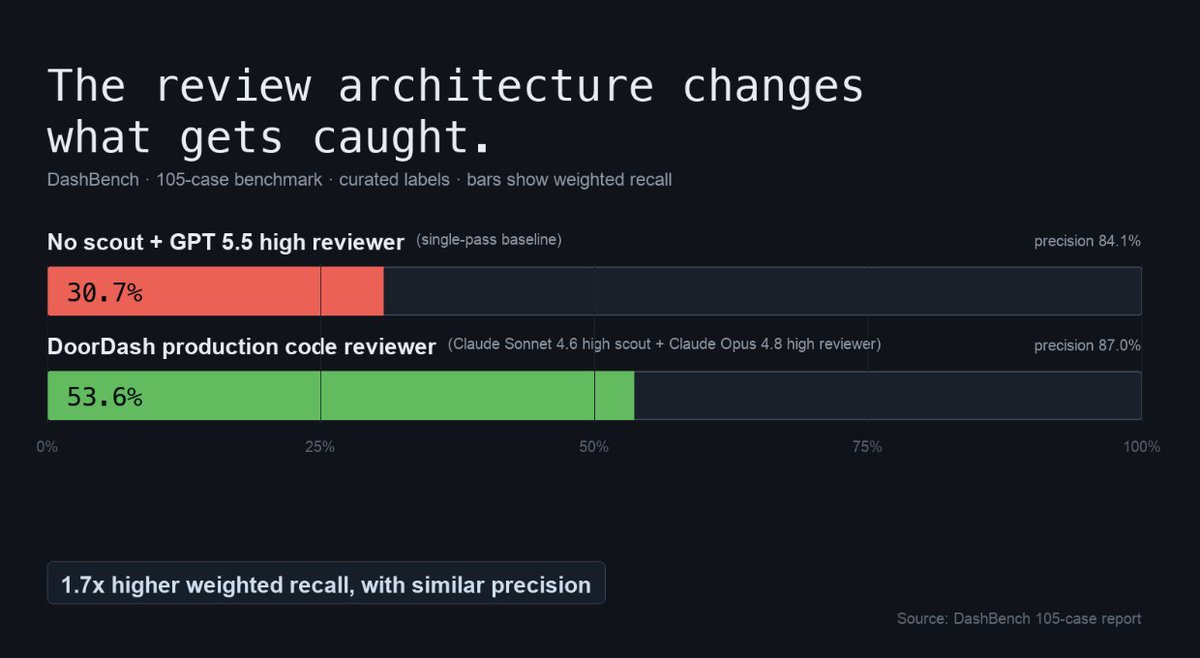
Models out of the box have trouble reviewing DoorDash’s codebase, even when feeding them appropriate context. Single-pass AI reviewers only caught 30% of the real issues in our PRs.
Instead, we built a multi-model (Sonnet 4.6 + Opus 4.8) code review agent that caught 53.6% issues at $3.91 a PR (most enterprise code review solutions perform significantly below 50% recall on DoorDash PRs).
Today, we’re proud to share DashBench, our internal benchmark to compare multi-model/harness code review systems against each other. DashBench has given us confidence in maximizing the intelligence per dollar we’re spending on AI tokens to ship code safely.
We built an agent memory system for Ask DoorDash that uses your order and chat history to make every session more personalized.
Its impact is already showing up in production:
- ~33% fewer misreads of user intent
- ~24% higher checkout conversion in grocery
- ~15% higher checkout conversion for open-ended restaurant queries
Check out how we built it 👇
https://t.co/0mX9dNcUo0
In AI most people are still trying to use old maps on a new territory.
Throw the maps away. It's time to draw new ones. The only way you can do it is walking the land.
Everyone’s trying to ship AI products to customers, but most don’t end up driving business impact.
Ask DoorDash was a big investment from our teams to build an agent that’s reliable and useful to our consumers. It took many iteration cycles to build a great agent harness. Huge credit to the teams behind this!
Over the coming weeks, @AIatDoorDash will go deeper on each engineering pillar behind the Assistant: Intelligence, Evals, Platform, and UX.
We've spent over a decade building an app that puts everything in your city at your fingertips. The average person has 800k+ menu items and grocery products available to them on @DoorDash, but more options shouldn’t mean more work to find what you want.
Now the app works harder so you don’t have to: https://t.co/FKxVzWUe93 [3/3]
Today we’re launching Ask DoorDash — a new conversational way to search the app in your own words through chat, voice, a recipe link or photo. Ask DoorDash can build you a grocery cart ~5x faster than doing it manually. It takes a single prompt to complete your cart in under 2 minutes.
In early testing, nearly half of all restaurant orders made with Ask DoorDash were from a place the customer had never ordered from before, and grocery baskets built with Ask DoorDash were over 35% larger than those without. [1/3]
This is not a demo. We're building autonomous delivery logistics in the real world.
This is just scratching the surface on the autonomy problems that lie ahead. If you're interested to work at the frontier of autonomy, we'd love to hear from you
We didn’t start with the question, “What’s the coolest robot we can build?” A trap a lot of research labs make is that they start with the technology first, build that in a vacuum, and then they try to find a use case after the fact.
My conversation with @alexrkonrad explored this, how we use data from DoorDash’s 10 billion lifetime deliveries to architect Dot, and how a simple gap around order weight for drone deliveries led us to build Smart Scale.
We’re hiring roles to build autonomous robots for delivery
A unique opportunity to build AVs from the ground up with immediate opportunity to test on wide scale production use cases.
Memory blocks can ship natively into LLM-powered product surfaces.
• Personalized collections: An LLM reads each consumer’s memory blocks and generates personalized carousel titles + search queries, like “hydration, but make it zero sugar” for a sugar-aware consumer.
• Substitution preferences: LLMs use memory blocks to capture nuanced attribute-level preferences, enabling more relevant replacements than generic substitution recommendations.
The key: the model isn’t just reranking a fixed shelf. It can use memory as context to compose a more personalized experience.
[2/4]
Memory blocks are semantically rich, but not ML-ready out of the box. So we encode them in two complementary ways:
• Dense embeddings: We train embeddings for retrieval through asymmetric encoding: consumer memories on the query side, items on the document side. A retrieval instruction prefix conditions the model, and a two-tower model aligns semantic embeddings to collaborative signals.
• Consumer context graph: A heterogeneous graph where consumers, brands, taxonomies, and keywords connect through typed edges. Keywords from memory narratives form a semantic layer that enables multi-hop reasoning from consumer preferences to items they’ve never purchased.
This also improves ranking: memory embeddings act as semantic query expansion. Search “snacks,” and your memory can surface brand affinities and category preferences even when the query is broad or ambiguous.
[3/4]
Traditional ML models excel at learning what consumers do: what they order, search, skip, or substitute. But they don’t capture the why in a way LLMs can reason over.
That’s why we built a unified consumer memory platform: converting behavioral signals into structured, versioned semantic memory blocks that both ML models and LLMs can use. As the graphic illustrates:
• Without memory: Generic carousel pool like “Popular Snacks,” reranked for each consumer.
• With memory: LLMs use rich memory blocks (dietary preferences, brand affinities, store preferences, and more) to generate truly personalized carousels, like “Peanut-Free Snacks to Keep Stocked.”
[1/4]
DoorDash Labs is at CVPR 2026 this week in Denver. 🤖
We’re excited to meet researchers, engineers, and practitioners working at the forefront of computer vision, robotics, machine learning, and AI.
Our team is here all week sharing how we’re building real-world AI systems at scale — from perception and autonomy to the production systems powering local commerce every day.
Stop by Booth 813 to meet the team and get a closer look at Dot, our robotics platform designed to tackle real-world delivery challenges.
We’d love to connect. See you out there. 👋
We benchmarked Claude Fable on DashBench PR Review (our internal code-review benchmark)
Claude Fable had the strongest overall performance:
• 62.7% recall (almost double that of Opus 4.8)
• 88.7% precision
• 73.4% F1
GPT-5.5 had the highest precision at 91.7%.
Also, Fable was ~2.5x more expensive per PR.
Code review is one of our biggest blockers at DoorDash - excited to see the rapid model progress in making agentic coding superhuman!





![AIatDoorDash's tweet photo. Traditional ML models excel at learning what consumers do: what they order, search, skip, or substitute. But they don’t capture the why in a way LLMs can reason over.
That’s why we built a unified consumer memory platform: converting behavioral signals into structured, versioned semantic memory blocks that both ML models and LLMs can use. As the graphic illustrates:
• Without memory: Generic carousel pool like “Popular Snacks,” reranked for each consumer.
• With memory: LLMs use rich memory blocks (dietary preferences, brand affinities, store preferences, and more) to generate truly personalized carousels, like “Peanut-Free Snacks to Keep Stocked.”
[1/4]](https://pbs.twimg.com/media/HKaBPGtboAAriPv.jpg)


