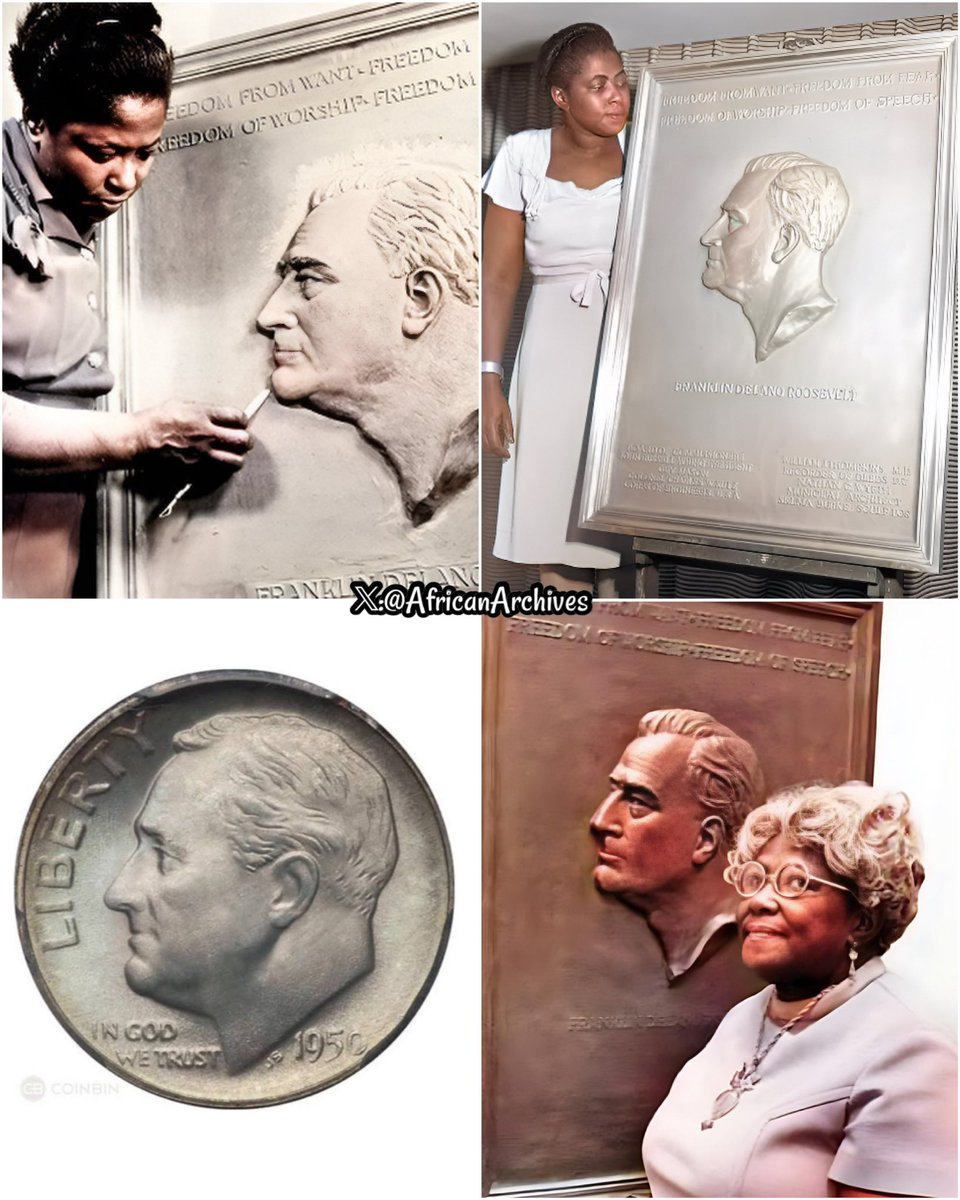
Selma Burke was a sculptor & member of the Harlem Renaissance movement, best known for her bas-relief portrait of President Franklin D. Roosevelt
She never received credit for her portrait of President Franklin D. Roosevelt which was later featured on the US dime.
—In 1943, Franklin D. Roosevelt sat for a portrait by a young African-American artist from Mooresville. That artist was Selma Burke.
However, John R. Sinnock’s signature is on the dime, and he receives credit for the work while Burke’s portrait, which she spent two years working on, is only recognized as an inspiration and model for the final image used on the coin. According to Lisa E. Farrington, author of “Creating Their Own Image, The History of African-American Women Artists,” Sinnock made “barely perceptible alterations.”
HONORS
As well as a sculptor, Burke was also a lifelong student and educator, winning numerous awards and fellowships. She earned her first degree from Winston-Salem State University in North Carolina and eventually graduated with a Master of Fine Arts from Columbia.
She started her first art school in 1940, eventually starting her second in 1946, and opened the Selma Burke Art Center in Pittsburgh, which operated from 1968 to 1981.
Burke is an honorary member of Delta Sigma Theta sorority. She received several honorary doctorate degrees during her lifetime, including one awarded by Livingston College in 1970 and one from Spelman College in 1988.
Milton Shapp, then-governor of Pennsylvania, declared July 29, 1975, Selma Burke Day in recognition of the artist's contributions to art and education. Her papers and archive are in the collection of Spelman College.
Burke was a member of the first group of women – along with Louise Nevelson, Alice Neel, Georgia O'Keefe, and Isabel Bishop – to receive lifetime achievement awards from the Women's Caucus for Art, in 1979. She received the award from President Jimmy Carter in a private ceremony in the Oval Office.
She received a Candace Award from the National Coalition of 100 Black Women in 1983 and the Pearl S. Buck Foundation Women's Award in 1987.
She died in 1995 at the age of 94.
🖊️As the only admin behind this page, I try to research to educate. If you appreciate this effort, you can support to help the page thrive on https://t.co/HHs3SgCItN. Your support is deeply appreciated! (Or just the ko-fi page for articles/posts roundup)
🚨‼️MUST WATCH and SHARE before Elon Musk bans it:
Since US media won’t tell you, UK activists, Led By Donkeys, dropped this video on how Elon Musk and his use of X helped get Donald Trump elected.
@ByDonkeys
cc: @BryanDawsonUSA
30 years ago, I gave a speech warning of a two-tiered society composed of a few winners and a larger group of Americans left behind, whose anger and whose disillusionment could be easily manipulated.
We're seeing the ramifications of this yet again.
Be warned: The more Trump can tear down democracy, the safer the oligarchy becomes.
This is why billionaires who once disavowed Trump are crawling back — and spending their fortunes to put him back in the White House.
Let’s set the record straight: Trump is not a “successful businessman.” He is, objectively, a business failure.
He says he'll run the country like he ran his businesses. But here's the thing — he ran his businesses into the ground.
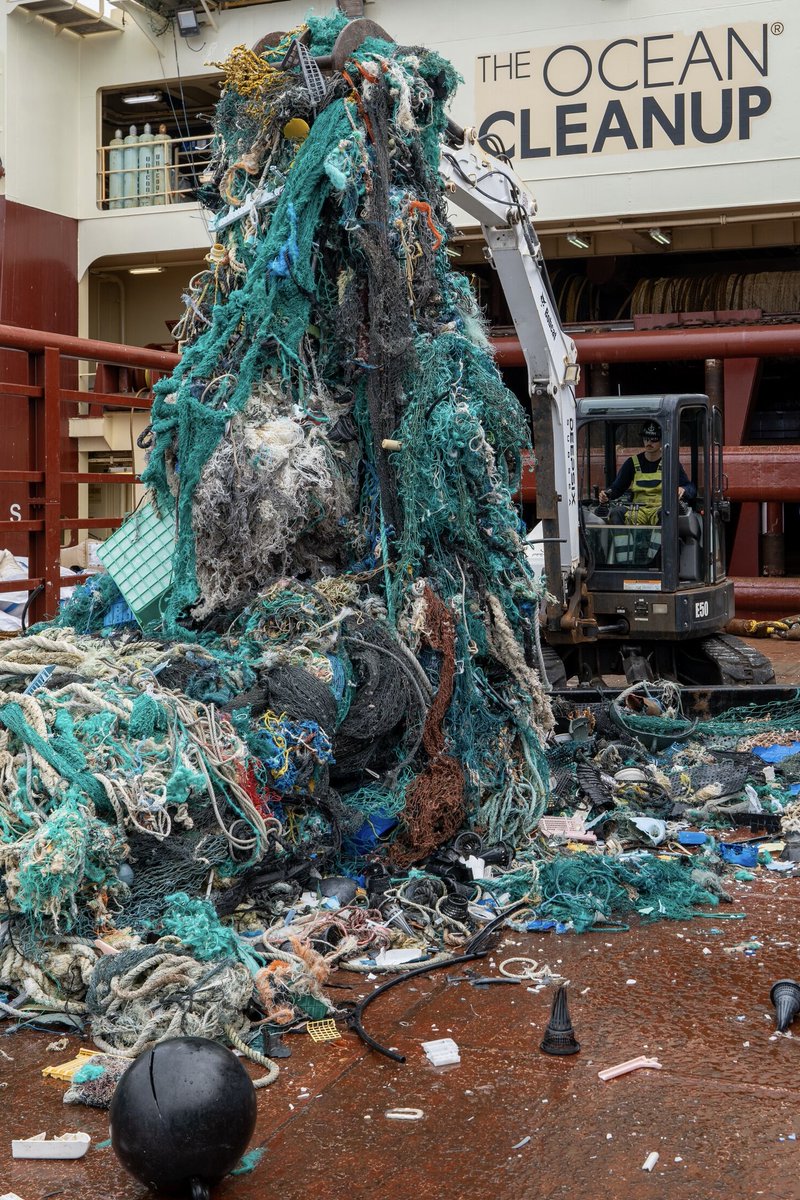
We have just completed the last trip to the Great Pacific Garbage Patch for 2024, resulting in our total catch of over 500,000 kg (1.1m lb) from the GPGP so far.
Here are some facts about our ocean operations to date:
One underappreciated fact about the ocean plastic problem is that plastic pollution is persistent in some places but not in others.
For most of the world's oceans, plastic only persists for a few weeks or months before ending up back on land. In our models, we see that 80% leaves the ocean again within a month and 97% within a year.
What this means is that, when we reduce the amount of plastic flowing into the ocean, we should see an almost immediate reduction in the amount of plastic in the ocean.
It also means that most plastic pollution you see is hyper-local. Unlike something like CO₂, countries and cities therefore have a "selfish" incentive to curb their plastic emissions. For example, want to eliminate plastic pollution in Bali's waters and coastlines? Then stop plastic from leaking from Bali's towns and cities!
Another consequence is that, for most of the world's oceans, there is no need to sweep the ocean surface; it cleanses itself once we stop putting new waste in.
The exception to this is the ocean garbage patches, where currents trap the plastic and keep the trash away from coastlines, preventing it from washing up.
This is why The Ocean Cleanup employs a two-pronged approach: intercepting plastic in rivers to stop inflow and cleaning up the legacy pollution in the ocean garbage patches.