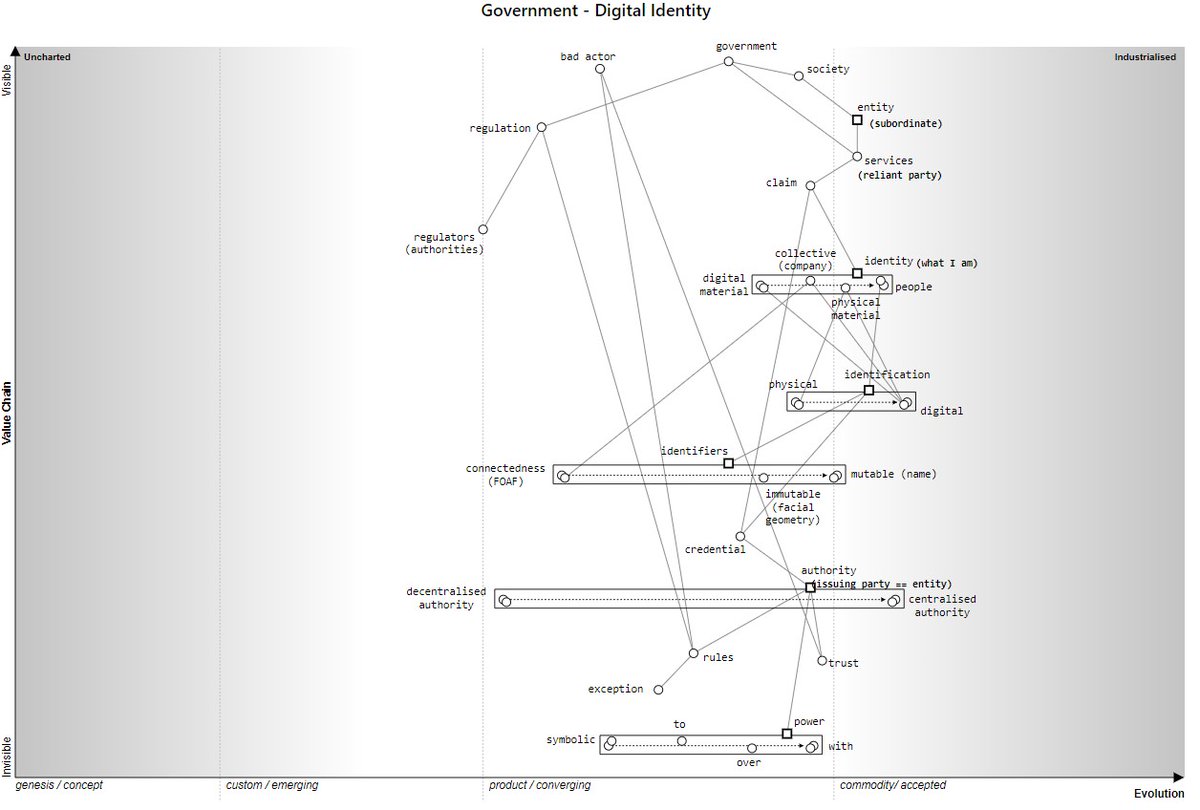
@bt_uk If a customer suddenly no longer has a working phone line, how are they meant to contact BT? Or call their friends or family? What of the many people with nobody to rely on? What of the people with no access or ability to use the internet? #youandyours
@bt_uk@age_uk@DisRightsUK BT, you do know your botched rollout of digital phone lines is going to result in actual deaths, right? Many don’t know it’s happening. Many don’t know that their phone already no longer works. Nor why. Many don’t know how to fix it. #youandyours
Me : Do you map?
X : I've heard of your technique but we don't use it.
Me : Ok, so your business operations is not based upon a map of the landscape?
X : No
Me : And your strategy is not based upon a map of the landscape?
X : No
Me : What made you think they would align?
... the reason I say "good" is that I worked on mapping out the defence sector in 2022/23. We used the maps to identify where we should invest.
Supply chain awareness was one of two high priorities, from a defence perspective, though low in terms of market perspective
Mgmt Consultant: Where do we want to be in 5 years?
Real person: I dunno, Dorset?
Strategy is indeed prepositional (direction, time, place), but most methods and tools to help understand and express that fail us.
This video on Wardley Mapping is brilliant.
My favourite presentation that I've given for an awfully long time.
Thank you @SEACONGLOBAL
for giving me the opportunity.
X Marks the Spot - from maps to healthcare to defence to transport to AI to conversational programming - https://t.co/jtcTSEjgjo
Back in 2022 / 2023, I mapped out the defence industry with a group of people with experience in the space, in order to ask the question "where should we invest?"
Unsurprisingly, the answers differed depending upon whether your goal was a benefit to society (i.e. improving defence) or making money (i.e. selling stuff to defence organisations). This is summarised in the table below.
Top of the list for benefit to society was the use of principles (i.e. the avoidance of one size fits all, such as agile everything, or drones are the answer) and awareness of the supply chain (and not just physical but technological components).
Neither topics barely got a mention in the swathe of analyst reports I had to wade through to create a market perspective. Unsurprisingly, AI, Cyber and Space were at the top of the market lists. For reference, LLMs that were trained on public data tended to concur.
Once again, where to focus for the benefit of society was in disagreement with where the market wanted to focus. Hence, I was pleasantly surprised and impressed by the NDIS (National Defense Industrial Strategy) which put supply chains at the top. Good move. Situational awareness of the landscape should always be top of mind whether territorial, technological or economic.
National Defense Industrial Strategy
https://t.co/nkEXeNjqOv
I mention this because of an excellent post by @anne_e_currie on "What's the best green data" - https://t.co/c5ZzppNYvd ... the brutal truth is that most of our grids are huge singular AC machines which we poorly understand despite heroic efforts.
Asked about where should we focus our investment in energy? Well, I had a research group (made up of people in the energy industry) look into this and the answer depends upon whether you're focused on benefit to society or the market?
Must keep remembering this "Before you can make a great thing, you need to work in the right way. And before you work in the right way, you need to create the conditions inside your organisation to be allowed to work in the right way." https://t.co/b34bhnhxIJ
When @swardley would talk about conversational programming I would sort of just nod along and wonder where he got the shit he was smoking. Now I'm convinced, again, he was really just years ahead.
https://t.co/xGYzSjO3ce
@amcafee They bought Occulus, so they invested in a becoming a hardware company. The idea of the ‘killer app’ was much more spoken of in the years when hardware was the dependent factor in a new user/market ecosystem.
Holy cow is this not what you wanna hear (or admit) after spending $10B on the Metaverse last year:
“I want to be clear on this point. We are working on a product that has not found product market fit."
https://t.co/YJgDvFZhib
https://t.co/73bCAWjhzw.
Guest blog by @meta_better Solutions Director at @LoneStarAnalysi on fighting climate change using AI and why we need the 'AI jam' for climate change today.
Read 👇 to find out more:
https://t.co/mtxNwg2elP
How would you want to interact with that world? Bodily sensory experience will make it richer. (Spoken out loud) language is of course part of it. But it’s thoughts you need. Between you, the virtual world and others - at the speed of thought - that will make the difference.
The cross-modal decoding (generating language from silent video) is incredible.
Hot take: haptics and other attempts at XR interfaces are (for complex knowledge work) a dead end. They all try to extend *existing* bodies for embodied cognition.
Imagine in XR your in a living ‘rich picture’ all around you. It’s a metaphor for the problem you face or idea you’re all working on. It’s made out of tiny virtual robots that work together to change and move based on who you are and how respond to it.