Hi Mr @anndylian
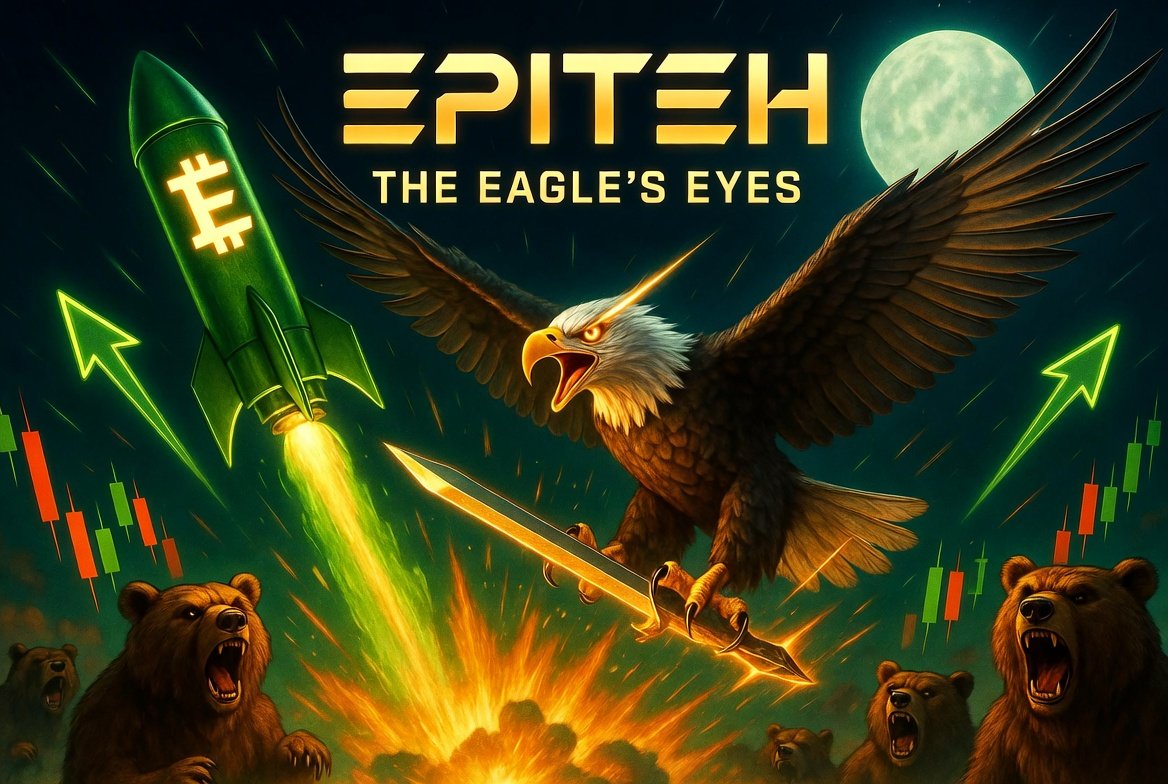
$EPITEH the eagle eyes 🦅🔥
Here’s why it’s built differently (and why it deserves your attention)
Zero dev/insider allocation. 100% fair launch on Solana. No pre-mint, no team wallets, no hidden bags. Every single token has been in community hands from minute one. That literally makes rugs impossible — the biggest cancer in meme coins is gone. The only “team” is the holders themselves. “No more rugs” isn’t marketing… it’s the actual tokenoms.
Long-term conviction play, not a 2-week hype flip. Most memes chase the next quick 10x and die.
$EPITEH is engineering a real movement: sharp, coordinated, sniper-like community that treats dips as launchpads. The eagle theme is perfect — high vision, rising above the noise, spotting alpha early. This isn’t noise; it’s culture.
Buybacks & value accrual baked in from day one. Community treasury strategies, revenue-driven repurchases, holder-led initiatives all designed to create real, ongoing demand instead of endless sell pressure. It’s not “hope for a pump.” It’s a flywheel i.e revenue → buybacks → stronger floor → more believers → bigger momentum. Diamond hands get rewarded over months and years, not just the first hour.
In a sea of dev-exit specials and faded hype, $EPITEH stands out because the incentives are perfectly aligned. Everyone wins together… or no one does. It’s early, the community is locked in and growing fast, the structure is bulletproof, and the energy feels organic.
This isn’t just another cashtag. It’s becoming a movement.
CA: DrCFxyLZ9zFC3bVSUwvhuoiQTsNDumdsgB6QbkEipump
TG: https://t.co/EmmEaQmY8s… (or check @theeagleeyes_
Web: https://t.co/motNYQMTDB
See the dip. Slash the bear. Ignite the moon.
Join the Blade… or bleed out. 🦅
What do you think, sir? $EPITEH catching your eye too? 🚀
$EPITEH the eagle eyes 🦅🔥
Here’s why it’s built different (and why it deserves your attention)
Zero dev/insider allocation. 100% fair launch on Solana. No pre-mint, no team wallets, no hidden bags. Every single token has been in community hands from minute one. That literally makes rugs impossible — the biggest cancer in meme coins is gone. The only “team” is the holders themselves. “No more rugs” isn’t marketing… it’s the actual tokenoms.
Long-term conviction play, not a 2-week hype flip. Most memes chase the next quick 10x and die.
$EPITEH is engineering a real movement: sharp, coordinated, sniper-like community that treats dips as launchpads. The eagle theme is perfect — high vision, rising above the noise, spotting alpha early. This isn’t noise; it’s culture.
Buybacks & value accrual baked in from day one. Community treasury strategies, revenue-driven repurchases, holder-led initiatives all designed to create real, ongoing demand instead of endless sell pressure. It’s not “hope for a pump.” It’s a flywheel i.e revenue → buybacks → stronger floor → more believers → bigger momentum. Diamond hands get rewarded over months and years, not just the first hour.
In a sea of dev-exit specials and faded hype, $EPITEH stands out because the incentives are perfectly aligned. Everyone wins together… or no one does. It’s early, the community is locked in and growing fast, the structure is bulletproof, and the energy feels organic.
This isn’t just another cashtag. It’s becoming a movement.
CA: DrCFxyLZ9zFC3bVSUwvhuoiQTsNDumdsgB6QbkEipump
TG: https://t.co/yA7Y3eGTTJ (or check @theeagleeyes_
Web: https://t.co/motNYQMTDB
See the dip. Slash the bear. Ignite the moon.
Join the Blade… or bleed out. 🦅
What do you think, sir? $EPITEH catching your eye too? 🚀
Thank you for this opportunity sir @anndylian
$EPITEH isn’t another fleeting meme coin riding hype. It’s the rare project actually built to last — and here’s why it deserves serious attention as a long-term conviction play.
First, it’s purely community-driven with zero supply allocated to devs or insiders. This was a fair, transparent launch on Solana (no pre-mint, no team wallets, no hidden allocations). Every single token is in the hands of holders from day one. That removes the single biggest risk in this space i.e the rug.
The official narrative nails it “no more rugs” because the structure literally makes rugs impossible. The eagle-eyed community is the only team here, and they’re locked in.
Second, the long-term vision is real and already in motion. While most memes chase the next 10x flip, $EPITEH is building a sustained movement: sharp, coordinated holders who treat this like a sniper operation observant, strategic, and relentless. The energy is organic and growing louder every day because people see the difference. This isn’t noise, it’s a culture.
Eagle theme = perfect metaphor — high vision, rising above the noise, spotting opportunity early.
Third, buybacks are a core part of the long-term thesis. The community is actively aligned around mechanisms that create real, ongoing demand, treasury strategies, revenue-driven repurchases, and holder-led initiatives that put pressure back into the token rather than letting it bleed out in endless sells.
This isn’t “hope for a pump.” It’s engineered for value accrual over months and years: community revenue → buybacks → stronger floor → more believers → bigger flywheel.
In a market full of dev-exit specials and faded hype, $EPITEH stands out because the incentives are perfectly aligned. No one is getting rich quietly at the community’s expense.
Everyone wins together or no one does. That’s why the momentum feels different. It’s early, the community is tight, the tokenomics are bulletproof, and the buyback/long-term focus is baked in from the start.
If you’re looking for the next meme that actually survives the cycle and rewards diamond hands, this is it. $EPITEH isn’t just a cashtag — it’s becoming a movement.
What are your thoughts, Sir Aandy? I’d love to hear why it caught your eye too. 🦅
(CA for anyone watching: DrCFxyLZ9zFC3bVSUwvhuoiQTsNDumdsgB6QbkEipump
— TG https://t.co/9thvEsqp2T
- Site: https://t.co/P6CEXdzMEn
Let’s build something that actually lasts. 🚀🦅
@Ralvero Been watching a project that’s building around the whole “Eagle’s Eyes” narrative feels different from the usual hype stuff. Quietly picking up momentum.
Website: https://t.co/UaiNXLqxIT
Chat: https://t.co/S5p1TeFssS
English is the most widely used language in the world. It is spoken by over 1.4 billion people across the globe.
The English language spread around the world mainly because of the British Empire, and later grew even more because of the global influence of the United States.
Just as the name suggests, English originated in England. In fact, the people from England are called English, and the language they speak is also called English. However, the original inhabitants of the country we now call England did not speak English at all.
They spoke a Celtic language known as Brittonic. The original form of this language is now extinct, but it later developed into languages like Welsh, which is still spoken in Wales today.
🫡 Ok, so if the original inhabitants of what we now call England did not speak English, so where did the English language come from ?
Well, English originated from settlers who arrived in Britain, coming from Northern Germany and parts of Denmark, around 450 AD, roughly 1600 years ago.
The most notable of these settlers were,
▪️The Angles
▪️The Saxons
▪️The Jutes.
That’s where you get the term Anglo-Saxon. The Jutes are less talked about because they were the smallest of the three.
These groups spoke similar types of the same language, which came from an older language called Proto-Germanic.
When they first arrived in Britain, each group had its own slightly different dialect. Over time, as they settled and lived together, these dialects mixed and blended into one common language which had regional variations. By around 700–800 AD, that language had developed into what we now call Old English. It looked and sounded completely different from the English we speak today.
Old English gradually evolved into Modern English over a long time, mainly because of invasions, internal evolution and cultural mixing.
A major change happened in 1066 when England was conquered by French speaking people. From that point, many French words entered the English vocabulary, especially in law, government, and food. By the time of William Shakespeare, English was much closer to what we speak today.
In short, English started as a Germanic language, then mixed with French and Latin, and changed in sound over time.
If you are a curious person, you might ask, who lived in Britain before the Anglo-Saxons arrived?
Well, I already partially answered this question. When the Anglo-Saxons arrived, England was inhabited by a people called Britons. These people had lived under Roman rule for nearly 400 years.
By the time the Anglo-Saxons arrived, the Romans had already pulled out of Britain.
Over time, the Anglo-Saxons took control of much of what we now call England by force and established several kingdoms there.
The most notable of these kingdoms were,
▪️Northumbria
▪️East Anglia
▪️Mercia
▪️Wessex
▪️Sussex
▪️Essex
▪️Kent
In the 9th century, the Vikings, mainly from Denmark, took control of large parts of England but Wessex remained the strongest independent kingdom.
Under Alfred the Great and the kings who came after him, Wessex fought back against the Vikings and slowly took control of more land. Over time, this led to the creation of one united kingdom called England.
The name England comes from Engla land, which means “land of the Angles.”
The “Eng” instead of “Ang” comes from how Old English was spoken and written.
#metanoia
America and Russia are the biggest nuclear powers in the world. Together, they hold most of the nuclear weapons on earth.
However Russia has the largest stockpile of nuclear weapons, closely followed by the United States.
For context:
Russia has over 5,000 nuclear warheads
▪️The United States has over 5,000 nuclear warheads
▪️China has over 600
▪️France has over 200
▪️The United Kingdom has over 200
No African country has nuclear weapons.
There are nine countries known to have nuclear weapons. These countries are:
▪️United States
▪️Russia
▪️China
▪️France
▪️United Kingdom
▪️India
▪️Pakistan
▪️Israel (though Israel neither confirms nor deny it)
▪️North Korea
The United States is the only country that has used nuclear weapons on people. It did so twice during World War II when it bombed two Japanese cities, Hiroshima and Nagasaki.
The most powerful nuclear weapon ever tested was made by the Soviet Union. It was called the Tsar Bomba. It was about 3,000 times more powerful than the bomb dropped on Hiroshima.
For context, the bomb dropped on Hiroshima killed around 70,000 to 80,000 people on the same day.
Now imagine the damage that could be caused by a bomb that is 3,000 times more powerful.
There are two main types of nuclear weapons:
▪️Atomic bombs
▪️Hydrogen bombs
1 Atomic bombs:
An atomic bomb is made by splitting an atom. Imagine you're cutting a piece of metal into smaller and smaller pieces. Eventually, you reach the smallest piece of that metal. Too small to see with a naked eye. That smallest piece is called an atom.
If you break into the center of that atom, you release a large amount of energy. This process is called nuclear fission. When scientists split atoms of materials like uranium-235, a huge amount of energy is released in a chain reaction. This is how atomic bombs work.
2 Hydrogen bombs:
The second and more powerful type of nuclear weapons is the hydrogen bomb. It is far more powerful than an atomic bomb. Hydrogen bombs work by forcing hydrogen atoms to join together under extremely high heat and pressure.
The hydrogen used in a hydrogen bomb is not the same hydrogen found in the water we drink. Instead, the bomb uses special types of hydrogen called deuterium and tritium.
When these hydrogen atoms are forced to join together under extreme heat and pressure, they release a huge amount of energy, making the explosion far more powerful than an atomic bomb.
Crazy as it sounds, these weapons actually prevent major wars. The fear of nuclear destruction keeps powerful countries from fighting each other directly. Some emerging powers want nuclear weapons because it gives them an extra layer of security. It makes superpowers think twice before attacking them.
#metanoia
The War between America and Japan, how it started!
The second world war started in 1939, but the United States was not directly involved at this stage. However it benefited economically by supplying weapons and materials, especially to Allied countries.
When World War II began, Japan was the dominant military power in East Asia. It already controlled Taiwan, Korea, and parts of mainland China.
In 1940, Japan signed a military alliance with Germany and Italy called the Tripartite Pact. They became known as the Axis Powers. Their military alliance recognized Japan’s leadership in East Asia.
As Japan continued to build its empire, the United States viewed this expansion as a threat and started applying economic pressure. But again, I should emphasize that America had not yet joined the World War at this stage.
When Japan moved its troops into Vietnam, the United States responded by imposing an oil embargo on Japan.
America was a very important trading partner for Japan and supplied most of its oil, about 80%. But Japan wanted to stop depending on the United States, more so because the United States had become concerned about Japan’s expansion in Asia.
So Japan decided to find oil elsewhere, especially in Indonesia. But the problem for Japan was that the United States already had strong military bases in the Pacific.
For the benefit of those who may not know, when we say "The Pacific" we mean the area around the Pacific Ocean, including the countries near it.
The Pacific Ocean is the biggest ocean in the world. It stretches between Asia, Australia, and the Americas and has many islands such as Samoa, Philippines, Hawaii, Tonga and many others.
So during World War II, the United States already had strong military bases in the Pacific, especially in Hawaii and the Philippines. This made it harder for Japan to expand freely. Japan knew that American naval power could threaten its plans to move oil from Indonesia. So, to weaken that threat, Japan attacked Pearl Harbor, an American military base in Hawaii.
Hawaii is the 50th state of America, located in the Pacific Ocean. That is where an American military base called Pearl Harbor is located. But in 1941, when all this happened, Hawaii was not yet a state. It was still an American territory.
On the day Japan attacked Pearl Harbor, it also attacked American military bases in the Philippines. As I already explained, the goal was to weaken America’s power in the Pacific so Japan could move oil and take resources without being stopped.
Japan also hoped that by damaging the American Pacific Fleet, America would agree to negotiate and allow Japan to control Southeast Asia.
However, this gamble became Japan's biggest mistake in World War II, because it ultimately backfired. It woke up a sleeping giant. That is how America joined World War II.
It is also important to note that Japan's military actions during World War II directly led to the death of millions of people. Some historians estimate that over 10 million people died because of Japan's military operations. Remember during World War II, Japan directly invaded or occupied the following countries China, the Philippines, Malaysia, Singapore, Myanmar, Indonesia, Vietnam, Cambodia, Laos, Brunei, and Timor-Leste.
#metanoia
80 years ago, America dropped 2 atomic bombs on Japan. Two Japanese cities, Hiroshima and Nagasaki were affected. This was the first and only time nuclear weapons have been used in war.
The first bomb was dropped on the city of Hiroshima on 6 August 1945. That single bomb killed about 70 000–80 000 people on the same day, many of them died instantly.
Just pause and let that sink in
Imagine thousands of people dying in an instant, just like that!
That ladies and gentlemen, is the destructive power of nuclear weapons.
Three days after Hiroshima, a second bomb was dropped on Nagasaki, killing about 35 000–40 000 people immediately.
However, the impact did not end there. The thing with nuclear weapons is that, the damage does not stop after the explosion. Radiation can cause even more deaths, as people may die days, weeks, or months later from radiation exposure.
Radiation is basically invisible energy coming from the broken pieces of atoms left after the explosion. Put simply, Radiation is like an invisible poison that the bomb leaves behind. It's not like heat or fire that you feel right away. It's something that gets into your body and slowly damages it from the inside. People who survive the blast can still get sick and die days, weeks, or even months later because of this radiation.
So by the end of 1945, total deaths are estimated at around 140 000 in Hiroshima and about 70 000 in Nagasaki. Combined, this brings the total to roughly 200,000 people.
Six days after the Nagasaki bombing, Japan surrendered. After that, the United States ruled Japan from 1945 to 1952. During this time, Japan’s political system was changed, including a new constitution. Japan’s army and navy were shut down. All soldiers were dismissed, and military offices and barracks were closed. Japan was left with no military for a while.
Japan’s new constitution included a clause saying the country gives up war as a national right and will not maintain traditional armed forces like an army, navy, or air force. This was meant to prevent Japan from becoming a military threat again, and this clause is still in the constitution today. That is how Japan changed, from being an enemy to becoming an ally of America.

Japan did not rebuild its military until 1954.
What actually happened is that, when North Korea, (backed by the Soviet Union), invaded South Korea in 1950, America worried that Japan would face a similar threat. In response, America allowed Japan to create a small National Police Reserve, which later grew into the Japan Self-Defense Forces in 1954.
Today, Japan's military has about 250,000 active personnel and one of the most advanced militaries in the world. However, under its constitution, it is still officially limited to defense and does not maintain an offensive military.
The relationship between America and Japan is no longer that of a victor and a loser. Japan is now an equal partner, although that equality can be interpreted differently depending on perspective. However, it is important to understand that Japan chooses to allow the American military to remain in the country. America still has thousands of troops in Japan, especially in Okinawa.
In the comments section, I will now explain how the war between America and Japan started.
#metanoia
@Pumpfun@a1lon9@json1444 🙌🏾🫶🏾.
I love the changes I'm seeing on the platform and this only shows the company and team is taking notice of every criticism and is ready to try out the possible positive suggestions made by the community to better the company and the platform.
Yeah it's not easy as it may seem but I see changes.
This has made my convictions about the platform upgrade more positively knowing with time we all will experience a better community platform.
For every great move and upgrade made so far, I can confidently say it's time to launch our token on the platform.
Get ready on the 5th of may (Tuesday). Load your phantom with Solana, big players are ready, we own the month of may and beyond.
NB: I SHALL OWN NO CREATOR FEES, EVERYTHING GOES BACK TO BUYBACK OF THE TOKEN (This was the initial aim of creating the creator fee rewards to help push the creators token)
No mercy. No dilution. No excuses.
Join the blade or bleed out!
If Musk wins big, the judge could:
Order hundreds of billions in "wrongful gains" (recent figures cited around $134–150+ billion) paid or clawed back, directed toward the OpenAI's nonprofit arm.
Force structural changes: unwind or constrain the for-profit shift, potentially restoring more nonprofit oversight.
Remove or sideline Sam Altman and Greg Brockman from key roles (board/officer positions).
This isn't automatic bankruptcy, but it's not a slap on the wrist either.
How hard would it hit them? A realistic breakdown
1. Financially — Painful but probably survivable in the short term (with scars)
OpenAI is valued in the $730–850+ billion range after massive recent funding rounds (tens to over $100 billion from Microsoft, Amazon, Nvidia, SoftBank, etc.). It's burning serious cash on compute, talent, and scaling, with revenue growing fast (ChatGPT subscriptions, enterprise deals) but not yet covering the insane costs of frontier AI training.
A $150 billion judgment (or equivalent restitution/unwinding of gains) is enormous even for a company this hyped.
It could force asset sales, heavy dilution of the for-profit entity, or emergency fundraising on worse terms.
Spook future investors. Why pour in another $50–100B if the corporate structure is unstable or profits might get redirected to the nonprofit mission?
Slow down their burn rate dramatically. Training the next models (think GPT-5/6 level or o-series successors) requires eye-watering compute clusters. Delays here mean losing ground to Google, Anthropic, xAI, Meta, and Chinese labs.
That said, OpenAI has deep-pocketed backers (Microsoft especially) and huge momentum. They might negotiate a settlement, spin off parts, or find creative workarounds. It's not "game over" money in the way it would be for a normal company, but it would sting like a major regulatory hammer or failed merger. Cash flow stress could lead to layoffs or project cuts, hitting morale hard.
2. On Sam Altman personally
Altman has become the face of the AI boom: charismatic, politically connected, the guy who survived his own board drama in 2023 and kept the company rocketing. Losing the case and getting removed (even partially) would be humiliating.
Limit his operational control, forcing him to step back or pivot (maybe to a new venture?).
Trigger more internal chaos — board fights, talent flight.
On the flip side, Altman is resilient, well-networked, and wealthy from prior success. He wouldn't be "ruined" financially in a personal bankruptcy sense, but his aura as the unstoppable AI king would take a real hit. Some see irony here: a win for Musk might ironically make Altman and early insiders richer in certain scenarios by clarifying equity, but the immediate power loss would hurt more.
3. On the company culture and talent
OpenAI's edge has been its talent density and "move fast" energy. A messy court-ordered restructuring could spark an exodus. Top researchers and engineers hate uncertainty; many might jump to xAI, Anthropic, or start their own labs. The "nonprofit soul" debate could demoralize those who bought into the original mission or energize those who prefer the commercial path.
4. Broader ripple effects
The AI race: A weakened or distracted OpenAI hands breathing room to competitors, including Musk's xAI. Progress on AGI timelines might slow slightly if OpenAI's scaling hits bureaucratic or funding speed bumps. Or it could accelerate fragmentation more players, less centralized power.
Investor trust: Big money (sovereign funds, tech giants) hates legal unpredictability in "nonprofit-turned-capped-profit" structures. Future AI startups might structure more carefully from day one.
Public perception: It reinforces the narrative that AI is driven as much by ego, broken promises, and power struggles as by pure science. Some would cheer it as accountability for "selling out" the mission; others would see it as Musk using courts to kneecap a rival.