Forecasters at NOAA have issued a rare Severe Geomagnetic Storm Watch for the first time since 2005.
A spectacular aurora is likely Friday night and into the weekend.
It's possible that satellite communications and power systems could be affected.
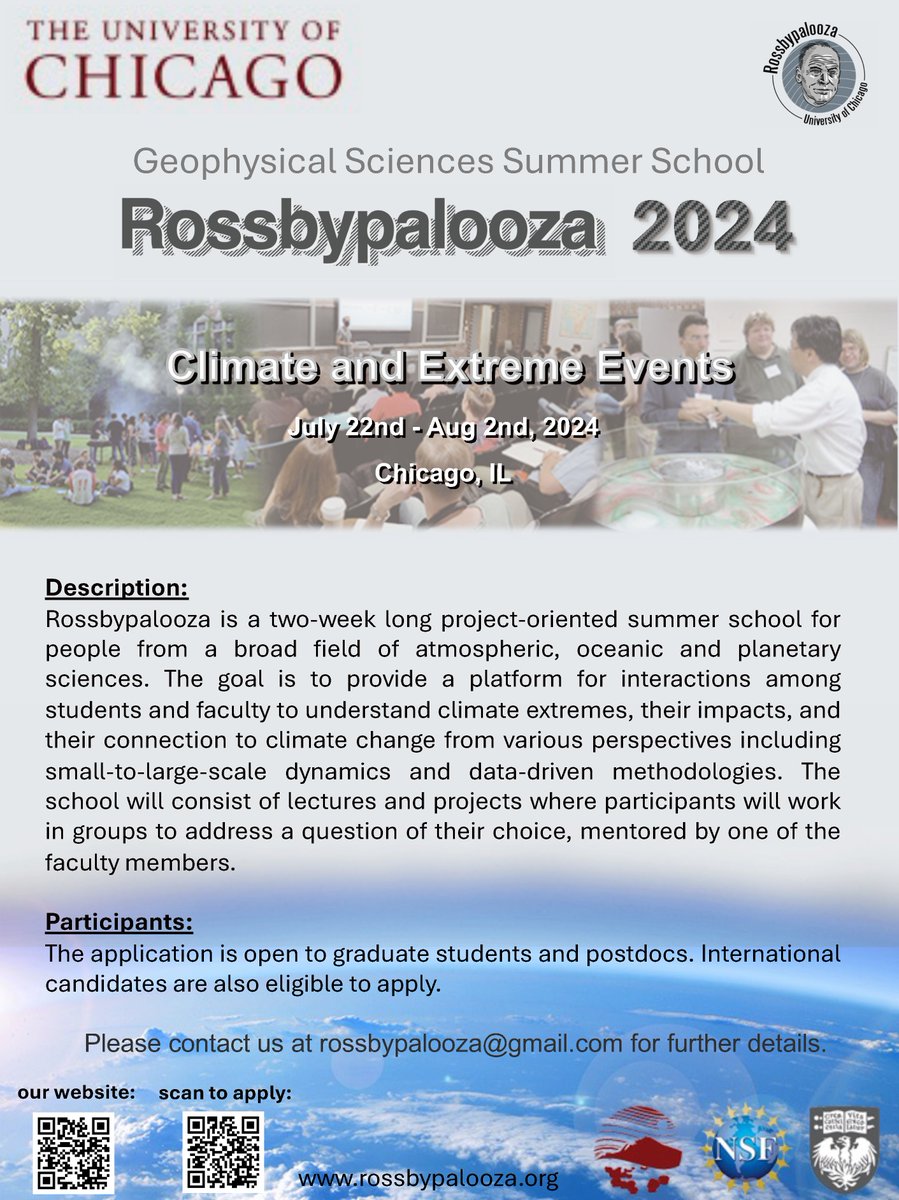
Students/postdocs: Join us @GeoSci_UChicago for the Rossbypalooza 2-week summer school on "Climate and Extreme Events" this July https://t.co/5hyOcINQaP. Visiting faculty: Paul O'Gorman (MIT, keynote), @BillBoos (Berkeley), @profadamsobel (Columbia), Yi Zhang & Jon Weare (NYU)
...and is something we can measure on other planets. It turns out that when clouds are present on these planets, the albedo varies greatly both by season and whether you are in the summer or winter hemisphere. 🌼🌳🍂❄️
Why is this interesting I hear you ask? It comes down to something called albedo, which is simply a measure of how good something is at reflecting light🔦: snow has a high albedo☃️ and coal has a low albedo🪵. It affects how climates respond to radiation...
Clouds like to interact with their surroundings—notice how the coldest nights are the ones without clouds—we find that clouds modify the seasonal behaviour in a feedback loop, changing the circulation and the timings of the seasons. 🌡️📅
We find that seasons change massively with rotation rate; as you slow down, clouds drift significantly north/south with the seasons. We can link this with the large-scale circulation of the atmosphere, where regions of ascending air are more likely to form clouds. ☁️
Absolutely thrilled to announce that my first paper has just been published online! 🍾
If you’re looking to procrastinate this afternoon then do take a look: https://t.co/5TOqtpAGkL 🌦️🌍💨
But if you’d rather not scroll through the entire article, here’s a quick explainer 🧵
Thanks to the magic of climate models, we can test just that! Take an Earth-like planet with a global ocean (think Kamino you Star Wars fans), and spin it at different rates: from 128x slower than Earth🐢 to 4x faster than Earth (good luck sleeping when the day is 6hrs!). 🐇
We’ve all seen the iconic Blue Marble image of Earth, covered in swirling bands of clouds. Clouds seem to form in specific areas, which ultimately is an effect of Earth's rotation. What if someone changed this rotation, would the clouds move? ⏱️
Interested in climate or weather and looking for a friendly, welcoming conference in which to present your work, look no further! The RMetS annual Early Career and Student Conference is now open for abstract submissions (until 29th February).
👇For more details 🌦️
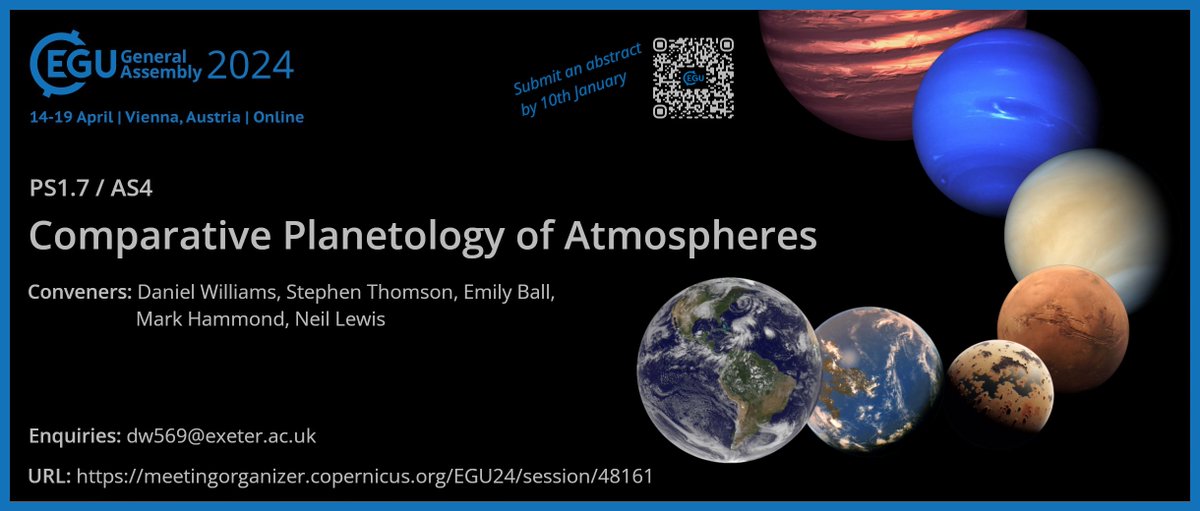
Please do consider submitting to our new #EGU24 session on 'Comparative Planetology of Atmospheres' convened by the brilliant @meteo_dan, @EmilyRBall, Mark Hammond and @neiltlewis (and me). #planets#atmospheres
Submitted an abstract yet for our session #EGU24 yet? We've got an exciting session on the Comparative Planetology of Atmospheres we'd love to see contributions to. Don't let my graphic design skills go to waste!
https://t.co/6dDYtwc0Jc
@EuroGeosciences