MEE is a scientific journal promoting new methods in #ecology & #evolution, and facilitating their dissemination and uptake by the #research community.
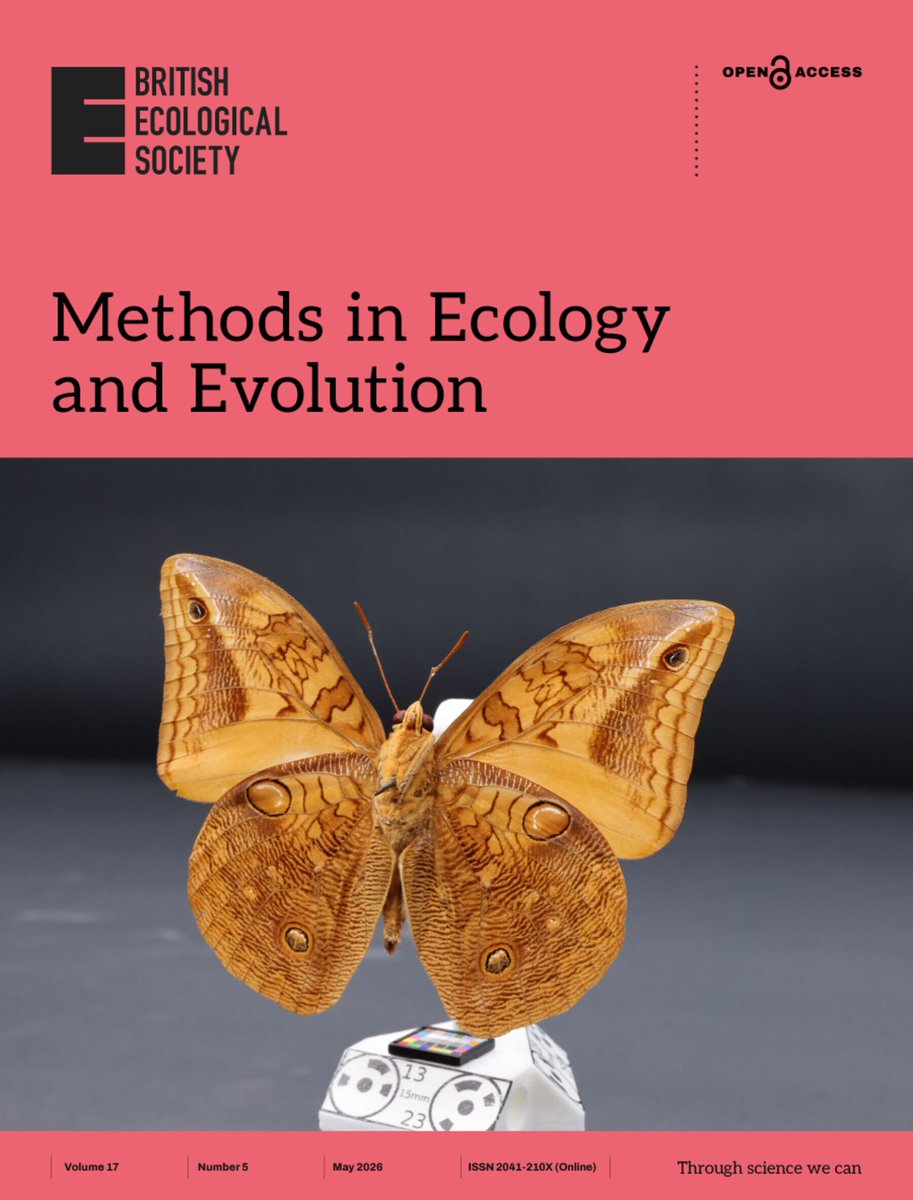
Our May issue is now out! 🦋
This issue contains the special feature 'Emerging Methods in Business and Biodiversity'. Read the special feature, and all the papers in the issue here 👇
https://t.co/HVX8LbukL4
📖 Published📖
Addressing false negatives and positives in eDNA studies🌍 🧪 🧬
This approach not only encourages scientific advancement but also enables
sound ecological inference 👇️
https://t.co/nKu0C1BgFm
📖 Published📖
Discovering data-driven microbial growth models with symbolic regression
Authors found that balancing data fit, parsimony and biological relevance favoured both the simplest, linear approximation and models🖥️ 🌍
🔎 https://t.co/HjVzkuAsi5
📖Published📖
Authors developed a state–space model that predicts continuous changes in mass for animals that engage in primarily flapping flight, where we can measure wingbeat frequency and foraging behaviour 🪽
Read here👇
https://t.co/Vhd3gixv5t
New blog post! 🚨
Read the story behind the paper 'From video to behaviour: An LSTM-based approach for automated nest behaviour recognition in the wild' 🪺
https://t.co/Msly5o3c4d
P.S This is my (Harriet, Assistant Editor at MEE) first paper as an author! 🎉If you’re happy to share, drop a link to your first paper below, I’d love to see them! (6)
We recently published a paper looking at archiving of code and data at the BES, giving recommendations for improvements.
https://t.co/AsL3bhdIEW
This paper has 138 authors from 29 countries! 🌍
Read below to find out how this paper came to be👇 (1)
The paper makes recommendations for how authors, the BES and other journals/institutions can improve the archiving of code and data, helping on the road to making science reproducible! (5)
📖Published📖
Check out our newly published research article 'Statistical analyses of ecological multinomial time series to identify environmental drivers and biotic interactions'
Read here 👇
https://t.co/IbAucRNTAz
📖 Published 📖
Common ground: Efficient, consistent, observer-independent bioacoustic call density estimation with adjudicated ground truth and capture–recapture detection functions🌍 🐦⬛
👇️
https://t.co/rISWrj0siY
📖 Published📖
SOUPE: An R package to test and optimise the phylogenetic and ecological representativeness of a taxonomic sample 🧪 🌍 🖥️
🔎 Read more: https://t.co/o4nZKClqqU
📖 Published📖
Tuning the tools: Validating empirical and modelled correction factors for diet estimation in pelagic teleosts🌍 🐟️ 🖥️
🔎 Find out more: https://t.co/pXoT3FLrQw
🎧️ Check out our recent podcast episode with our Early Career Research prize winner on drone use in ecology 🌍
👉️ https://t.co/6rRqKL5Uok
👉️ https://t.co/5WvrTlCj5r
📖 Published📖
MorphSim: An R package for simulating discrete morphological data
MorphSim integrates directly with TreeSim, FossilSim and SimClock, providing a complete end-to-end pipeline for generating datasets🖥️ 🌍 🧪
🔎 https://t.co/rUzqL6y9pm
New blog post! 🚨
Jonathan Syme tells us the story behind his recent application article 'sampley: A Python package for sampling visual survey data'
Read here 👇
https://t.co/OgOewsNqA4
📖 Published📖
An intuitive method to calculate the utilization distribution of an animal from step-selection analysis🖥️ 🌍 📈
🔎 Read more: https://t.co/j8QlC3hin2
New blog post! 🚨
Nyniane Steinkampf–Pellecuer, Idriss Pelletan and Pauline Provini tell the story behind their new paper 'SOUPE: An R package to test and optimise the phylogenetic and ecological representativeness of a taxonomic sample'
Read here👇
https://t.co/JrbSCcxnWN