This clip proves Joseph Vijay’s real character.
That’s exactly why he runs away from press conferences his short temper and true face will get exposed.
He only wants limelight, constant applause, and admiration.
Classic narcissist 🤦♀️ https://t.co/N3C5zWqhMR
Fifty three years ago, one film turned the course of political history in Tamil Nadu, that film was Ulagam Sutrum Valiban. It was released during the very period when Puratchi Thalaivar #MGR had launched the #AIADMK movement.
At that time, the DMK allegedly made every possible attempt to stop the film's release. While serving as the Treasurer of the DMK, MGR openly accused several party leaders of amassing wealth far beyond their known sources of income. He declared that he would question the party's finances in the executive committee meeting. That accusation exposed, in the eyes of the public, how the Karunanidhi family was allegedly using the party for personal gain. Soon after, Karunanidhi hurriedly convened the executive committee and suspended MGR from the DMK. Leaders including Madurai Muthu sharply criticized him, and demands were made for MGR to apologize. But MGR refused to bow down. Finally, on October 14, Karunanidhi announced MGR's permanent expulsion from the party. On that very day, MGR celebrated by serving payasam to those gathered at his house. What seemed like a sweet celebration eventually turned out to be poison for the DMK in the years that followed. The moment news spread that MGR had been expelled, Tamil Nadu erupted in protest. Fans blocked buses and lorries, college students poured into the streets, and the agitation spread even into schools. Out of that political storm was born the AIADMK.
It was during this historic phase that Ulagam Sutrum Valiban was gearing up for release. Madurai Muthu famously challenged that if the film released successfully, he would wear a saree. Around the same time, Dindigul MP Rajangam passed away, leading to a by-election announcement for May 20, the first election AIADMK would ever face. Karunanidhi reportedly deployed the entire cabinet machinery for the Dindigul by-election campaign. The DMK feared that if MGR's film released during that sensitive political period, it would become a massive embarrassment for them.
During a meeting in Vathalagundu, MGR's fans, who had by then transformed into loyal political cadres, insisted that he announce the film's release date immediately. MGR boldly declared that the film would release on May 11, just nine days before the by-election. That announcement further enraged the DMK. Theatres were pressured, and in Chennai, taxes on film posters were increased. MGR personally contacted theatre owners, assuring them of protection from his own supporters. Anticipating sabotage, he reportedly sent the original film reel along with nine duplicate fake reels, ensuring that even if DMK men intercepted some boxes, the real print would still safely reach theatres. Unprepared for this strategy, the DMK government allegedly resorted to sudden power cuts across several places on May 11. Many theatres operated using generators. Though theatre owners petitioned the police for security, officers allegedly stayed away after instructions from the ruling government. In many places, AIADMK cadres themselves protected the theatres.
MGR was determined that theatre owners should not suffer losses due to political violence. Despite every obstacle, the film finally released. The very first scene featured the AIADMK flag, and theatres erupted with whistles, applause, and celebration. The opening song of the film became an anthem of energy and inspiration for AIADMK supporters, "Namathu Vetriyai Naalai Sarithiram Sollum," a song that continues to emotionally energize generations of party cadres and loyalists even today. The film went on to become a massive blockbuster, and in the Dindigul by-election too, AIADMK registered a landslide victory. The devoted followers of MGR, the Rathathin Rathangal, who worshipped him like a god, celebrated his historic victory with overwhelming emotion and pride.
நீதிக்கு இது ஒரு போராட்டம்,
இதை நிச்சயம் உலகம் பாராட்டும் ♥️ @AIADMKOfficial@AIADMKITWINGOFL
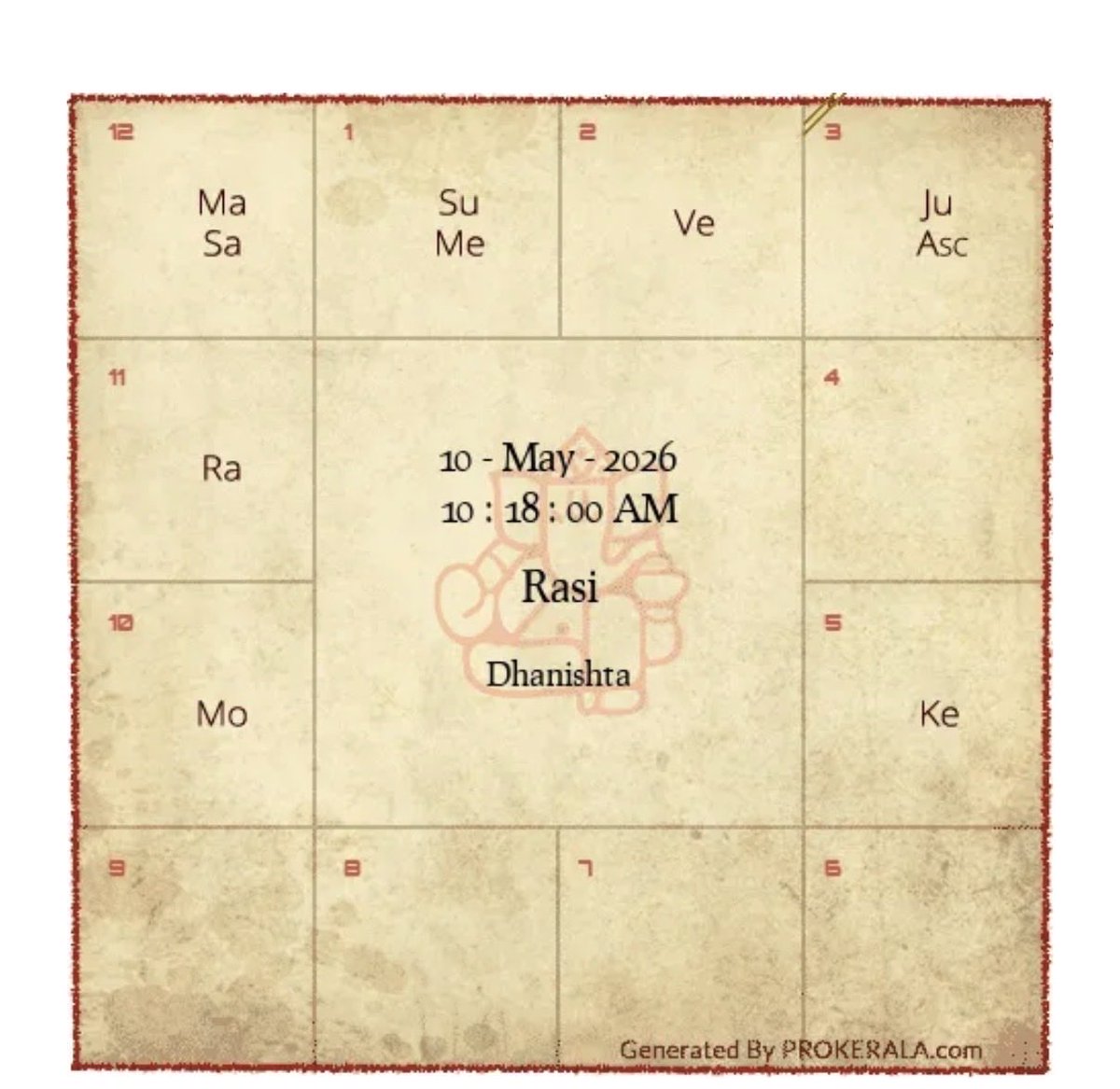
Chief Minister Vijay's Oath Taking Chart Points Towards A Transformative Yet Turbulent Tenure! #TVKVijay#TVKVijayHQ@TVKVijayHQ@CMOTamilnadu
The oath taking chart indicates the beginning of a politically transformative and highly visible government. Based on the overall strength of this oath taking chart, a sudden collapse or premature fall of the government does not appear as the primary indication. The chart has enough Saturn-Jupiter support for continuity, endurance, and completion tendency. The chart leans more toward survival through negotiation, control, and strategic adjustments rather than an outright collapse. From the very first day, the administration appears driven by strong public emotion, aggressive political momentum, and a leadership centric style. The chart carries the signature of a government that does not remain ordinary or low profile at any stage of its tenure. It suggests a period where governance, politics, media narrative, and public sentiment remain deeply interconnected throughout the full term.
The opening phase of the government looks extremely energetic. Public expectations rise sharply, and there is likely to be a feeling of political transition or a new era atmosphere among supporters. The leadership image becomes the central pillar of the government, often overshadowing even the cabinet itself. Symbolic decisions, rapid announcements, administrative reshuffling, and attempts to establish a distinct political identity are strongly indicated in the chart. Media attention remains intense from the beginning, and the government may dominate public discourse continuously during the early months. At the same time, the chart does not indicate a calm or easy administration. Strong Mars and Saturn influence shows that pressure begins immediately after assuming office. The government may function with an aggressive administrative approach, preferring fast decisions and visible action. However, this also creates friction, both politically and bureaucratically. Resistance from entrenched systems, institutional hurdles, opposition attacks, and internal balancing become recurring themes throughout the tenure.
The first year appears dominated by momentum, popularity, and restructuring. Public enthusiasm remains high, especially among emotionally invested supporters and younger voters. Welfare announcements, image building exercises, and administrative visibility may define this period. Yet internally, alliance equations and power sharing adjustments begin quietly during the same phase. The government starts strong externally, but behind the scenes, multiple factions and expectations may already require management.
During the second year, governance pressure increases substantially. The emotional honeymoon phase begins reducing as administrative realities become more visible. Opposition forces become sharper and more organized. Media scrutiny intensifies. Questions surrounding governance quality, finances, implementation, or concentration of authority may emerge more strongly during this period. The chart suggests that the government may increasingly depend on strategic communication and narrative control to maintain political momentum. Internal dissatisfaction within certain sections of the alliance or administrative setup may also begin surfacing intermittently.
The third year appears comparatively stable and important for consolidation. Jupiter's protective influence becomes more active here, helping the government regain balance and strengthen institutional control. This phase may bring major infrastructure projects, welfare expansion, investment narratives, or visible governance achievements that improve public perception again. Leadership authority consolidates more firmly during this period, and the administration becomes more structured and system oriented compared to the emotionally charged beginning years. Politically, this may become the strongest and most stable phase of the tenure.
However, the fourth year again shows rising turbulence. Saturn and Rahu combinations indicate increasing political heat, strategic rivalries, and internal power struggles. Questions regarding succession, leadership hierarchy, alliance positioning, or distribution of influence may become more pronounced. Opposition narratives could gain temporary traction, particularly around governance fatigue, financial management, or administrative controversies. Sudden political developments, reshuffles, or unexpected strategic decisions are possible during this phase. The chart suggests that the leadership may become more cautious, selective, and centralized while handling growing political pressure.
The fifth and final year strongly shifts into election mode. Governance and political campaigning begin merging together. Public communication, emotional connection, legacy building, and image protection become the primary focus. The leadership appears determined to retain control and maintain authority despite criticism and fatigue accumulated over the years. The government may rely heavily on welfare politics, symbolism, emotional messaging, and direct public outreach during this final phase.
Importantly, the chart overall still supports durability and completion of the full term. Even though the government continuously faces resistance, pressure, controversies, and internal adjustments, there are enough stabilizing influences to prevent sudden collapse. Saturn gives endurance through struggle, while Jupiter repeatedly offers institutional protection during critical periods. Rahu keeps the political environment dramatic and unconventional, ensuring that the government remains constantly discussed, debated, and scrutinized.
The most striking feature of this oath taking chart is that stability does not come through peace or absence of conflict. Instead, the government survives and continues through constant adaptation, strategic balancing, strong leadership projection, and political management. This is not the chart of a silent administration, it is the chart of a government that remains active, confrontational, emotionally charged, and politically dominant throughout its tenure.
The more sensitive period for instability appears around the later middle phase to Year 4, when Saturn - Rahu type pressures peak. That is the phase where the government may look politically vulnerable externally. Even then, the chart still leans more toward a government under pressure than a government falling.
Important dates & timings
May 2026 - October 2026: Strong public support, high visibility, rapid administrative decisions, cabinet structuring, and political momentum. Government establishes authority quickly.
November 2026 - February 2027: Internal adjustments and alliance balancing begin quietly. Opposition starts regrouping. Bureaucratic pressure increases.
March 2027 - August 2027: Aggressive governance phase. Major announcements, welfare measures, and image-building politics likely. Strong media dominance continues.
September 2027 - January 2028: First noticeable pressure cycle. Criticism regarding governance, finances, or administration may rise. Internal dissatisfaction possible.
February 2028 - September 2028: One of the strongest phases for consolidation. Government may gain stability through projects, welfare visibility, investments, and stronger institutional control.
October 2028 - March 2029: Leadership authority peaks. Public perception improves comparatively. Strategic political expansion possible.
April 2029 - September 2029: Sensitive political phase begins. Alliance equations, internal camps, and power struggles may intensify gradually.
October 2029 - February 2030: Highly volatile period in the chart. Opposition aggression, controversies, cabinet reshuffles, legal/political pressure, or administrative criticism possible.
March 2030 - August 2030: Government shifts towards survival mode and strong image management. Leadership becomes more centralized and cautious.
September 2030 - April 2031: Full election mode governance. Emotional appeal, welfare politics, symbolic announcements, and direct public outreach dominate the political atmosphere. Despite pressure, the chart still supports continuity till term completion.
This chart looks good on the surface, but when you dig deeper, you will find many afflictions.
As per my calculations, the current elected Tamil Nadu government will face three major challenges during this period:
• By mid-November, public perception will start shifting. Visible cracks in collation. • From November 2026 to November 2027, communications against the government may face heavy censorship, with increasing control over criticism and public expression. • From 13 April 2029 to 13 June 2029, Tamil Nadu could face major financial stress.
Some stability is seen between 13 June 2029 and 19 October 2029. However, due to reputational damage, scandals, overpromising, and underdelivery, I do not believe this government will complete its full term.
Between 19 October 2029 and 20 May 2030, the government may dissolve. Post 20 May 2030, I see a sudden shift in politics.
What concerns me more is the possibility of financial instability, external influences (read foreign influences), curbing of freedom of expression, ineffective communication, and growing indifference.
What is the Anti-Narcotic Task Force (ANTF) Expansion?
Tamil Nadu's specialised anti-narcotics unit the ANTF currently functions in only 15 of the state's 37 districts. More than half the state has no dedicated narcotics enforcement presence on the ground.
@CMOTamilnadu sanctioned 65 ANTF stations on his first day in office one in each of the 37 districts, and 28 more spread across the nine city police commissionerates that cover Tamil Nadu's major urban centres: Chennai, Coimbatore, Madurai and others.
The local police are already burdened with law and order and bandobast duties, leaving narcotics enforcement chronically under-resourced. A dedicated ANTF presence in every district separates narcotics enforcement from the general policing machinery.
@xpresstn
Tamil Nadu Police’s Cyber Crime Wing issued a takedown notice to X Corp on May 8, demanding the suspension of more than 20 accounts, including that of YouTuber Maridhas, within three hours, invoking intermediary liability provisions under the IT Act and the IT Rules, 2021. Most of the flagged accounts were supporters of the DMK and had posted content criticising @CMOTamilnadu . The police characterised the posts as threats to “public tranquillity.”
@xpresstn
Everyone was watching Bengal.
No one looked south.
Tamil Nadu.
A new party won 108 seats.
It was born 26 months ago.
From zero to government.
They called it a people’s revolution.
I called it something else.
I called it well funded.
I started digging.
The funding trail does not add up.
The international connections run deep.
Very deep.
There are networks involved.
Networks that IB and RAW know well.
This is not a rags-to-riches story.
This is something far more sinister.
I have been researching this for days.
What I found is not comfortable.
It is not a good news story for India.
A full expose is coming next week.
Every layer will be named.
Every money trail will be traced.
Every connection will be shown
Tamil Nadu is not done making news.
The real story has not started yet.
Watch this space.
Vijay Joseph came dressed like a saviour.
But political messiahs are rarely self-made.
The posters sold a hero of the poor.
The money trail tells a darker story.
Some are elected.
Some are installed.
A 26-month-old party suddenly built a machine.
108 seats.
70,000 booth agents.
Digital warfare.
Mega rallies.
Constituency saturation.
BJP took decades to build booth infrastructure.
TVK did it in months.
Money was flowing like monsoon water.
Estimated TVK Campaign burn rate?
~₹1,500 crore.
No declared donor trail.
No transparent funding map.
Just advertisements.
Volunteers.
Ground networks.
Everywhere.
So, I dug deeper.
One face kept appearing beside Vijay.
Every rally.
Every frame.
Every campaign trail.
Aadhav Arjuna.
TVK’s General Secretary.
The Number Two.
Aadhav is the son-in-law of Santiago Martin.
India’s Lottery King.
The same Santiago Martin.
Who became the single largest buyer of electoral bonds.
₹1,368 crore.
ED cases followed.
Money laundering allegations followed.
Assets attached.
Raids happened.
Yet the network kept expanding.
One family.
Inside multiple parties.
Winning from multiple directions.
No matter who governs…
The Martin Family is inside.
But Santiago Martin is not just a businessman.
Pope Benedict XVI personally issued,
an apostolic blessing to Martin and his family.
One of the highest symbolic honours in Catholic circles.
And then another layer appeared.
Martin also served as Consul General for Liberia.
Diplomatic access.
Diplomatic corridors.
Diplomatic insulation.
Then I moved further back.
Vijay’s father.
S. A. Chandrasekhar.
Born into a Catholic family.
From Thangachimadam.
A region shaped for centuries by missionaries.
Then came Loyola.
Vijay’s uncle Xavier Alphonse led Loyola College.
A powerful Jesuit institution.
Another uncle,
Xavier Britto,
Produced Vijay’s early films.
After TVK launched,
Loyola’s international alumni activity exploded globally.
Fundraisers.
Events.
Networking.
But Jesuit do not operate like normal organisations.
They operate across continents.
Across institutions.
Across generations.
Then came polling week.
Catholic Bishops reportedly circulated pamphlets.
Through churches.
During Sunday Mass.
The messaging was clear.
Vote strategically against BJP.
Then came the TVK poll promise.
SC reservation for Dalit Christians.
Now pause there.
Because this is where ideology meets economics.
Government jobs.
Scholarships.
Reservation benefits.
Attached to religious identity.
That changes the conversion equation permanently.
And Delhi knows this.
IB knows this.
RAW knows this.
The real question is whether anyone wants to confront it openly.
Because Tamil Nadu is not just another state.
It was always a centre of Catholic Missionaries.
And now a new power structure stands there.
Unexplained money.
Transnational Lottery empire.
Generational and Powerful Jesuits influence.
This is not a rags-to-riches political story.
This feels far more organised than that.
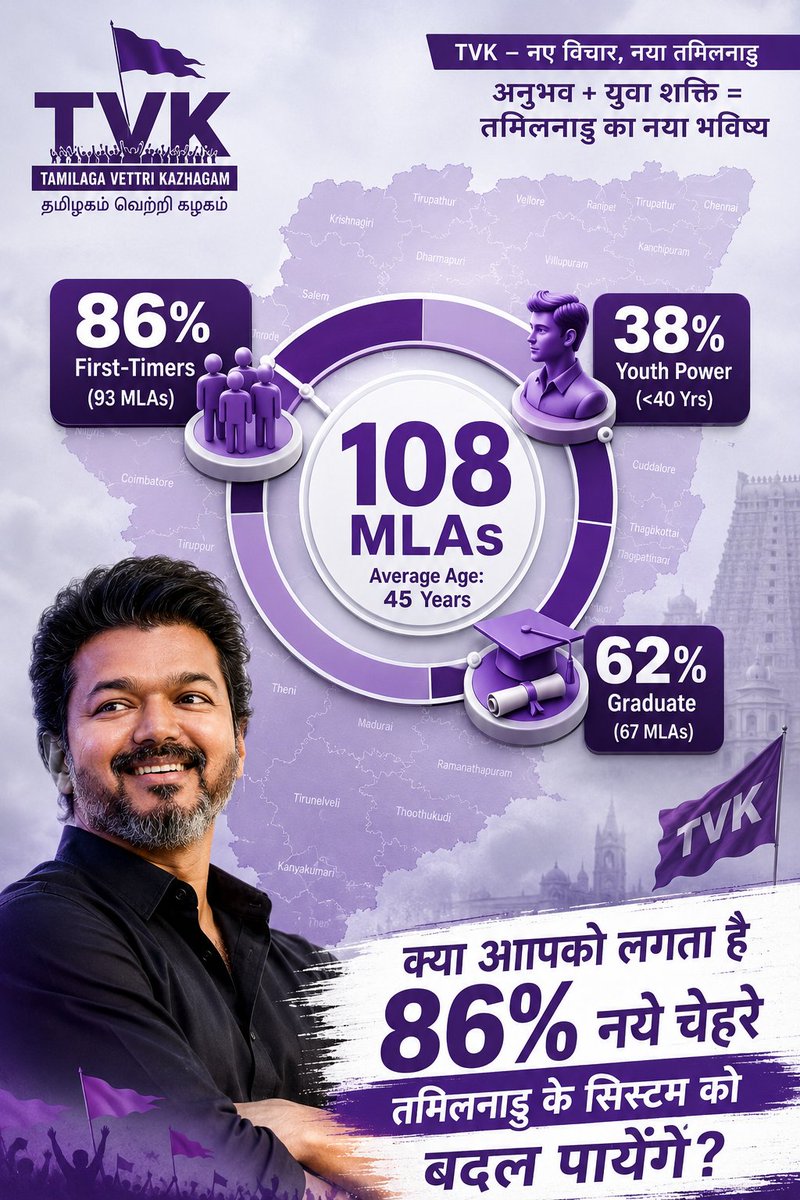
TVK’s Political Disruptors: A Data-Driven Breakdown-
The numbers for TVK’s 108 MLAs are out, and they signal a massive "System Reset" in Tamil Nadu’s political landscape. We aren't just looking at a new party; we are looking at a complete generation shift.
The Power Stats:
86% Fresh Blood: 93 out of 108 MLAs are First-Timers. No political baggage, just pure intent.
The Youth Surge: 38% are under the age of 40. The average age of the bench is just 45 years.
Educated Leadership: 62% (67 MLAs) are Graduates, bringing professional logic to policy-making.
The Balance: A 9% veteran presence to guide the new energy.
Is this the "New Era" Tamil Nadu has been waiting for, or will the lack of traditional experience be a challenge?
#CMJosephVijay #TamilnaduCM #TVKVijayHQ
Palladam TVK MLA K.Ramkumar (a butcher) literally WENT to DMK & ADMK candidates, admitted he’d lose, and DEMANDED bribes to stop his campaign!
He stayed true to the cash, did zero groundwork, and won by 37,897 votes. 🤣
Extorting money to sleep is Vijay's "Maatru Arasiyal"? 🤡
I urge everyone to sign the petition to expel russia from the UN 👉 https://t.co/SVN1lwHG1n
And also a petition calling for the resignation of Guterres 👉 https://t.co/IyVZExD0Dw
Unmanned Systems Forces continue to destroy enemy air defense systems, deployment sites, and logistics. This time, FP-2 drones struck: 2 Buk-M3 air defense systems in Donetsk Oblast, a Strela-10 air defense system in Zaporizhzhia Oblast, railway tank cars carrying fuel and lubricants in Luhansk Oblast, and a fuel and lubricant depot in Luhansk Oblast. We thank the USF for such excellent cooperation.
"Well, here we go — the night of May 7 from the USF Birds: three Buk and Strela air defense systems, fuel tankers and depots, pilot command posts…
Inside the enemy’s operational depth in Temporary Occupied Territories, the agenda from the USF Birds is as follows: everything is burning.
Among the 22 military targets struck overnight in the enemy’s operational depth:
🔥 “Buk-M3” air defense system, Donetsk Oblast, 1st Separate Centre of the USF
🔥 “Buk-M3” air defense system, Donetsk Oblast, 1st Separate Centre of the USF
🔥 “Strela-10” air defense system, Zaporizhzhia Oblast, 414th USF Brigade “Birds of Magyar”
🔥 Rail tank cars with fuel and lubricants, Luhansk Oblast, 1st Separate Centre of the USF
🔥 Fuel and lubricants depot, Luhansk Oblast, 20th USF Brigade “K-2”
🔥 UAV command posts, Zaporizhzhia Oblast, 414th USF Brigade “Birds of Magyar”
🔥 Ammunition depot and concentration of personnel and equipment, Luhansk Oblast, Main Department of Unmanned Aerial Systems of the USF “Phoenix” of the State Border Guard Service and 413th USF regiment “Raid”
🔥 Underground fuel storage facility, Luhansk Oblast, 1st Separate Centre of the USF
Three misslie systems were added to the list of destroyed air defense elements between May 1 and 7. A total of 9 so far in the first week of May.
April was fruitful — 38 air defense systems and radars were destroyed, as reported.
Will May be just as fruitful? We’ll see."