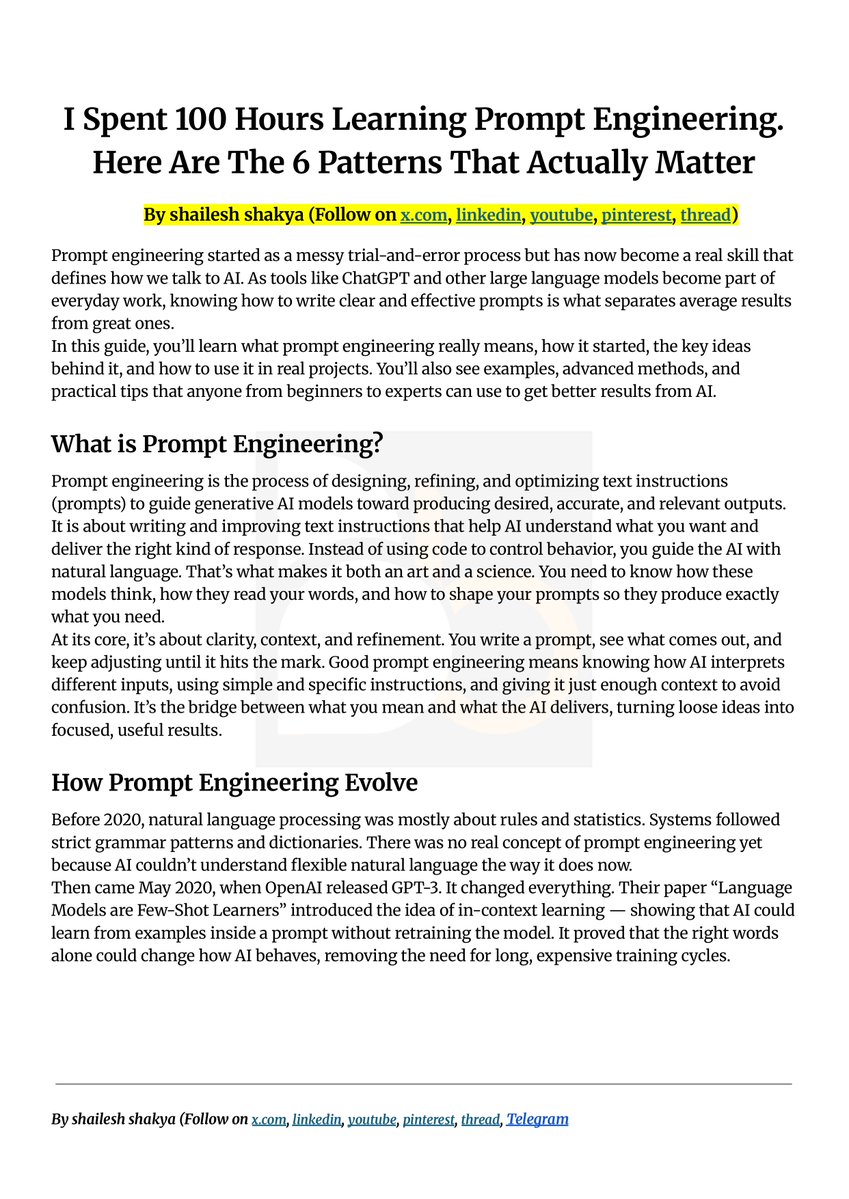
Bad prompt: "Write about marketing in simple words"
Result: Generic 400-word fluff
Good prompt:
"You are a digital marketing strategist. Write a 1500-word guide on email automation for e-commerce brands with <50 employees. Include: 3 tool recommendations, 2 case studies, implementation checklist. SEO focus: 'email marketing automation.' Tone: actionable, simple, no jargon."
Result: Comprehensive, actionable guide
The difference? Specificity + Structure.
After 100 hours of testing, I found 6 patterns that turn weak prompts into expert-level ones:
1. Role Assignment ("You are a...")
2. Chain-of-Thought ("Think step-by-step...")
3. Few-Shot Examples (show 2-3 samples)
4. Context + Constraints (background + boundaries)
5. Output Specifications (length, format, tone)
6. Self-Critique ("Review and improve your answer")
These patterns work for coding, content, data analysis, and more.
Want the complete guide with 20+ templates?
Like this post
Repost it
Comment "SEND"
I'll DM you the full framework (includes real examples & advanced techniques
Every PM should be using Claude Code.
So I built a HUGE course for you to learn Claude Code... IN Claude Code!
🔹 Complete guide
🔹 Make PRDs, analyze data, create decks
Soon, I'll sell it for $149.
For the next 24h: FREE!
Follow + RT + comment "CC" & I'll DM it.
I MADE A VOICE AI AUTOMATION AGENT FOR A REAL ESATE AGENT THAT MADE THEM $43,000
Literally created this bot in 20 mins with n8n
Want a Doc + workflow on how to do it?
RT, Like & reply "AI” and I’ll DM it to you
(Must follow for dm)
I scaled a brand from $67K/month,
to $1.8M/month
in 90 DAYS!
The 4 key unlocks were:
• Offer + funnel
• Creatives
• Media buying
• Subscription
I filmed a 25-min case study with ALL the data!
I show EVERYTHING!
Like + RT + comment “CASE” (must follow) & I’ll DM it.