Dear followers, I would like to share this new working paper.
https://t.co/orOij1jAlO
It’s a theoretical exploration of the political consequences of pervasive automation. The worrying implication from the analysis is that the combination of rapid automation and redistribution used in order to quell discontent doesn’t seem stable – more automation necessitates more and more redistribution. This creates a natural complementarity between pervasive automation and repression as the method of choice for holding pitchforks at bay – a particularly concerning conclusion as AI is expected to lead to a lot more automation in the years to come.
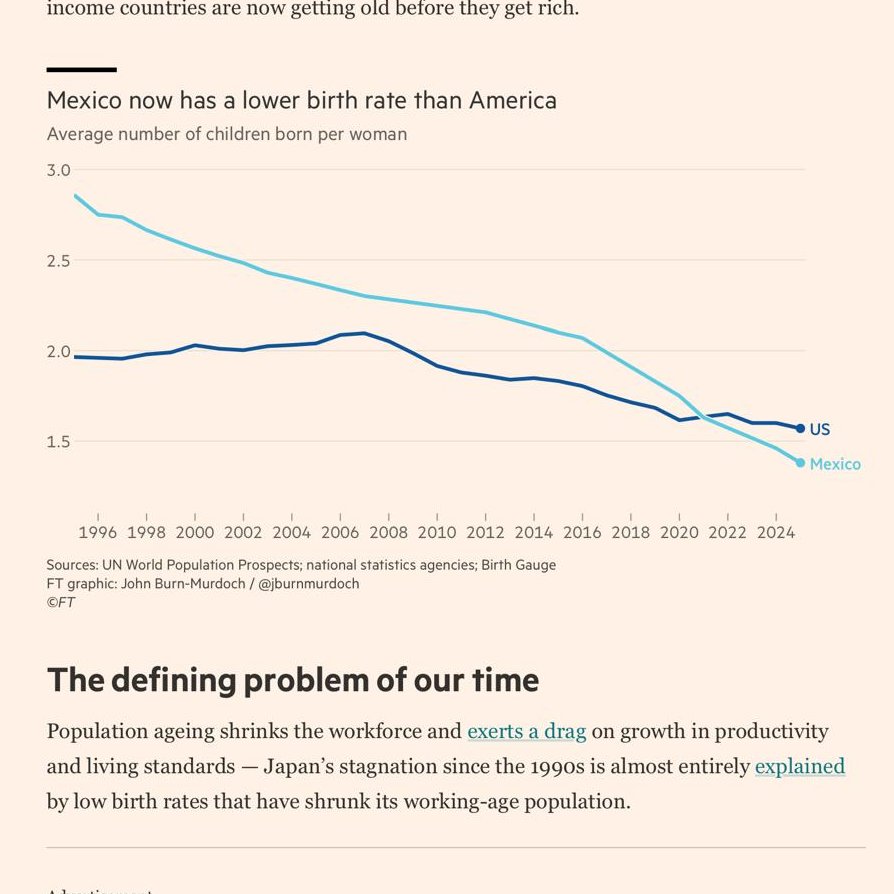
Abro hilo ( 1 de 3). Un artículo muy interesante del Financial Times muestra que en un gran número de países (incluido México) la tasa de natalidad está por debajo de 2,1, el porcentaje necesario para reemplazar la población actual. Por debajo de esta tasa, la población total empieza a decrecer.
De manera sorprendente y por primera vez desde 2023, esta tasa para México🇲🇽 es menor a la de Estados Unidos 🇺🇸.
Mexican management quality is both lower on average and less correlated with firm size than in the United States, a sign of misallocation in the economy, say researchers at @Stanford, @WorldBankGroup, and @LSEnews. #Chart https://t.co/9jAe5FbgKq
1789, 1945, 2026: trois crises de la dette
L'histoire montre qu’il existe plusieurs façons de s’en sortir, y compris en quelques années et avec des dettes plus importantes qu’actuellement.
https://t.co/xpHuIBR0af
Poverty is an important cause of mental health issues.
Poverty and mental helath issues have a bidirectional causal link, with poverty raising risks of depression, anxiety, and other disorders 1.5–3 times higher via chronic stress, while mental illness can deepen economic hardship.
Jesús Fernández-Villaverde on global fertility decline—and why it matters. Henry Lecture, University of Miami. A masterful performance! Recording available shortly. Slide deck: https://t.co/ZDVAyqDu8V
Moderate consumption of caffeinated coffee or tea was linked to reduced #dementia risk and modest improvements in #cognitive outcomes; no benefit was seen for decaffeinated coffee in an observational study of US adults.
https://t.co/fJlHR5rJs0
How do social protection programs fight poverty and protect people from shocks? How can governments and nonprofits design effective social protection programs in low- and middle-income countries?
The Handbook of Social Protection, published by MIT Press and edited by J-PAL affiliates @rema_nadeem and @Ben_Olken, tackles this question. From cash transfers to health insurance, the handbook examines real-world programs and the evidence behind them.
Check out the open access handbook: https://t.co/JFkwSNgmFR
¿Sabes cuáles serán los municipios del país con más #PersonasMayores en 2030?
Conoce esa información y otros indicadores en el artículo “Envejecimiento demográfico en México. Una mirada a su heterogeneidad estatal y municipal a partir de las nuevas proyecciones de la población”.
"I retained both my self-confidence and the desire to never let my gender define what I would or could do."
Read more about Esther Duflo's life and journey to becoming a laureate in economic sciences: https://t.co/si6c1Ycerp
#WomenInScience
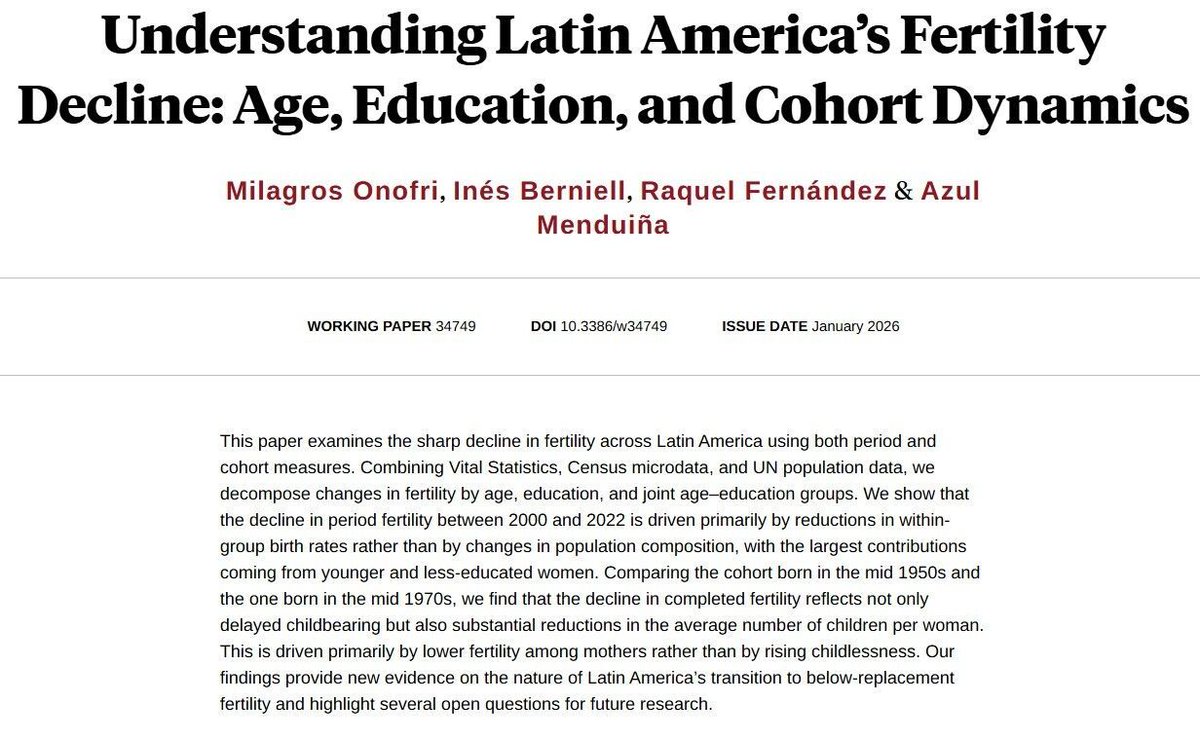
The very rapid decline in fertility in Latin America is driven by behavioral change, rather than demographic changes. Childlessness plays only a minor role in, from @milagrosonofri, @InesBerniell, @raquel1fernan, and Azul Menduiña https://t.co/uXUMyexW8K
Every time I post about fertility decline, someone in the comments asks: why don’t you talk about contraception? Isn’t that the obvious explanation?
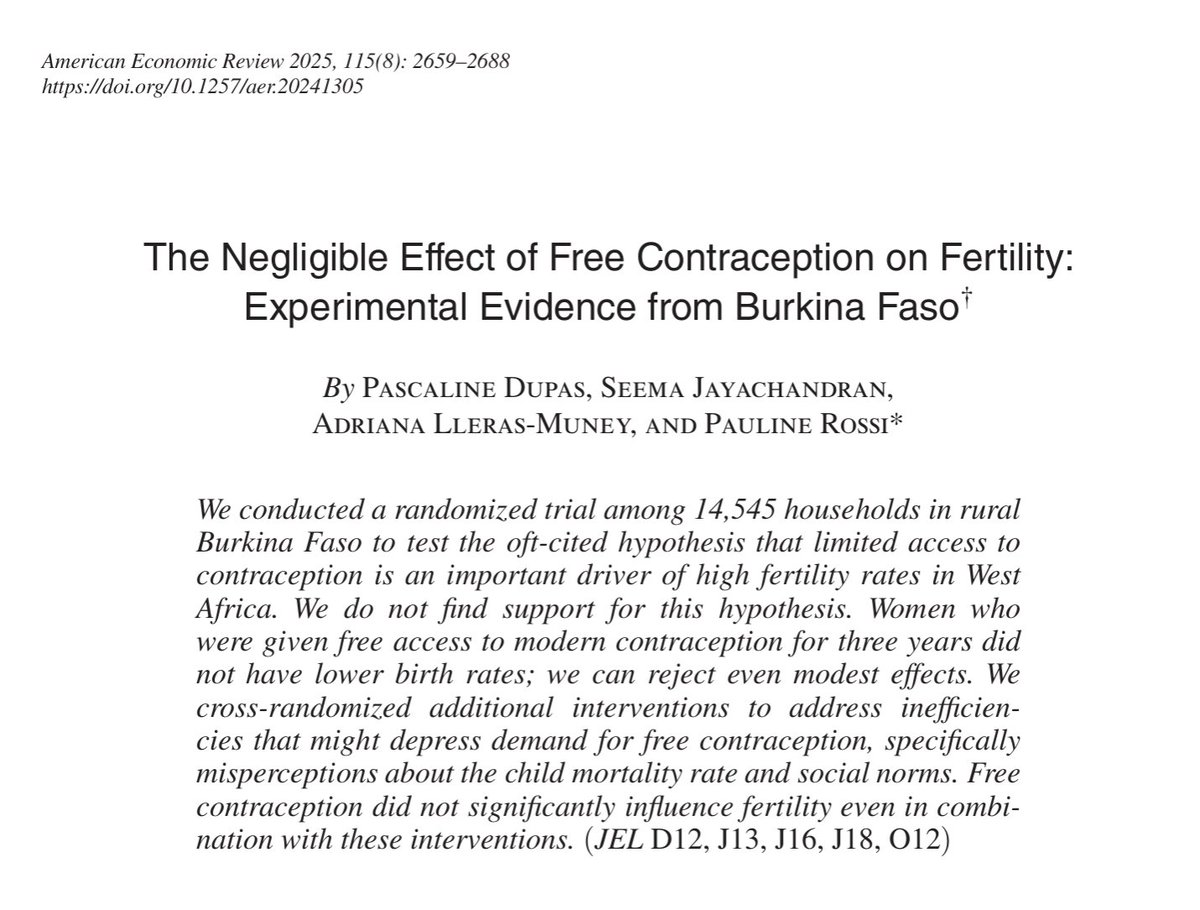
This has nothing to do with contraception being a taboo topic. There are plenty of papers in top economics journals studying the effects of contraception on fertility. For example, I include a screenshot of an outstanding paper by Pascaline Dupas (@DupasPascaline), Seema Jayachandran, Adriana Lleras-Muney (@LlerasMuney), and Pauline Rossi, which appeared in the American Economic Review a few months ago.
The issue is statistical, and it goes back to the very first lesson of causal analysis: do not try to explain one choice with another choice that is determined at the same time.
Fertility and contraception are both outcomes of the same underlying decisions, preferences, constraints, and norms. Couples decide whether to have children and whether to use contraception jointly. If you simply regress fertility on contraceptive use, you are confusing cause and effect. Low fertility can lead to more contraception just as easily as contraception can lead to lower fertility.
A simple analogy helps. Suppose you observe that people who carry umbrellas are more likely to get wet. Would you conclude that umbrellas cause rain? Of course not. Both umbrellas and getting wet are driven by a third factor: rain. In the same way, contraception use and fertility are both driven by deeper factors: desired family size, income, education, norms.
Because of this endogeneity, a simple correlation between contraception and fertility tells you nothing about what causes what. Without a credible source of variation that affects contraception but not fertility directly (a natural experiment, a policy change, something), the estimates are biased and potentially meaningless.
This is why serious research in this area relies on instruments, randomized rollouts, policy discontinuities, or structural estimates. Not simple correlations. The concern is not ideology or taboo. It is basic statistical logic.
I am looking forward to participating on this panel at our upcoming Stone Center symposium.
See the full agenda and register here: https://t.co/4p5H6QAwRb