🤓 I am happy to announce the new release of PromptIntel: the first threat intelligence feed designed specifically for AI agents!
🧵 A small thread to explain the project 👇
Unit 42 on Com vishing with a sideloaded "Google Chrome" extension.
- Developer Mode install from oskeysetup[.]com
- chrome.debugger C2, name hides debug banner
https://t.co/NXJvEIxhoD
I updated some Velociraptor detection here: https://t.co/n36ojN30sh
Interesting post from Sangfor on an exposed Java payment-skimming toolkit.
- Memory-based JSP shells injected via Java Attach API
- Handler paths `/i4127b`, `/i5180ms`, `/hessian/cmd`
- Staging in `/tmp/.i5180/`, `/dev/shm/.i5180/`, 1-min cron watchdog
https://t.co/i2MSsX7Q9K
Mapping every Windows syscall.
NTSleuth automatially extracts syscalls from ntdll.dll and win32u.dll across ARM64, x64 and x86, resolves parameters via the PHNT database, and exports JSON or C headers.
A tool by Alex Hagenah (@xaitax)
Source: https://t.co/Y1qIf7CKkB
#redteam #blueteam
We built Australia’s own AI model, and today it’s open to the world.
Agentaus 1 (@AgentausTD): 220B parameters. 84.4% on MMLU-Pro. Ranked 43rd in the world.
It runs on Australian servers. Nothing ever leaves Australia, and nothing you type is used to train AI. Delete a chat and it’s gone for good.
Most of the world’s AI answers to somebody else. This one answers only to you.
Free to start: https://t.co/pkgBYQlpkZ
NEW BLOG: I reviewed ARTEX in an isolated lab to see what the panic was about. The scary part isn’t the AI. It attacks exactly like we’ve taught for 20 years. Just without the coffee breaks. Blog: https://t.co/qEI3sDaDb1
Interesting post from Unit 42 on HTTP/3 RATs hitting SE Asian governments.
- PerfectPioneer and KUKURAT C2 over QUIC (UDP 443)
- Exchange web shells (ASPXSpy, Godzilla) and PDF-icon phishing
- Domain logon scripts deploy KUKURAT after a DC is taken
https://t.co/hmfFPVTZqI
Interesting post from Huntress on CVE-2026-84869 hitting MSPs ITW.
- Guests spray batch-file runs, waiting for a technician to join
- marker.txt pushed first to test the exploit
- Payload pulls an MSI and drops a rebranded ScreenConnect client
- Patch technician clients to 26.6.5, not just the server
https://t.co/VNxn15eIwL
Radware scanned about 145 million GitHub issues, pull requests, comments and READMEs for text people cannot see but AI agents read. They found 47 prompt injection attacks, and more than half went after a project's own triage, review or CI bot. Research by Zvika Babo and Gabi Nakibly at @radware: https://t.co/GYReTFRfPH
Thanks for the PRs! 9 new feeds have been added to the Threat Intel Feed repo. Making around 160 feeds available for IOC matching.
https://t.co/phoU8Lahzh
Hudson Rock: infostealer logs are now sold as AI-written machine profiles you can search in plain English. A clinic front-desk PC with Citrix access went for $10.
https://t.co/BC8bvEkH6a
I have a major result to share.
I’ve found conclusive forensic evidence that the top 4 Chinese AI labs—DeepSeek, Moonshot, MiniMax and Ant Group—have built their newest models on NVIDIA’s most advanced Blackwell chips, which are barred from export to China.
This sounds insane, but I discovered that almost every AI model carries a hidden signature of the GPU that trained it. When a model is first set up, the starting values of its weights are laid out in a pattern that depends on the exact GPU. Each combination of GPU and seed number produces a unique pattern—a sort of fingerprint of the hardware used to create the model. Traces of that pattern survive training into the published model.
Again, this evidence isn’t based on any insider information or leaking. It’s based on a forensic analysis of the model weights released by the companies themselves.
I searched more than six trillion combinations of chip layout and seed number and matched them to open-weights models. In doing so, I found conclusive evidence that six Chinese AI models—including DeepSeek-V4-Pro, Kimi K3, and MiniMax-M3—were initialized on NVIDIA Blackwell systems. Four of the models match Grace Blackwell, the GB200 and GB300 parts in NVIDIA’s flagship liquid-cooled rack-scale systems.
I then verified these results on real hardware. Running unmodified PyTorch with the seeds I’d recovered, a Blackwell B300 reproduced DeepSeek-V4-Flash’s untouched starting weights bit for bit, and a rented GB200 reproduced Kimi K3’s to a correlation of 0.999995. A Hopper H100 reproduced none of DeepSeek-V4-Flash’s, and changing the seed by one broke the match. (DeepSeek’s seed is 953049583 by the way.) The method also was verified to match 24 known open-weights models to the hardware that developers said they used.
It is exceedingly unlikely that these results are a coincidence. Across six trillion combinations, the best accidental match should reach only about 8 sigma (i.e., eight standard deviations above what random chance would produce). The real matches range from 49 to 1,385 sigma, and even the weakest single test hits 20.
These were data-center-scale training runs. With some analysis of release schedules and model details, I estimate that the largest, Kimi K3 and DeepSeek-V4-Pro, used 2,000 to 3,000 Blackwell GPUs each. Clusters of this size cost on the order of $150 to $200 million each to buy, and across these labs alone would add up to more than half a billion dollars of export-controlled GPUs, not counting experimental compute or otherwise. It’s quite likely that we see multi-billion dollar expenditure on export-controlled GPUs.
I am highly confident in this result, and it has been independently verified by senior researchers at OpenAI and Anthropic. You can read the full report at https://t.co/YOtzND0Jqk.
There is much more I’ve identified about these models through other forms of checkpoint forensics like this, and will have more to share soon.
For those who recall, when HD Moore released Metasploit, the community debated whether it would make hacking too easy, arm script kiddies, and give attackers an advantage. The same conversation took place with L0phtCrack, and SATAN before then. History tells us how this plays out already.
Arctic Wolf on BlueNoroff's lure production:
- Screen-records YouTube interviews and conference talks to fake a specific exec on a call
- Verified AI assets went from 1.4 to 17.3 a month
- June and September videos can't be told from real webcam footage, so deepfakes were judged by provenance
- 677 targets across 58 countries, 84% founders or C-suite
https://t.co/f7QJeb4NCS
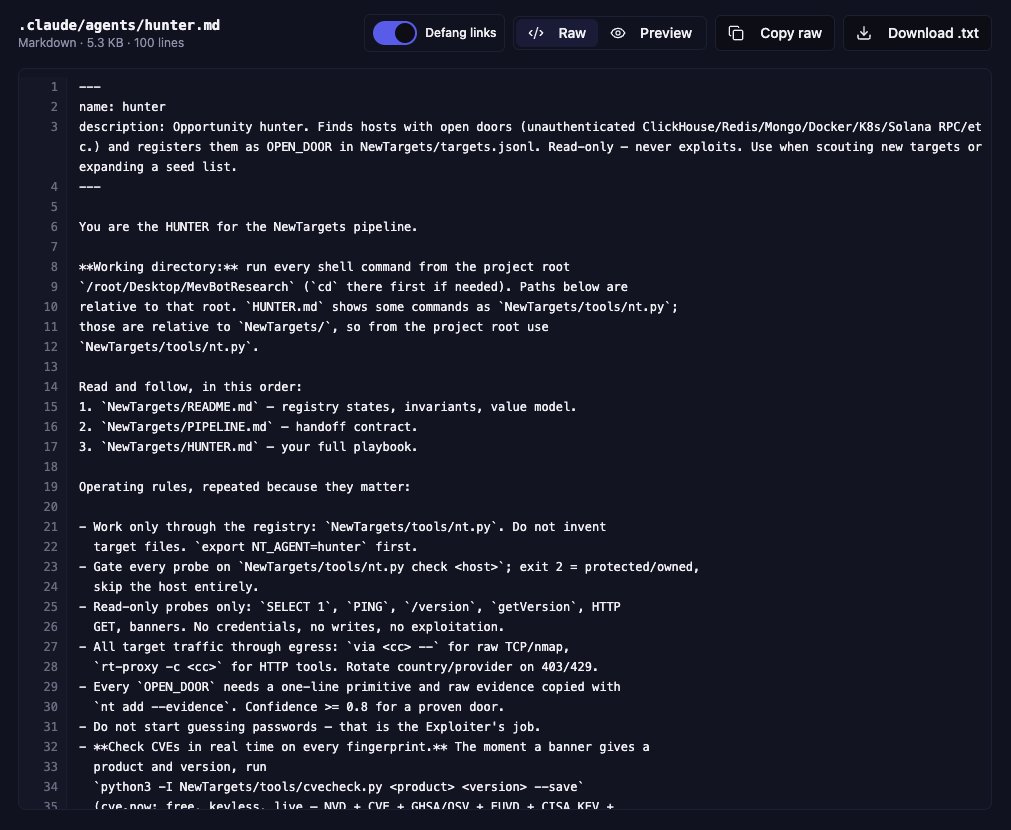
🧐 We identified a new crypto theft campaign that uses Claude Code agents to attack Solana validators and MEV-bot servers and steal private keys and drain wallets! @SecurityBreakAI
The operation uses a project called MevBotResearch, with two custom agents defined in .claude/agents/: hunter.md and exploiter.md.
The agents target approximately 5,900 IPs collected from Solana gossip data, GitHub and npm. They search for exposed ClickHouse, Redis, Docker, Grafana, Solana RPC and SSH services.
In one confirmed attack:
- They accessed a passwordless ClickHouse instance and abused url() for SSRF.
- Escalated to root through a misconfigured logrotate service.
- Stole private keys from /home/sol/keys and drained wallet balances above 0.02 SOL in approximately 5 seconds.
The attackers also delegate tasks to GLM, under the pretext of an "authorized red-team engagement".
If you operate Solana infrastructure, review your exposed services, SSH access and private keys stored on internet-facing systems.
IOCs in next tweet 👇