This PyFu post covers Python introspection, the ability to inspect objects at runtime, and how it becomes a weapon inside restricted execution environments.
Everything in Python is an object, and from a single reference you can read an object back to its class, climb to the base object, and enumerate every class the interpreter has loaded.
A common pattern observed before is a sandbox that strips import, eval, and open but still lets you evaluate one expression against a real object.
That single expression is enough. Introspection walks the object graph to a useful gadget, pivots through its module globals to __builtins__ and reaches command execution, no imports or other functions scope required.
https://t.co/c2RYNjzVx2
#offsec #appsec #AI
This PyFu post covers vulnerable code in LLM-based applications that leads to Server Side Template Injection (SSTI) in the prompt passed to the backend.
The post includes a Docker-based lab to practice discovering and exploiting the issue.
https://t.co/IY4kHY0Y4C
#offsec
After a few months of writing this on and off, it's finally ready. Pyfu, The Hacker's Handbook for Python Exploitation.
Sharing what I've learned about attacking Python apps, plus 40+ offline Docker labs to practice on.
#offsec#cybersecurity#python
https://t.co/mRe3eyMyqn
I finalized a few updates for DNSStager, including Linux and macOS payloads that can be used to stage your payload over DNS.
You will be able to fetch and run your payload over DNS on Linux and Mac boxes using several new payloads and custom execution techniques, with the ability to modify your loader within DNSStager itself.
A new release of DNSStager is coming soon!
https://t.co/V9ZB08vaLz
Security researchers become trapped into an identity that they can’t escape, life seems purposeless, reality shifts and they realize they can’t bend like a tree in the wind. It turns out that intelligence isn’t the key to happiness.
For those that know. Chop wood, carry water.
I just published a new blog post about the recent ISC DHCP research I did.
In this blog post, I explained how I achieved remote root code execution on the ISC DHCP service on Debian 13 by abusing a chain of a few features in the service.
https://t.co/UyEk5dI9d3
#offsec #cybersecurity
I had the chance to dig into a popular Linux-based DHCP server which I wanted to look at for a while now.
I spent some time tracing through the application source code, focusing on the management interface and how it handles authentication, parsing, object creation and brushing up on some DHCP protocol internals along the way.
And after mapping out the flow, I found that a chain of misconfigurations can lead to unauthenticated remote command execution as root on the network level.
No memory corruption or logic bugs in the code itself, just some misconfigurations and features (ab)use that together create a clean path from a regular TCP connection to arbitrary root command execution.
A good reminder that sometimes you don't need a 0day to pwn a service, sometimes a deep dive at the code will help you, and it's much easier nowadays with LLMs for sure.
Will share a detailed blog post walking through the full chain soon.
#offsec #cybersecurity
Simple modifications to the techniques your agent uses during code review, combined with full access to the deployed environment, or giving it the ability to deploy it directly, can significantly improve the vulnerability discovery process.
In a recent code review, the agent discovered a full unauthenticated RCE chain by combining an authentication bypass with SSTI under non-default login configurations.
Providing the agent with the right tooling and building automated pipelines to retrieve product documentation, recent bug reports, and non-default configurations will expand your attack surface when hunting for critical vulnerabilities.
I will share a detailed guide on my setup and how this bug was discovered once the vendor releases a fix.
#offsec #redteam #pentest
Last night, as part of my weekend research time, I was reviewing a codebase of a previously audited open-source project.
As part of the process, I used a small agent I built before to help identify entry points, perform source/sink mapping, and assist with other analysis tasks.
And after some tweaking, it ended up finding a 0-day RCE that allows low-privileged client accounts to execute arbitrary commands on the server.
The vulnerability only works under non-default configurations, which limits its real-world impact, but it was still interesting to observe how the agent conducted the review.
My goal was to evaluate the effectiveness of vulnerability research under different configurations and instructions. And from what I observed on multiple cases, AI doesn’t magically find bugs for you.
Without proper context, tooling, and a well-defined methodology, you won't find much interesting stuff.
#offsec #cybersecurity
Vulnerability research with LLMs is certainly much easier nowadays from what I have observed. However, that doesn’t mean you will find critical 0-days simply by pointing an agent at the codebase of a target application.
That could work for small and simple applications, but not for applications with previously audited codebases.
As a researcher, you still need a solid methodology and clear objectives. You must define how the review should be performed and what the agent should be looking for.
The more knowledge you have about the codebase, the better instructions you can provide, which will definitely lead to more accurate analysis and more critical findings, or at least reveal attack paths worth investigating.
LLMs don’t replace researchers. They help the ones who already know what they are doing.
#offsec #cybersecurity #redteam
my only career advice: focus on growing/sharpening your skills and the money will eventually follow.
there are a lot of ppl who focus on "what pays the most?!" instead of compounding their current skill sets.
learn, grow, make connections, and you'll eventually be rewarded 🖤🖤
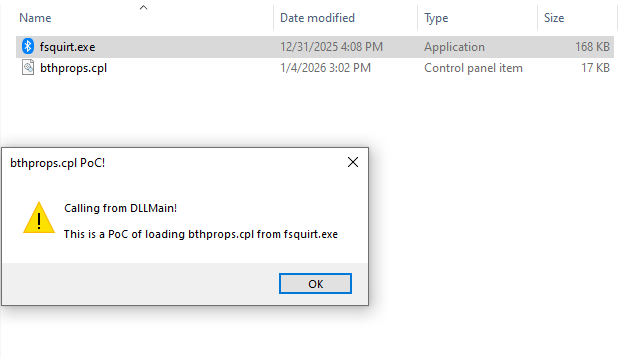
Fsquirt.exe - A Windows binary attempts to load a Control Panel applet (CPL) called bthprops.cpl from its current working directory. When bthprops.cpl is present alongside fsquirt.exe, the binary loads it and executes a MessageBox from DLLMain. https://t.co/Gs80oGP2Go
I found another simple technique that utilizes the native Windows binary fsquirt.exe to execute a malicious .cpl file by placing it in the same working directory.
PoC in here
https://t.co/HnrC6qQE7v
#cybersecurity#offsec#redteam
I came across a simple technique that abuses Fondue.exe, a native Windows binary, to execute a custom malicious APPWIZ.cpl file placed in the same directory.
PoC and More details on how it was discovered later!
#redteam#offsec
I got some time this evening to play with an idea that has been on my mind for a while to utilize GitHub Firehose (https://t.co/tQmK3iELTH) to monitor public code pushes in real time searching for unsafe functions for a specific language, generic keywords or secrets pushed publicly to Github.
Using Github FireHose is straightforward, and you can use it for targeted monitoring as part of offensive operations by filtering commits from a specific committer email or domain to map packages that may contain secrets or unsafe functions to start your code analysis from.
Or you can use it for generic bug hunting where public commits are scanned for exposed secrets, suspicious keywords, or unsafe functions.
I know there are already commercial platforms that do this, but as an independent researcher it’s still a nice way to quickly spot some low-hanging fruit and expand on it to apply your own logic.
Another interesting integration could be feeding the filtered code snippets into your favorite LLM and having it perform more customized audits tailored to your specific needs.
I’ll share the code and some documentation for this once I have it finalized!
#cybersecurity #offsec
I disconnected a bit over the weekend and conducted a code review against a Robotic Process Automation (RPA) software and found an interesting RCE 0-day chain in their latest version.
The chain combined Broken Access Control (BAC) with a file upload flaw. For me, these kinds of chains are becoming harder to find nowadays, but they are still present in modern software.
It was a fun one to dig into, and I hope I can share more details about it.
Meanwhile, I’m planning to write more content about my humble static code analysis work on
https://t.co/11XlMhnHSz
, where I’ve already published some of my previous findings.
#offsec #cybersecurity