“The Choke Points – Risk of Escalation”
Sea Lines of Communication (SLOCs) matter from both a geoeconomic and geostrategic perspective.
Both the Strait of Hormuz and Bab-el-Mandeb are extremely important to the global economy, and no warring party should blockade them.
If this happens, the entire global economy will be affected.
Also, this may drag other regional players into unwanted conflict, with a risk of dangerous escalation.
The geostrategic and geo-economic implications are immense.
#chokepoints #SLOCs #Hormuz #Iran #IranWar #Houties #US #UAE #Egypt #SaudiArabia
Guest Lecture:
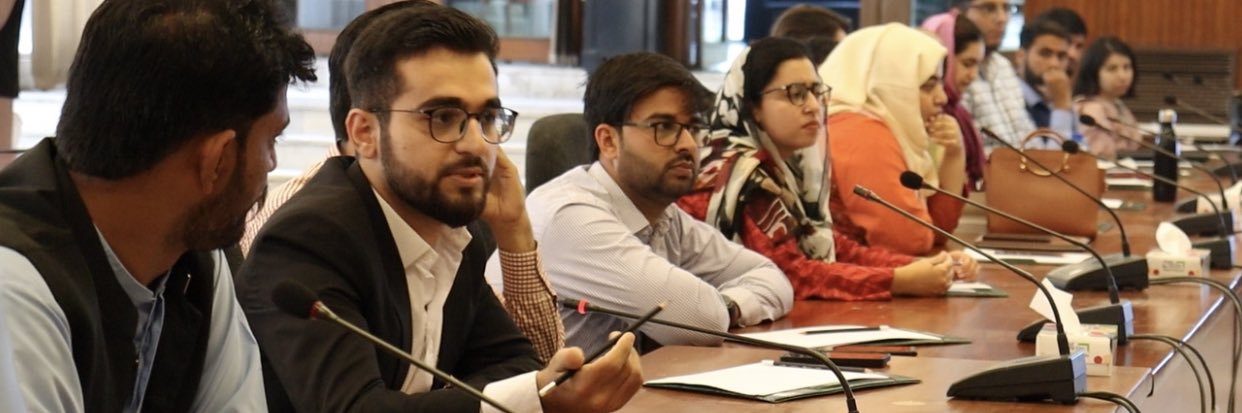
Zohaib Altaf, Associate Director at CISS AJK, delivered a lecture on "India's Aspiration for Acquiring and Integrating LAWS within the Nuclear and Military Domains - Implications for South Asia".
India is building a command-and-control ecosystem to integrate LAWS. These include capabilities in sensing, decision-making cycles, movement, and engagement.
Integrating AI into remote sensing and ISR may undermine confidence in the survivability of nuclear and conventional forces.
The danger also lies in the event when an autonomous weapon initially on a tracking mission, decides on its own, to engage a target without any intervening human approval. Therefore, diplomacy and crisis management might be outpaced by LAWS.
Challenges to attribution also create problems. Much like cyber-attacks, LAWS carry the issue of attribution. A machine-led weapon may decide to carry out an attack while also allowing the responsible state to distance itself from direct responsibility. This may encourage risk-taking behavior and create instability.
Zohaib reiterated the importance of Human-in-the-Loop mechanism. No weapon should be fully autonomous. He stated that Artificial Superintelligence poses a grave threat to stability.
Geopolitical competition is preventing leading states from regulating AI for fear of being left behind; however, the relentless pursuit for supremacy in AI may lead to our own undoing.
#ArtificialIntelligence #LAWS #AutonomousWeapons
@ArmsConAdvisor@zafarwafa1977@AsmaKhawaja5@ZohaibCISSAJK
The Balochistan Think Tank Network celebrated the 79th Independence Day of Pakistan with zeal and enthusiasm in which the Faculty of Research at BTTN gave their presentations on relevant topics. Mr. Aadersh Hamza, Associate Director, introduced and explained the concept of the Pakistan Progress Report.
The event served as a platform for the BTTN team to reinforce their commitment to serve the nation no matter what the obstacles are. Dr. Zafar Khan, Executive Director, BTTN, stated that Pakistan's journey as an independent state has been remarkable and it has emerged as an indispensable actor in the region and beyond regardless of the challenges and obstacles - he appreciated the efforts of the BTTN in launching the Pakistan Progress Report.
#IndependenceDay #14august
“BTTN Journal July Issue is out now”
Balochistan Think Tank Network (BTTN) publishes its Vol. 5, No. 1 (2026 in the HEC-recognized BTTN Journal.
https://t.co/dps3LQPUQd
This issue publishes 3 book reviews and 7 leading research articles on the broader contours of international and regional affairs successfully after a rigorous process of scrutiny and double-blind peer review.
Of interest to those mostly interested in strategic affairs, competing strategies, and emerging technologies as a broader part of international affairs.
#AcademicExcellence #research #theories #IR #Politics #technologies #India #Pakistan #SouthAsia
Strong nuclear security requires strong cybersecurity. One cannot exist without the other.
Data breach reportedly targets India’s Kudankulam nuclear power plant | Cybersecurity News | Al Jazeera https://t.co/iq3xbCTDHY via @AJEnglish
“Insecure and Unsafe Indian Nuclear Power Plants/ Critical Infrastructure”
1. India’s largest nuclear power plant, Kudankulam, was exposed in a data breach.
2. Very serious. Very critical.
3. Indian nuclear power plants and their critical infrastructure are not safe.
4. This is not the first time. They have experienced such critical and serious episodes in the past as well.
5. Yet, India has not learned anything from such critical breaches of Indian nuclear power plants and critical infrastructure.
6. Their nuclear power plants/ critical infrastructure remain vulnerable to such breaches and theft.
7. One wonders as to what is going on in India when it comes to consistent nuclear power plant breaches, policy/ protocol violation, and theft of nuclear-related facilities.
8. A big question mark on India’s safety and security of its power plants and the nuclear-related critical infrastructure.
Such consistent breaches/ theft cases of high-value critical infrastructure in India could have the following implications:
a. The intruders can put all other Indian nuclear power plants and other critical infrastructure into tatters.
b. The breaches are not only a violation of the NSG Cartel Group, to which India was unfairly provided a “special waiver”. Such a special waiver has grave and serious implications for both the NSG members and India, as well as the broader Asian region.
c. This is also a clear violation of the defined safety and security of the IAEA safeguards to which India is a signatory to both the IAEA and its Additional Protocols.
d. Non-state actors/ bad actors both within India and abroad could use these breaches files/ blueprints and other related theft materials to develop dirty bombs.
e. This is not only a safety and security issue for all Indian nuclear power plants, but also this may prove to be destabilizing for the broader South Asian strategic stability.
The international community, more importantly, the US, the NSG members, and the IAEA should take serious notice of such consistent breaches of Indian nuclear power plants to protect the safety and security of the entire Asian region.
@Reuters@ReutersWorld
#Kudankulam #India #Asia #SouthAsia #powerplants #nuclear
If repeated cyber incidents involving nuclear infrastructure fail to attract sustained international scrutiny, vulnerabilities risk becoming normalized. South Asia cannot afford complacency over nuclear security.
Nuclear responsibility is measured not only by capability, but by the ability to secure critical infrastructure. The reported Kudankulam data breach raises serious questions about India's nuclear security standards and its aspirations for grtr influence in the global nuclear ordr
🇵🇰 is using space technology to fight climate change.🛰
Through #SUPARCO's #Space4Climate initiative, satellites are helping monitor floods, glaciers, forests, air quality, and water resources.
A smart step towards a safer and greener future.
https://t.co/tld4P9XcU1
4/4
This highlights the urgent need for enhanced #cybersecurity-nuclear convergence, third-party audits, & transparency. Without reforms, such breaches risk destabilizing regional peace and forcing int’l stakeholders to reassess engagement with 🇮🇳
#Kudankulam#Nuclear#SouthAsia
3/4
The leak provides adversaries with intelligence on critical infrastructure. This accelerates targeting of supply chains, complicating stability in SA. It raises questions about compliance with Int’l safeguards and its match with 🇮🇳’s nuclear program
#India#NuclearSecurity
2/4
This breach shows a recurring pattern: repeated security lapses at #Indian#nuclear facilities in a region marked by strategic tensions, such exposures don’t just risk operational disruption, they invite potential hybrid threats leading to crisis.
#Kudankulam#nuclearbreach
1/4
The recent exposure of nearly 19,000 sensitive files from #India’s #Kudankulam Nuclear Power Plant is not a simple data leak, it signals systemic weaknesses in its #NuclearSecurity. Blueprints, and supplier details reveal how vulnerabilities can compromise national assets.
1/4 Serious breach exposed: Nearly 19,000 files from 🇮🇳’s Kudankulam Nuclear Power Plant — including blueprints, cooling system layouts, supplier records, and technical documents have been leaked on the dark web by a ransomware group.
#Nuclearleak#India#KNPP#leak
4/4 As this data circulates, the focus shifts to accountability and who might exploit these gaps next. Regional peace requires strong, reliable safeguards.
#Nuclearleak#India#Pakistan#leak
1/4 Serious breach exposed: Nearly 19,000 files from 🇮🇳’s Kudankulam Nuclear Power Plant — including blueprints, cooling system layouts, supplier records, and technical documents have been leaked on the dark web by a ransomware group.
#Nuclearleak#India#KNPP#leak
3/4 Access to this level of sensitive information gives outsiders a clear roadmap of critical assets. It highlights vulnerabilities in how large-scale nuclear projects are protected—a reminder that robust security protocols are essential to prevent escalation.
#Nuclear
Another reported breach. Another blow to India's #NuclearSecurity credibility.
If sensitive Kudankulam NPP documents can surface on the dark web, serious questions must be asked about the security of India's critical nuclear infrastructure.
#NationalSecurity#India#DarkWeb
Proud Milestone for BTTN Journal
We are delighted to announce that the BTTN Journal has once again been recognized by the Higher Education Commission (HEC) of Pakistan in the "Y" Category under the HEC Recognized National Research Journals (w.e.f. April 1, 2026, to December 31, 2027).
This recognition comes at a time when the HEC has introduced a more rigorous accreditation framework, enforcing stricter policies, quality benchmarks, editorial requirements, and international publishing standards. As part of this process, the HEC has discontinued the recognition of all research journals that failed to meet the prescribed criteria, rules, regulations, and academic standards.
As a result, the number of HEC-recognized national research journals has been reduced from 738 in the previous accreditation cycle to only 249 journals in the latest list. This reflects HEC's commitment to strengthening the quality, credibility, and international standing of academic publishing in Pakistan.
We are especially proud that the BTTN Journal is among the very few HEC-recognized research journals from BUITEMS in Balochistan. According to the latest HEC list, only three journals from the province have secured HEC recognition (Serial Nos. 48, 117, and 195), marking a significant milestone for Balochistan's academic and research community. We hope other academic journals will also be recognized by the HEC.
The BTTN Journal undergoes the HEC accreditation process every cycle and remains fully committed to complying with the HEC Journal & Publications Policy, editorial best practices, publication ethics, and internationally recognized scholarly standards. Our next goal is to further enhance the journal's international visibility through Scopus indexing.
We extend our sincere gratitude to our Editorial Board, reviewers, authors, advisory board, contributors, readers, and the entire BTTN team for their dedication, professionalism, and continued support. This achievement belongs to all of you.
Congratulations to the entire BTTN family on this remarkable success. Together, we will continue to promote quality research and strengthen the culture of scholarly publishing in Balochistan and Pakistan.