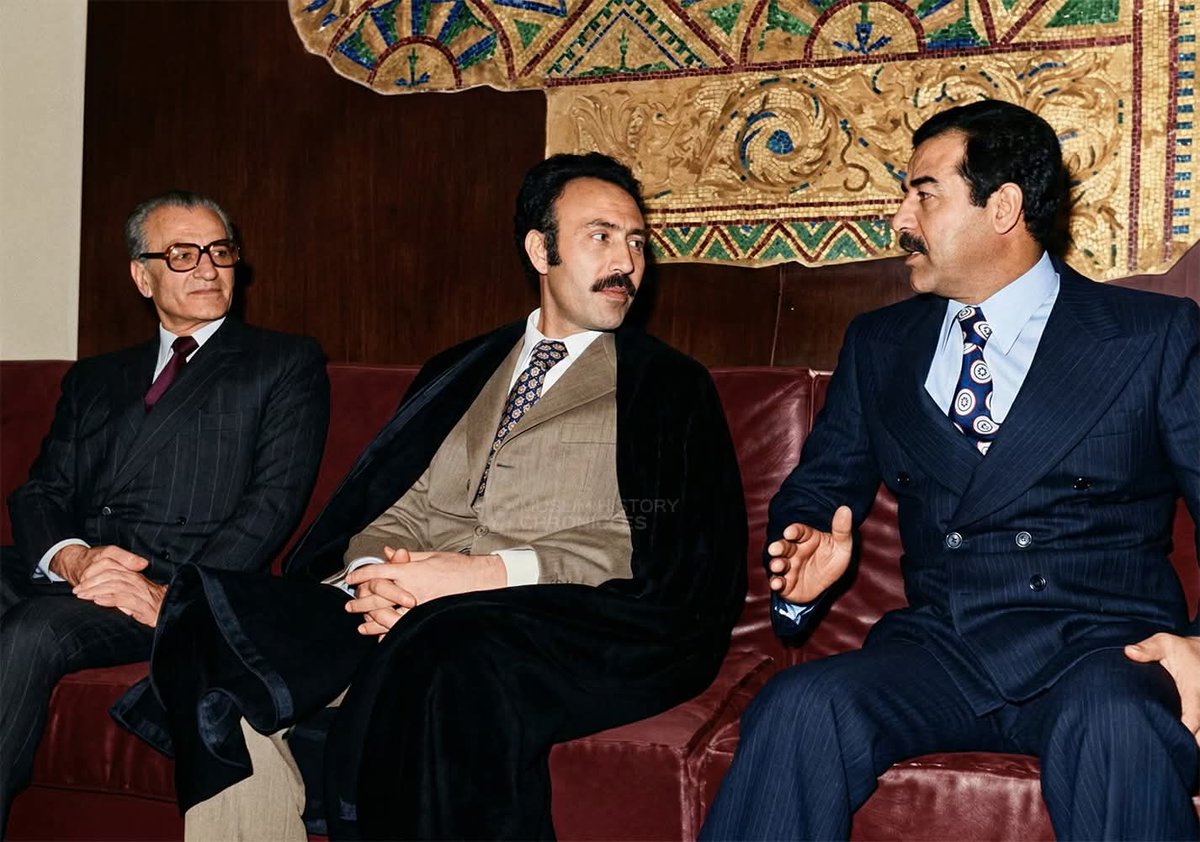
Saddam Hussein (right) with Iranian Shah Mohammad Reza Pahlavi (left), 6 March 1975, during the signing of 1975 Algiers Agreement
On this day, 6 March 1975, the Iraqi Vice-President Saddam Hussein and Iranian Shah Mohammad Reza Pahlavi signed the 1975 Algiers Agreement.
The agreement aimed to resolve long-standing border disputes between the two countries, particularly over control of the Shatt al-Arab waterway. The agreement was mediated by Algerian President Houari Boumédiène (center).
Iraq accepted the boundary along the river’s thalweg (deepest channel), giving Iran equal navigation rights, while Iran agreed to stop supporting Kurdish rebels who were fighting the Iraqi government in northern Iraq.
In 1980, Iraqi President Saddam Hussein unilaterally abrogated the treaty, claiming it was imposed on Iraq under pressure. This decision became one of the immediate triggers for the Iran–Iraq War (1980–1988).
(Disclaimer: This photo has been colorized using LLMs. Find the original photograph in the comments.)
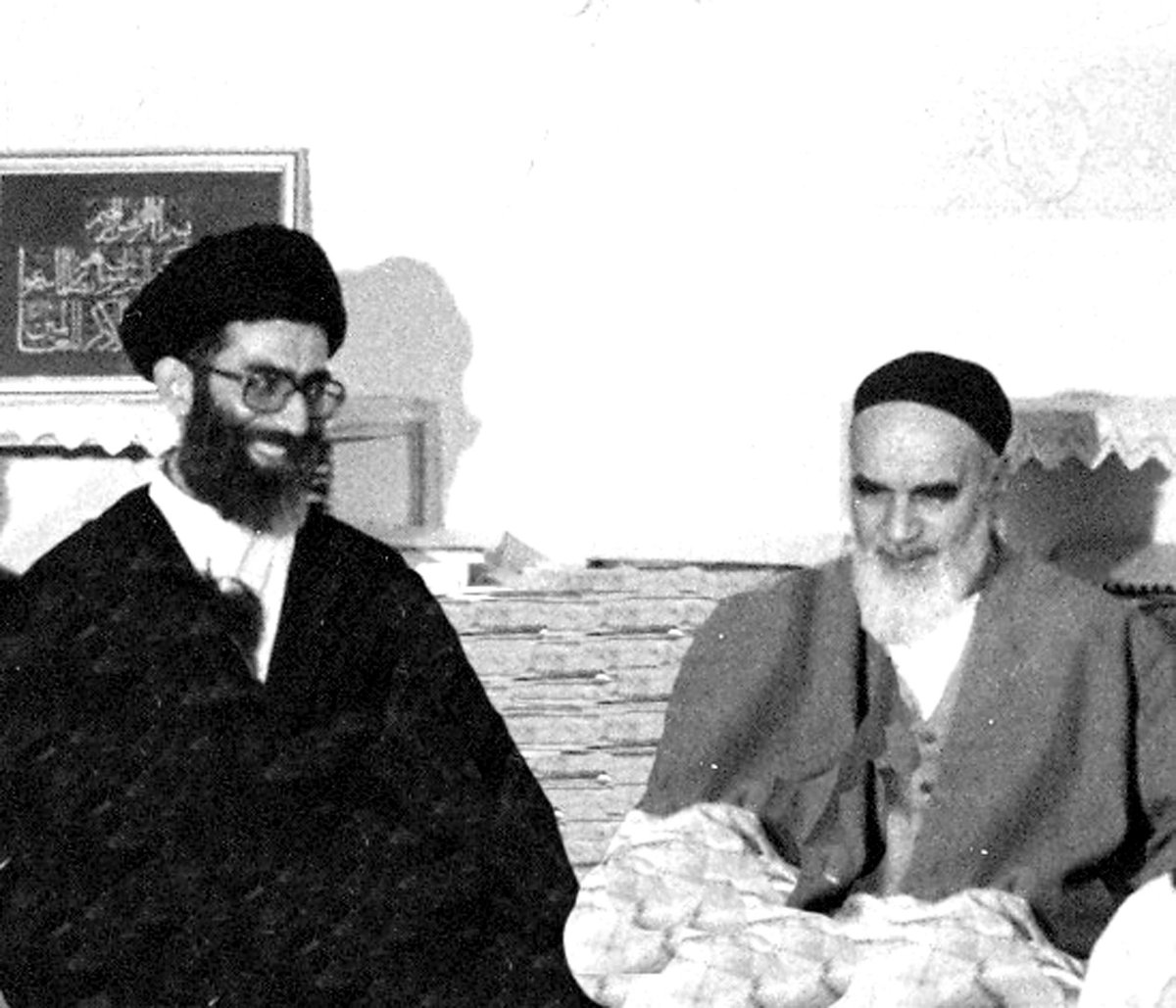
Ruhollah Musavi Khomeini with his successor Ali Hosseini Khamenei, 13 August 1986
Ali Khamenei succeeded Ruhollah Khomeini as the new supreme leader of Iran in 1989.
On June 4, 1989, Iran held an election to elect its second Supreme Leader after the death of Ruhollah Khomeini. Ali Khamenei emerged victorious, securing 60 votes out of 74 cast by the Assembly of Experts.
Ruhollah Khomeini was leader of the Iranian Revolution of 1979, which overthrew Mohammad Reza Shah Pahlavi of the Pahlavi dynasty. As a result in 1979, he founded the Islamic Republic of Iran and became its first supreme leader.
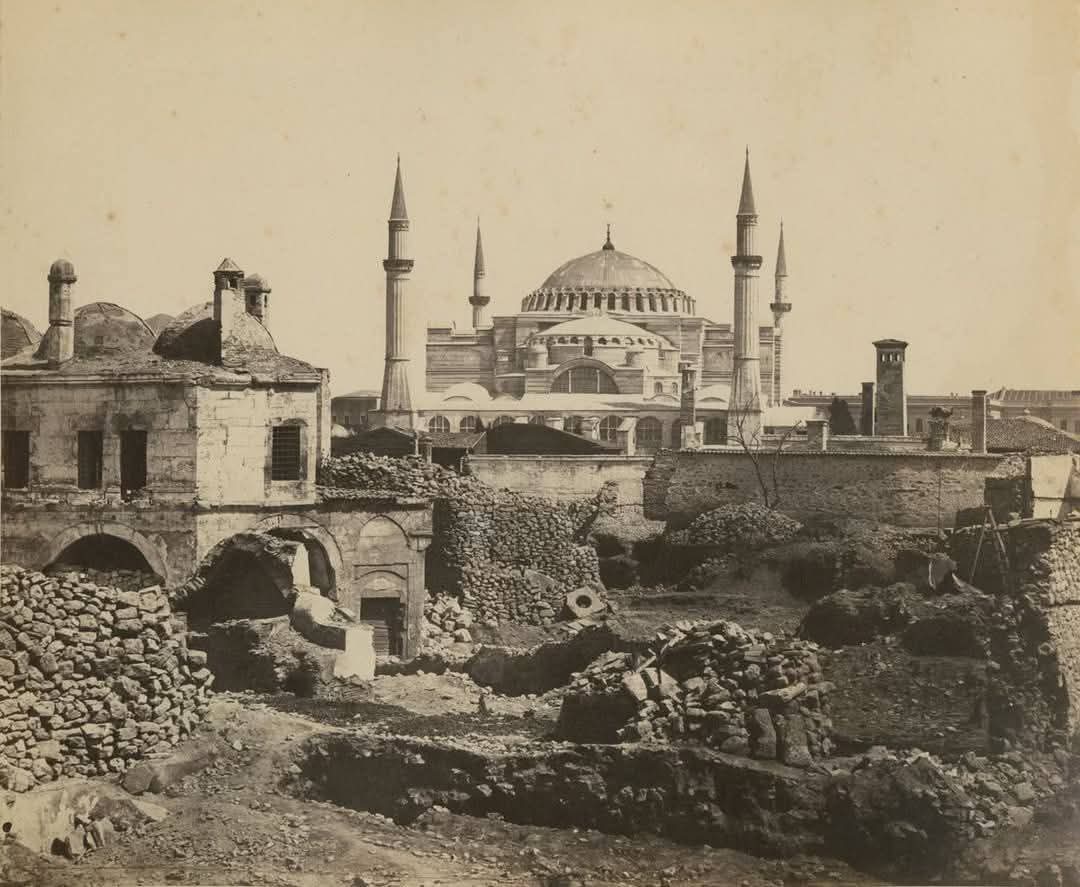
Hagia Sophia pictured in 1870 by Abdullah Frères or Abdullah Brothers, a group of three brothers who became the most famous photographers in the Ottoman Empire.
The group earned international fame. Sultan Abdulaziz also appointed them as the official court photographers in 1863.
On the 7th of Ramadan in 428 Hijri (1037 AD), Muslim physician, philosopher, and father of early modern medicine, Ibn Sina (known in the West as Avicenna) died at Hamadan, Iran. Ibn Sina is known as the most influential philosopher of the pre-modern era.
Ibn Sina's full name was Abu Ali Husayn ibn abd-Allah ibn Sina. He was born in a Persian family in the village of Afshana near the Samanid capital of Bukhara.
His writing subjects include astronomy, alchemy, geography, psychology, Islamic theology and Sufism, logic, mathematics, physics, and poetry.
His encyclopedia of medicine, al-Qanun fi al-Tibb (The Canon of Medicine) remained a medical authority for centuries not just in the Islamic world but also in Medieval Europe. It was used as a standard medical textbook through the 18th century in Europe.
Ibn Sina lived during a time when Islamic civilization was at its height, and he made significant contributions to many areas of knowledge and learning.
His impact on Islamic intellectual culture can be compared to that of Plato and Aristotle in classical antiquity, or Kant in modern European philosophy, in that all subsequent thinkers had to respond to him favorably or unfavorably, explicitly or implicitly, directly or indirectly. He supplanted Aristotle as the figure who, more than any other, represented what ‘philosophy’ ( falsafa) was.
On the 5th of Ramadan in the year 899 (Hijri), Babur became the king in Ferghana at the age of 12.
After repeated defeats by the Uzbeks, especially the loss of Samarkand, Babur could not rebuild a stable empire there. Therefore, he later founded the Mughal/Timurid Empire in north India in 1526.
Northern India was one of the richest regions in the world at the time, known for its fertile land. Compared to the harsh terrain of Central Asia and Afghanistan, India promised long term prosperity and resources to support an empire.
The ruling power in north India, the Delhi Sultanate, was politically unstable. Sultan Ibrahim Lodi was unpopular with many nobles, some of whom invited Babur to intervene. This internal division made conquest possible.
Babur did not see India as just a raid target. He intended to rule and settle. His memoirs show that although he initially disliked India’s climate, he recognized its potential for building a powerful and enduring state.
In Tuzuk i Baburi, Babur writes:
"In the month of Ramadan of the year 899 (Hijri), in the province of Fergana, in my twelfth year, I became king."
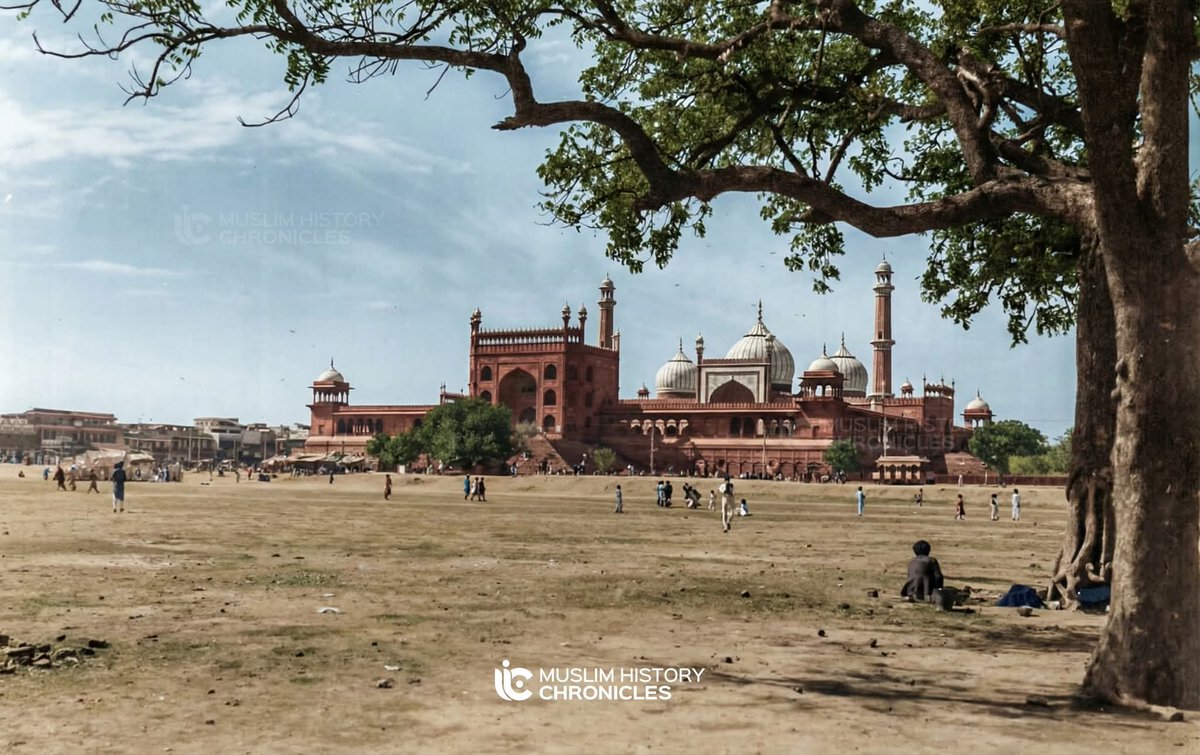
Delhi's Jama Masjid, pictured around 1910
This colorized photograph captures the magnificent Jama Masjid in a rare moment of serene grandeur.
Long before the modern chaos of honking rickshaws and dense storefronts, the mosque stood as a quiet sentinel over the vast, dusty Maidan.
The people scattered across the foreground, some resting in the shade, others crossing the open expanse, offer a hauntingly beautiful sense of scale and the slow pace of life in a city on the cusp of a massive historical transformation.
1910 was the last year of "Old Delhi" being the primary city. In 1911, King George V would visit for the Delhi Durbar, and construction on "New Delhi" (Lutyens' Delhi) would begin shortly after, forever changing the city's layout.
(Disclaimer: This photo has been colorized using LLMs. Find the original photograph in the comments.)
Saudi Crown Prince Mohammed bin Salman praying in the Prophet’s Mosque, Madinah on Friday.
Alongside him is Abdul-Rahman Al-Sudais, who is the chief Imam of the Grand Mosque, Masjid al-Haram in Makkah.
Mohammad Reza Pahlavi of Iran praying to Allah during his Hajj pilgrimage in the 1970s.
Mohammad Reza Pahlavi performed Hajj in 1955, during the early phase of his reign. The pilgrimage fulfilled one of the core obligations of Islam.
Mohammad Reza Pahlavi was personally religious in a limited, traditional sense, but he was not a devout or orthodox Muslim, and his approach to religion was shaped far more by politics, monarchy, and nationalism than by theology.
Reza writes in his book Mission for My Country:
"From the time I was six or seven, I have felt that perhaps there is a supreme being, who is guiding me. I don't know. Sometimes the thought disturbs me because then, I ask myself, what is my own personality, and am I possessed of free will? Still, I often reflect, if I am driven-or perhaps I should say supported-by another force, there must be a reason."
Mohammad Reza Pahlavi was the last king of the Pahlavi dynasty that ruled Iran until 1979. He was ousted following the Iranian Revolution led by Ruhollah Khomeini. He died at Cairo in 1980.
Mughal Woman, painting by Francesco Renaldi, Calcutta, 1787.
British artist Francesco Renaldi travelled to India with the backing of the British East India Company in 1786. He produced various portraits from his time in Calcutta, such as this piece of an unidentified woman of elite rank, wearing expensive fabric and jewels, sitting down.
Given the seclusion of elite Muslim women in India at the time, she may have been a hired model or a so-called bibi, an Indian woman who became the wife or concubine of a European man.
Renaldi is best known for introducing European oil painting techniques to Indian subjects, particularly members of the Mughal and regional elite. The sitter is shown seated with quiet dignity, adorned with delicate jewellery, a translucent veil, and finely patterned garments. Renaldi’s soft handling of light, subtle modelling of the face, and careful attention to costume reveal his ability to blend European portrait conventions with Indian courtly aesthetics.
Coinage depicting Umayyad Caliph Abd al-Malik ibn Marwan
Abdul Malik bin Marwan is famous for his administrative, social, and economic reforms. It's only him who re-established the Umayyad dynasty after the second Fitnah.
Abdul Malik introduced the new Arabic or Muslim coin for the first time in Islamic history. In the days of the Prophet and Abu Bakr, the Roman and Persian currency were used in the Islamic world. He issued purely Muslim coinage of gold, silver, and copper.
Abdul Malik bin Marwan was the second Umayyad caliph of the Marwanids branch. He came to the throne after the death of his father, Marwan bin Hakam.
Mohammad Reza Pahlavi of Iran praying to Allah during his Hajj pilgrimage in the 1970s.
Mohammad Reza Pahlavi performed Hajj in 1955, during the early phase of his reign. The pilgrimage fulfilled one of the core obligations of Islam.
Mohammad Reza Pahlavi was personally religious in a limited, traditional sense, but he was not a devout or orthodox Muslim, and his approach to religion was shaped far more by politics, monarchy, and nationalism than by theology.
Reza writes in his book Mission for My Country:
"From the time I was six or seven, I have felt that perhaps there is a supreme being, who is guiding me. I don't know. Sometimes the thought disturbs me because then, I ask myself, what is my own personality, and am I possessed of free will? Still, I often reflect, if I am driven-or perhaps I should say supported-by another force, there must be a reason."
Mohammad Reza Pahlavi was the last king of the Pahlavi dynasty that ruled Iran until 1979. He was ousted following the Iranian Revolution led by Ruhollah Khomeini. He died at Cairo in 1980.
Princess Diana with Sultan Qaboos of Oman
Dating back to 1986, this vintage royal photo shows Princess Diana of Wales curtsying to His Majesty Sultan Qaboos bin Said Al Said, The Sultan of Oman during a ceremony held at the prestigious Al Alam Palace in Muscat, Oman. Princess Diana dons a regal dress designed by David Emanuel.
This image is often cited by royal historians because of the depth of Diana's curtsy. In royal protocol, the depth of a curtsy is a sign of profound respect. Despite her own high status, Diana followed the strict etiquette required when meeting a sovereign monarch, and the photo became an iconic example of her poise and grace during international tours.
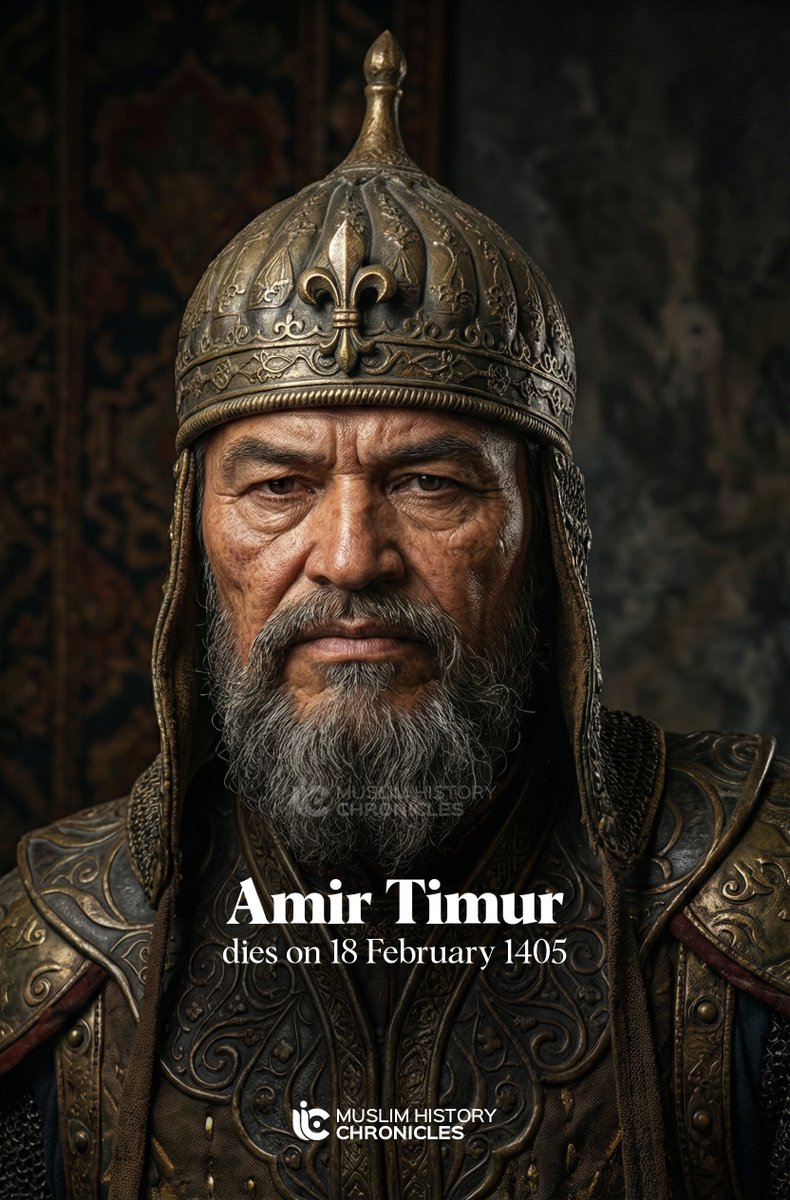
On this day, 18 February 1405, the founder of the Timurid Empire, Amir Timur or Tamerlane died in a freezing cold winter in modern-day Otrar, Kazakhstan.
Timur was riding east for his last campaign against the Ming emperor of China. In January, Timur arrived at Otrar and fell ill, where he died because of a severe fever.
Timur was born on April 9, 1336, near Shakhrisabz, south of Samarkand during the rule of Chagatai Khanate. A military genius, Timur moved like a whirlwind through Eurasia and left a name familiar throughout the world.
From 1382 to 1405 his armies crisscrossed Eurasia from Delhi to Moscow, from the T'ien Shan Mountains of Central Asia to the Taurus Mountains in Anatolia, conquering and reconquering, razing some cities, sparing others.
Timur has been defined as one of the most ruthless conquerors in human history.
(Disclaimer: This photo has been created using LLMs for educational purposes. It draws inspiration from facial reconstruction from Timur's skull made by Mikhail Mikhaylovich Gerasimov.)
Muhammad Ali riding a horse near the Sphinx and Pyramids in Egypt, 1964
Muhammad Ali visited Egypt in June 1964, shortly after converting to Islam and changing his name. During this trip, he was treated as a state guest, met with President Gamal Abdel Nasser, visited the Al-Azhar Mosque, and toured the Great Pyramids. The trip was significant as it helped cement his status as a global icon, particularly in the Muslim world.
Muhammad Ali used to say:
“If my mind can conceive it, and my heart can believe it, then I can achieve it.”
On this day, 14 February 1483, Babur, the founder of the Mughal Empire, was born in Andijan (present-day Uzbekistan).
Babur became the king in Ferghana in the month of Ramadan, 899 Hijri (1494 CE) at the age of 12. He later founded the Mughal/Timurid Empire in India in 1526 after defeating Ibrahim Lodi in the First Battle of Panipat.
Although the Mughal Empire was founded by Babur, it was consolidated two generations later by his grandson Akbar and lasted until the mid-18th century when its possessions were reduced to smallholdings. The last Mughal, Bahadur Shah II, was exiled in 1857.
In Tuzuk i Baburi, Babur writes:
"In the month of Ramadan of the year 899 (Hijri), in the province of Fergana, in my twelfth year, I became king."
(Disclaimer: This photo has been created using LLMs for educational purposes.)
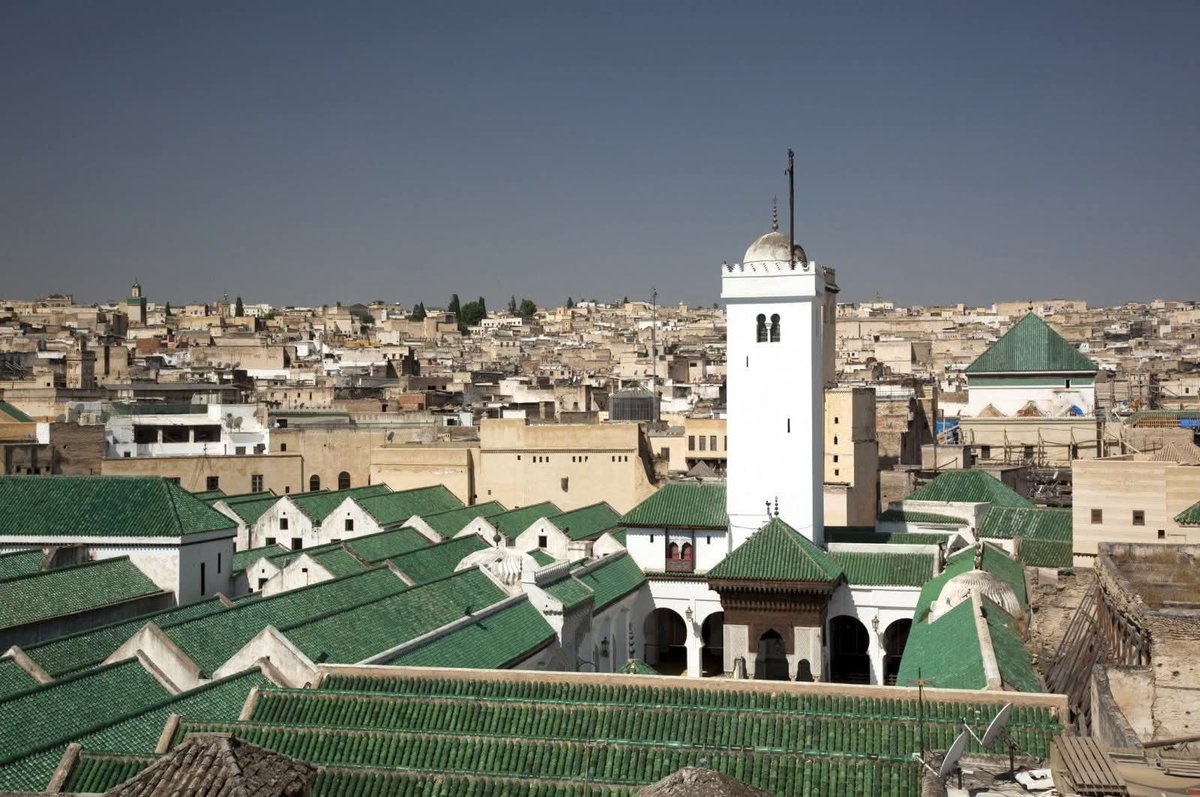
University of al-Qarawiyyin in Fes, Morocco, is considered the world's oldest continuously operating educational institution/university.
Founded between 857 and 859 CE by Fatima al-Fihri, it began as a mosque serving the local Muslim community. Over time, it developed into a renowned center of learning, evolving into a madrasa that specialized in Islamic studies, theology, jurisprudence (fiqh), grammar, rhetoric, logic, astronomy, and mathematics.
By the 10th century, al-Qarawiyyin had become one of the leading intellectual hubs of the Muslim world. It attracted scholars and students from across North Africa, Al-Andalus (Islamic Spain), and beyond.
In 1963, al-Qarawiyyin was formally reorganized into a modern university within Morocco’s state education system, while preserving its historic religious and scholarly traditions. Today, it remains both a functioning mosque and an academic institution.
Sir Syed Ahmad Khan of Aligarh Movement sitting with his admirers
Seated second from the left, Sir Syed Ahmad Khan was the visionary founder of the Aligarh Movement. A reformer, educationist, and thinker, he dedicated his life to uplifting Indian Muslims through modern scientific education. The establishment of the Muhammadan Anglo-Oriental College, which later became Aligarh Muslim University, stands as his greatest institutional legacy. Through his writings and activism, he encouraged reconciliation with modernity while preserving intellectual dignity and communal confidence during a period of political decline.
At the center of this rare photograph sits Justice Syed Mahmood. Syed Mahmood was the son of Syed Ahmad Khan. He was one of the most brilliant legal minds of nineteenth century India. Educated at Cambridge, he became one of the first Indian judges of the Allahabad High Court and played a pioneering role in shaping modern judicial reasoning in colonial India. His legal opinions reflected intellectual independence, deep scholarship, and a commitment to procedural fairness.
In Syed Ahmad’s lap sits his grandson, Ross Masood (who was also the son of Syed Mahmood). Ross Masood represented the continuation of his grandfather's intellectual legacy into the twentieth century. Educated at Aligarh and later at Oxford, he became Vice Chancellor of Aligarh Muslim University and worked tirelessly to expand educational opportunities. Ross Masood symbolized the generational transmission of reformist ideals, linking the foundational vision of Sir Syed Ahmad Khan with the evolving aspirations of modern India.
(Disclaimer: This photo has been restored using LLMs. Therefore, certain facial features might not match. Find the original photograph in the comments)
Jama Masjid of Delhi, Now vs 1880s
This comparative visual juxtaposes the urban landscape surrounding Jama Masjid in Delhi across nearly a century and a half. The photograph on the left, taken in the 1880s by Samuel Bourne of the Bourne & Shepherd studio, captures the Mughal congregational mosque within a relatively open and pedestrian oriented urban fabric.
The image reflects late nineteenth century colonial Delhi, where Jama Masjid functioned not only as a religious monument but also as a central spatial anchor within the city’s social and commercial life.
The contemporary photograph on the right, taken in 2026, reveals the dramatic transformation of the same space under the pressures of modern urbanization. Dense traffic, informal commerce, electrical infrastructure, and layered architectural accretions now dominate the visual field.
While the monumental presence of Jama Masjid endures, its surrounding environment illustrates broader shifts in mobility, economy, and urban governance.
#OnThisDay 8 February 1265, the founder of Ilkhanate, Hulagu Khan died because of a serious illness. Hulagu ruled Ilkhanate from 1256 to 1265. He is known for besieging and sacking the Abbasid capital city of Baghdad in 1258.
Hulegu was the brother of Möngke Khan, the 4th Khagan of the Mongol Empire. In 1251, Mongke Khan ascended the throne of the Mongol Empire. He summoned his brother Hulagu Khan and entrusted him to achieve the incomplete mission of Genghis Khan of conquering the world.
Hulagu crossed the Oxus in January 1256. From there he first moved to Quhistan in April of 1256 and gradually eliminated the Ismaili state from Alburz mountains. During the operations against the Ismailis, Hulagu demanded reinforcements from the Abbasid Caliph. Caliph Al- Musta‛ṣim’s instinct was to comply; but because of internal disagreements among his amirs and ministers, he failed to send any troops.
In 1258, he sacked Baghdad and put an end to the Abbasid caliphate. But his invasion would be checked at the Battle of Ain Jalut by the Mamluks. Shortly before the battle, Hulegu withdrew from the Levant and left Kitbuga there. The victory was sealed when Kitbuga was captured and executed by the Mamluks. This caused the remaining Mongols to retreat.
Mohammad Reza Pahlavi and his wife, Farah Pahlavi leaving Iran before 1979 Iranian Revolution
During his life, Mohammad Reza Pahlavi married three times in official weddings.
1) Princess Fawzia of Egypt
She was his first wife. Fawzia was an Egyptian princess, daughter of King Fuad I of Egypt, and she married Mohammad Reza in 1939. This marriage was partly a political alliance between the Pahlavi dynasty in Iran and the royal house of Egypt. The couple had one daughter, Princess Shahnaz Pahlavi. Their marriage ended in divorce in 1948 after several unhappy years.
2) Soraya Esfandiary-Bakhtiary
She became the Shah’s second wife in 1951. Soraya was from a prominent Iranian family and served as Queen (consort) of Iran until their divorce in 1958. A major reason for the end of their marriage was that Soraya was unable to have children, and the succession issue put pressure on the relationship. After their divorce, Soraya lived much of her life in Europe.
3) Farah Pahlavi (born Farah Diba)
She was Mohammad Reza’s third and final wife, whom he married in Tehran in December 1959. Farah became the Empress of Iran and remained married to the Shah until his death. With her, he had several children including Crown Prince Reza Pahlavi, Princess Farahnaz, Prince Ali Reza, and Princess Leila. Farah Pahlavi is often remembered as the last Shahbanu (queen) of Iran.
Together these three women represent the official spouses of the last Shah. There are also accounts and historical discussions about other personal relationships he had outside these marriages, but Fawzia, Soraya, and Farah are the ones recognised as his wives in historical records.